Bone Graft Materials for Dental Implants: Autograft, Allograft, Xenograft and Synthetic, Compared on the Evidence
The graft material with the most new bone on a biopsy is not the one most often used, and for good reason. Here is how the histology and the survival data fit together.

Written and medically reviewed by Dr. Sam Jain, DMD, MS, and Dr. Arpana Gupta, DDS, MDS
Published
Four materials, three properties
Every bone graft used in implant dentistry belongs to one of four families. Autograft is the patient's own bone, harvested from the chin, the back of the lower jaw, or occasionally the hip. Allograft is human donor bone, processed and sterilized by a tissue bank. Xenograft is animal bone, almost always bovine, with its organic component removed so that only the mineral scaffold remains. Alloplast is synthetic — hydroxyapatite, beta-tricalcium phosphate, or a combination — manufactured without any biological source. Each is chosen for how it performs on three properties that Albrektsson and Johansson defined in 2001: osteoinduction, the ability to recruit and stimulate bone-forming cells; osteoconduction, the ability to serve as a scaffold that bone grows along; and, for the graft itself, how it resorbs and is replaced.
Only autograft is genuinely osteoinductive as well as osteoconductive, because it arrives with living cells and native growth factors. Allograft retains some inductive proteins depending on how it was processed. Xenograft and alloplast are scaffolds: they conduct bone but do not induce it. That ranking, on paper, would make autograft the material of choice for everything, and for decades it was called the gold standard. The clinical literature is more interesting than the paper ranking, because the material that makes the most bone is also the one that costs the patient a second surgical site and then shrinks.
The Aghaloo and Moy systematic review of 2007 is the most useful starting point because it counts the outcome patients care about — whether implants in grafted bone survive — across techniques and materials. In the maxillary sinus, from 5,128 implants followed for 12 to 102 months, survival was 92% for implants placed into autograft or autograft-composite grafts, 93.3% for allograft composites, 95.6% for xenograft alone, and 81% for alloplast and alloplast-xenograft mixtures. For ridge augmentation, from 2,620 implants, survival was 95.5% after guided bone regeneration, 90.4% after onlay block grafts, 94.7% after distraction osteogenesis and 83.8% after combined onlay and inlay grafting. Note that the material with the most biological potential did not produce the highest implant survival.
What the biopsies show
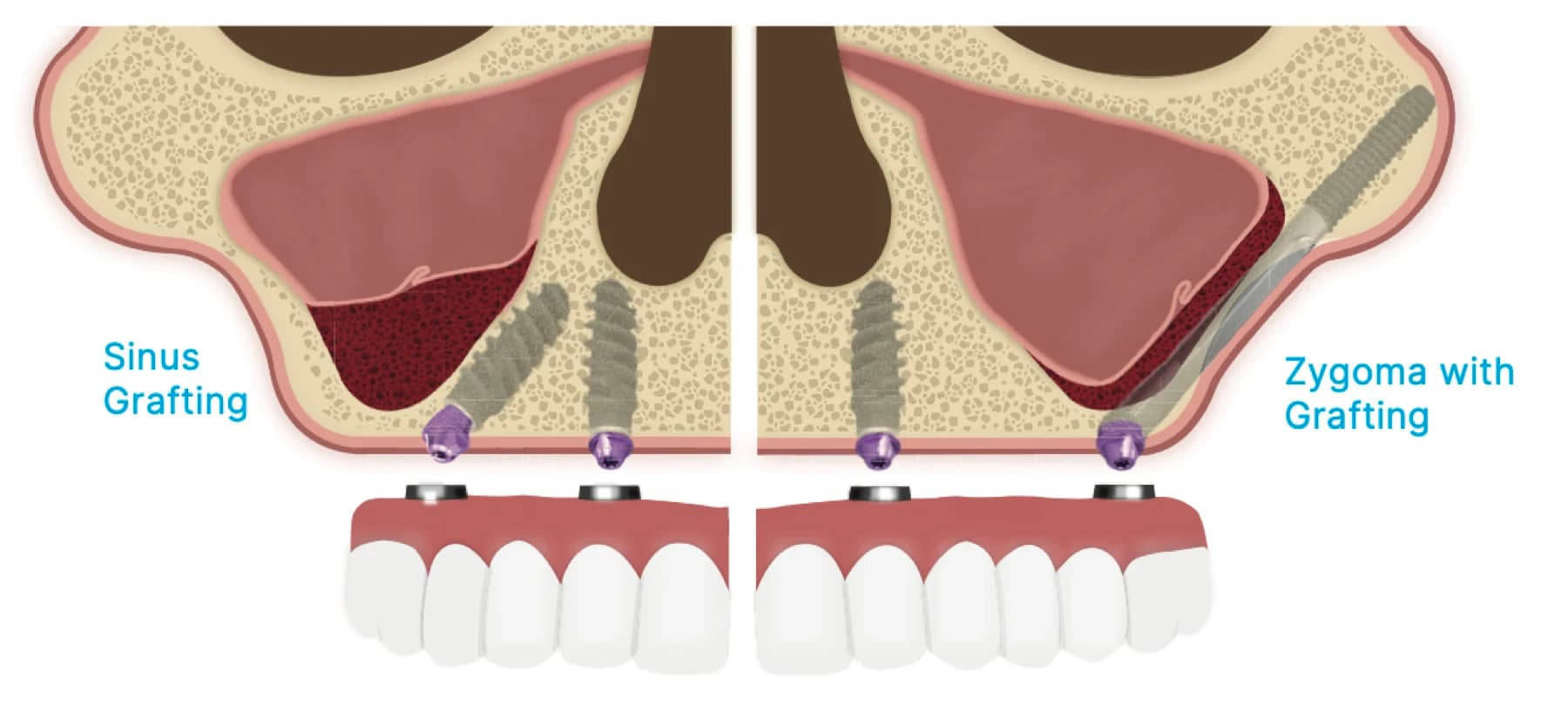
Sinus grafts are unusual in that surgeons routinely take a core of the healed graft when they place the implant, so there is a large histological literature on what each material turns into. Danesh-Sani's 2017 meta-analysis pooled 136 human studies reporting the proportion of new bone, residual graft and soft tissue in those biopsies. Autogenous bone produced the highest proportion of new bone and the lowest of residual graft. Bone substitutes — allografts, alloplasts and xenografts — produced less new bone and more residual particles, but the authors judged them good alternatives that avoid the disadvantages of autograft: donor-site morbidity, limited supply, and a high degree of volume change. Mixing autogenous bone into a substitute brought no significant advantage in new bone formation. On healing time, grafts left more than 4.5 months showed significantly more new bone than those examined earlier, but waiting beyond roughly six months added nothing for most materials, allografts excepted.
Corbella's 2016 meta-analysis of 84 histomorphometric studies after lateral sinus elevation reached compatible conclusions. Autogenous bone alone produced significantly more new bone than bovine bone alone, but a mixture of the two was no different from bovine bone alone, and bovine bone in turn produced significantly more new bone than hydroxyapatite. Their advice was that autogenous bone should still be considered when the highest possible new bone formation is the primary aim, and that bovine bone or a mixture of tricalcium phosphate and hydroxyapatite can be considered predictable when donor-site morbidity is a concern.
Two points from that histology change how I read a manufacturer's claim. First, residual graft particles are not failure. Deproteinised bovine bone resorbs very slowly, so a biopsy at six months still contains a great deal of it, integrated into new bone — and that slow resorption is exactly why it maintains the volume it was placed to create. Second, the percentage of new bone in a biopsy is not the same as the survival of an implant placed into it. Aghaloo's sinus data show xenograft, with its lower new-bone percentage, carrying the highest implant survival. A scaffold that holds its shape can outperform a graft that makes more bone and then loses half its volume.
Where each material earns its place
Sanz and Vignoletti's 2015 review in Dental Materials is the clearest statement of current indications. Deproteinised bovine bone mineral, they concluded, is effective for most clinical indications because it is osteoconductive, maintains space and resorbs slowly; a combination of hydroxyapatite and beta-tricalcium phosphate has reported similar histological and clinical outcomes; the use of bone substitutes is now the standard of therapy for lateral augmentation, particularly alongside implant placement; and autogenous block grafts remain the method of choice where vertical height must be built. That is the division I use. Width is a substitute's job. Height, when a graft is chosen for it at all, is still bone's job.
Jensen and Terheyden's 2009 ITI review, which examined 108 studies of localized ridge defects by defect type, added the conclusion that matters most to a patient weighing a graft: there is a high level of evidence that survival rates of implants placed in augmented bone are comparable to those of implants placed in native bone. The heterogeneity of the studies did not allow one grafting protocol to be declared best for any defect type, but a series of materials could be considered well documented for specific indications. Chiapasco's companion review reached a related and humbler conclusion — it was difficult to demonstrate that any one surgical procedure offered better outcomes than another, every procedure carried advantages and disadvantages, and priority should go to procedures that are simpler, less invasive, less prone to complication and quicker to reach their goal.
The technique that most often meets Chiapasco's criteria for width is guided bone regeneration: particulate graft under a resorbable collagen membrane, ideally placed at the same time as the implant. Wessing's 2018 meta-analysis of twenty controlled studies found implant survival to be similar whether the implant went in with the graft or later, that anorganic bovine bone under a collagen membrane produced sufficient regenerated bone with high implant survival, that cross-linked membranes exposed about 30% more often than non-cross-linked ones, and that fixing the membrane and perforating the cortex to bleed both modestly improved bone gain. Its recommendation — place the implant simultaneously when the defect allows — is the one that saves a patient a surgery, and it is what a lateral-incisor case of ours looked like.
The cost of using your own bone
Autograft's biology is bought with a donor site, and Nkenke and Neukam's 2014 review is the frankest account of what that costs. Across 24 comparative studies, patients preferred harvest from the ramus of the lower jaw, which can be done under local anesthesia as an outpatient. Acceptance of chin harvesting was low, because it produced considerable morbidity: pain, disturbed skin sensation and wound-healing problems at the donor site. Patients preferred the hip to the chin, despite the hip requiring general anesthesia and a hospital stay, and within the hip the posterior crest caused less morbidity than the anterior. The other cost is resorption: block grafts lose a proportion of their volume during healing, which is why Danesh-Sani listed high volumetric change among autograft's disadvantages and why a substitute that holds its shape often wins for width.
So autograft in my practice is a targeted tool, not a default. When vertical height must be built in the lower jaw and a short implant is genuinely not an option — a decision the short-implant trials have made rarer — the block comes from the ramus. Where a thin facial wall needs contour, particulate bovine mineral under a collagen membrane does the job without a second wound. In the sinus, the choice between bovine mineral, an allograft and a mixture is made on the height available and the time the patient can give it, with Danesh-Sani's finding that about six months of healing is the point of diminishing returns for most materials. What a graft feels like to recover from is described in the healing-stages guide, and the procedure itself on the bone-grafting page.
Two adjuncts deserve a word. Platelet-rich fibrin — a clot of the patient's own concentrated platelets — is widely used to improve soft-tissue healing; Strauss's 2018 systematic review found moderate evidence for a benefit in ridge preservation and the early phase of osseointegration, and Miron's 2017 review found very little randomized evidence that it adds bone in augmentation or sinus lifts. I use it for the soft-tissue benefit and do not promise more; the consent form says the same. Recombinant bone morphogenetic protein, the growth factor that can induce bone without a graft, is discussed in the future-research review.
Why the sinus is the best-documented graft of all
Grafting the floor of the maxillary sinus has been studied more than any other augmentation, and the two systematic reviews that define its record are Wallace and Froum's from 2003 and Pjetursson's from 2008. Pjetursson pooled 48 studies and 12,020 implants and found an estimated annual failure rate of 3.48%, translating to three-year implant survival of 90.1%; when analyzed by patient rather than implant, 16.6% of patients had lost an implant over three years. The best results — 98.3% implant survival at three years — came from rough-surface implants placed under a membrane covering the lateral window. Wallace and Froum's earlier review reached the same conclusion about technique and found that implants in grafted sinuses survived at rates comparable with implants in native bone.
That is a strong record and it should be read alongside the short-implant trials rather than against them. A sinus graft with a rough-surface implant and a membrane over the window is a predictable procedure; a short implant in the same site has now been shown to reach the same survival with less surgery. Which one a patient has should depend on the height of bone in the scan, the width of the ridge, and how much surgery they are prepared to undergo, not on which procedure the surgeon prefers to perform. Where the sinus floor is close and the ridge is wide, I increasingly do neither and place a short implant; where the height is minimal, the lateral-window graft with a slowly resorbing substitute remains the well-documented path, and the step-by-step page describes it.
The questions the field still has to settle
Chiapasco's complaint in 2009 — that the methodological quality of the augmentation literature was poor and that larger, well-designed, long-term trials were needed — is still largely true. Most comparisons are between materials in the sinus, where biopsies are easy; the harder questions about vertical ridge augmentation rest on small trials. The link between what a biopsy shows at six months and what an implant does at ten years has never been established directly, so material choices are made on surrogate evidence. And the newer materials — printed patient-specific scaffolds, growth-factor carriers, allografts processed to preserve inductive proteins — have almost no comparative data against the bovine mineral that has become the standard.
What is settled is enough to practice on. Implants in augmented bone survive as well as implants in native bone when the augmentation succeeds; slowly resorbing substitutes hold width better than the patient's own bone and spare a donor site; autograft remains the material for building height; and the graft that is not needed, because a short implant will do, is the safest graft of all. The survival-rate review sets the baseline that every grafted site is measured against.
Written and medically reviewed by Dr. Sam Jain, DMD, MS, and Dr. Arpana Gupta, DDS, MDS, who own this practice. Reviewed
This article is patient education, reviewed by Dr. Sam Jain, DMD, MS, and Dr. Arpana Gupta, DDS, MDS, and is not a substitute for an exam. Treatment recommendations are made only after an in-person consultation and 3D imaging.