The implant questions people are often afraid to ask—answered clearly.
Dental Implant Questions, Answered by the Doctors Who Do the Surgery
Twenty-one questions, zero runaround — start here
Schedule ConsultationThe Answer Desk · No Question Too Small
Ask Us Anything. Here's A Head Start.
Every question below was asked by a real patient in one of our chairs — usually more than once, usually with a little apology attached, as if wanting to understand your own mouth were an imposition. It isn't. Informed patients make better decisions and heal with less worry, so we'd rather over-answer than have you wonder.

We’ve grouped twenty-one of the most-asked into four sections: the basics, money, surgery and recovery, and the same-day technology questions. Every answer is the same one you’d get from the owner-doctors themselves — honest, specific, and free of sales script.
Question not here? It has a home: bring it to a free consultation and ask the person who’d actually hold the instruments.
Start Here.Everyone Else Did Too.
What exactly is a dental implant?
Three parts working as one tooth: a titanium post that takes the place of your tooth's root and fuses with the jawbone, a connector called an abutment, and a custom crown — the part you see. Because the root itself is replaced, an implant is the only tooth replacement that preserves the bone underneath it, which is why it's the standard modern dentistry measures everything else against.
How long do dental implants last?
The implant post, well cared for, can last decades — often the rest of your life; long-term studies commonly report ten-year success rates around 95% — the studies themselves are collected on our research page. The zirconia crown or bridge on top is engineered for everyday bite forces and cannot decay, though like anything used thousands of times a day it may need attention after many years. Upkeep is simple: brush and floss like natural teeth, and keep your regular cleanings so we can catch anything early.
Does getting an implant hurt?
Far less than its reputation. Placement happens under local anesthesia — with oral or IV sedation available if you'd rather remember nothing — and guided navigation lets us work through smaller openings than traditional freehand surgery. Most patients manage recovery with over-the-counter medication and are back to their routine within a day or two, usually reporting the anticipation was the hardest part.
Am I too old for implants?
No. There is no upper age limit — health status matters far more than birth year, and we regularly treat patients in their seventies, eighties, and beyond. Older patients often gain the most: restored chewing power protects nutrition, energy, and independence for the years when those matter most.
I was told I don't have enough bone. Is that the end of it?
Almost never. Between bone grafting, sinus lifts, precisely angled placement, and zygomatic implants anchored in the dense cheekbone, most patients turned away elsewhere have a workable path here — about 98% of the people we examine do. The answer comes from a free 3D CBCT scan of your actual anatomy, not from a policy.
Cost & Insurance —The Part Nobody Enjoys Asking About
Why won't anyone give implant prices over the phone?
Because an honest number requires seeing your bone. The one exception here is All-on-4: one fixed, all-included fee per arch. Everything else depends on whether a tooth still needs extracting, how much bone the site holds, whether grafting is needed, and how many implants your bite requires — all of which live on a 3D scan. Our fix: the consultation and CBCT scan are free, and you leave with an itemized plan in writing the same day. Real numbers, one visit, zero obligation.
Do you take my insurance?
We work with all PPO dental plans — including Delta Dental, Cigna, MetLife, Aetna, Humana, and Principal — and we file the claims and chase down your maximum reimbursement for you. Keep in mind most dental plans cap implant coverage at what a bridge or denture would cost, so it rarely covers the whole treatment. We currently can't accept Medicaid, Medi-Cal, Medicare, or HMO (DMO) plans for implants. Where coverage falls short, financing usually closes the gap more comfortably than people expect.
What financing options exist?
We compare offers from four trusted healthcare lenders to find the lowest rate and most comfortable monthly payment for your situation, whether your credit is excellent, good, or still rebuilding. Prequalifying takes minutes, online or at your visit, and doesn't affect your credit score. Financing is subject to credit approval; terms apply.
How can an implant-focused practice cost less than the big chains?
Structure. We're family-owned — no franchise fees or shareholder margins — and everything happens in-house: surgery, sedation, and the CAD/CAM lab that designs and mills your teeth. No outside lab markups, no visiting surgeon's travel bill, no middlemen. Cutting those layers out is exactly how exceptional and affordable fit in the same sentence.
Is the free consultation actually free, or a sales pitch?
Actually free: exam and medical-grade 3D CBCT scan (together a $499 value), a conversation with an owner-doctor — never a commissioned salesperson — and an itemized plan in writing. Then you go home and decide on your own timeline. We'd rather prove our thinking before you spend a dime; enough people come back that the math works out fine for us.
Do I need a referral, and can I just walk in?
No referral, ever — call, book online, or walk in. We're open six days a week (Monday–Friday, 9:00 AM–7:30 PM; Saturday, 9:00 AM–6:00 PM; Sunday by appointment), and you can book ahead for any future date. Either way, the first visit is a free consultation with a 3D CBCT scan.
Surgery & Recovery —What The Day Is Actually Like
What sedation options do you offer?
Three levels, honestly matched to your anxiety and your case: local anesthesia alone, oral sedation (a prescribed calming pill), and IV 'twilight' sedation — administered on-site by doctors trained at the Medical College of Georgia and certified in Advanced Cardiac Life Support, with emergency airway and EKG training behind every case. Most anxious patients choose IV and remember almost nothing.
How soon can I go back to work?
Most single- and multiple-implant patients are back to normal routines the next day, managing with over-the-counter medication. Full-arch patients typically take a couple of easy days. If your work is physically heavy, plan on 48–72 hours before serious exertion — elevated blood pressure and fresh surgical sites don't mix.
How long does the implant fuse to the bone?
Osseointegration — bone growing onto the implant surface — typically takes three to six months, working silently while you live normally. With same-day teeth, you're not waiting toothless: qualifying patients wear fixed teeth throughout, engineered to protect the implants while they integrate.
What does recovery actually involve?
A quiet first day protecting the blood clot, a swelling peak around days two to three, and a steady return to normal over the first week — with soft foods, salt-water rinses, and no straws or smoking while things knit together. We publish the full playbook on our post-op instructions page, and your doctor sends you home with written instructions tailored to your exact case.
What happens if an implant fails?
It's uncommon — and it's fixable. Depending on the cause, the path may be targeted treatment to save it, or removing it, rebuilding the site, and placing a new implant properly. We do this routinely, including for implants placed at other offices. The bigger point: most failures trace to planning shortcuts, which is why every case here starts with a CT scan and ends with lifetime follow-up.
Teeth Made In Hours —How That's Even Possible
Can I really get a permanent tooth the same day?
For many qualifying single- and multiple-implant patients, yes — a final tooth, not a plastic temporary, in as little as 24 hours. It's possible because our CAD/CAM lab is inside the practice: your implant is placed, and while you rest, your tooth is milled a few steps away. Whether your bone qualifies is measured at your free 3D scan, so you know before treatment starts.
How fast are full-arch (All-on-4) teeth here?
You chew on solid, non-removable teeth right away, and your final custom-milled arch arrives in about 72 hours — not after six to eight months in plastic dentures. We also place as many implants as your bone actually needs — four, six, or eight per arch — so your new teeth never depend on risky shortcuts.
What is guided implant surgery, and is it safer?
X-Guide™ and Navident EVO track our instruments against your CT scan in real time — turn-by-turn navigation inside your jaw. That means implants placed exactly where bone is strongest, safely clear of nerves and sinuses, through smaller openings. Patients feel it as less swelling and faster healing; we see it as refusing to guess with your anatomy.
What's actually in your in-house lab?
A full manufacturing floor: CAD/CAM design stations, CNC milling for ultra-dense FDA-cleared zirconia and PMMA, finishing and shade work — run by an engineering team that includes a mechanical engineer. It's why 'same-day' here describes a workflow rather than a wish, and why nothing about your teeth is ever mailed away to strangers.
Why does an engineer-led practice matter for my tooth?
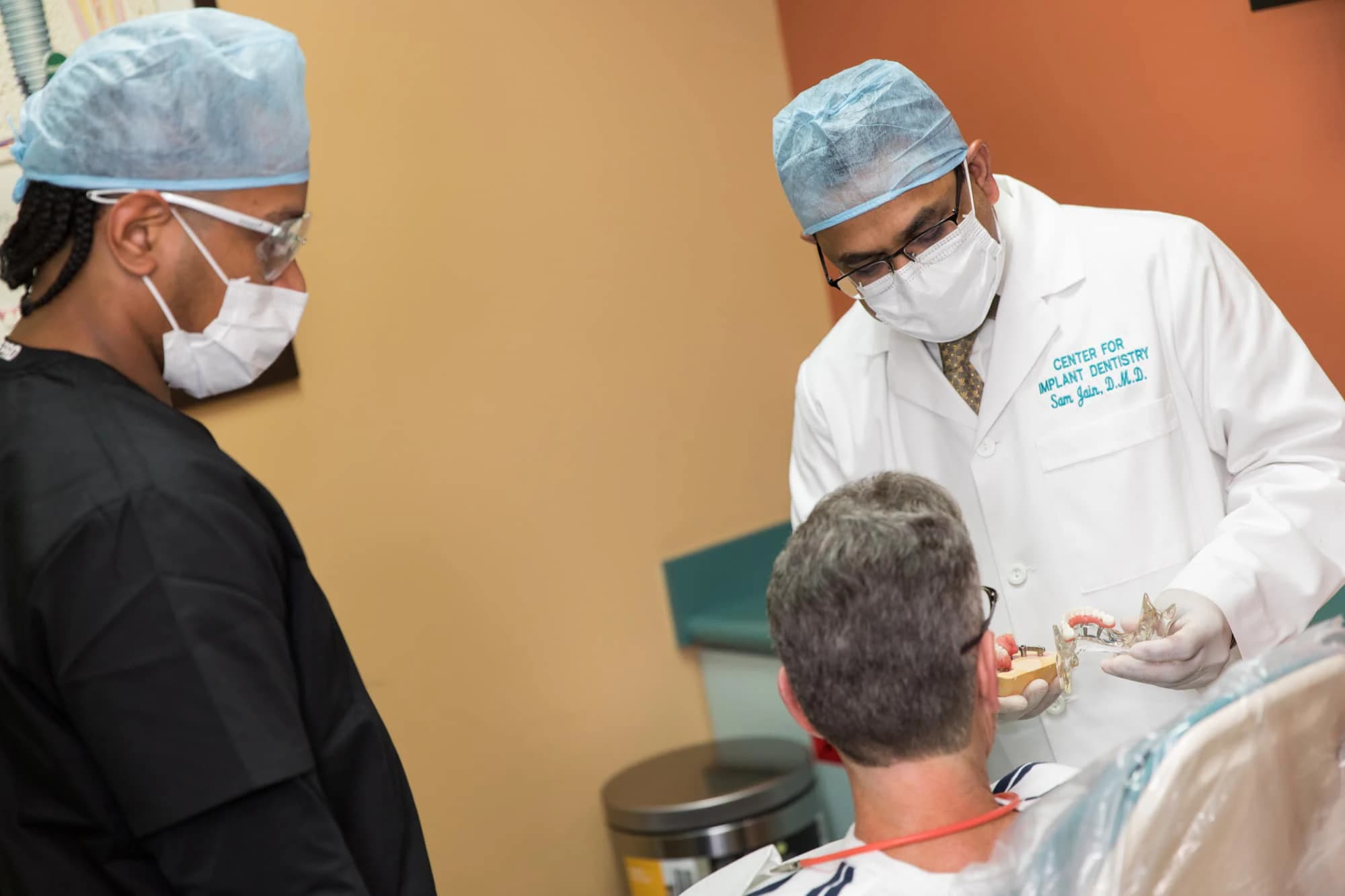
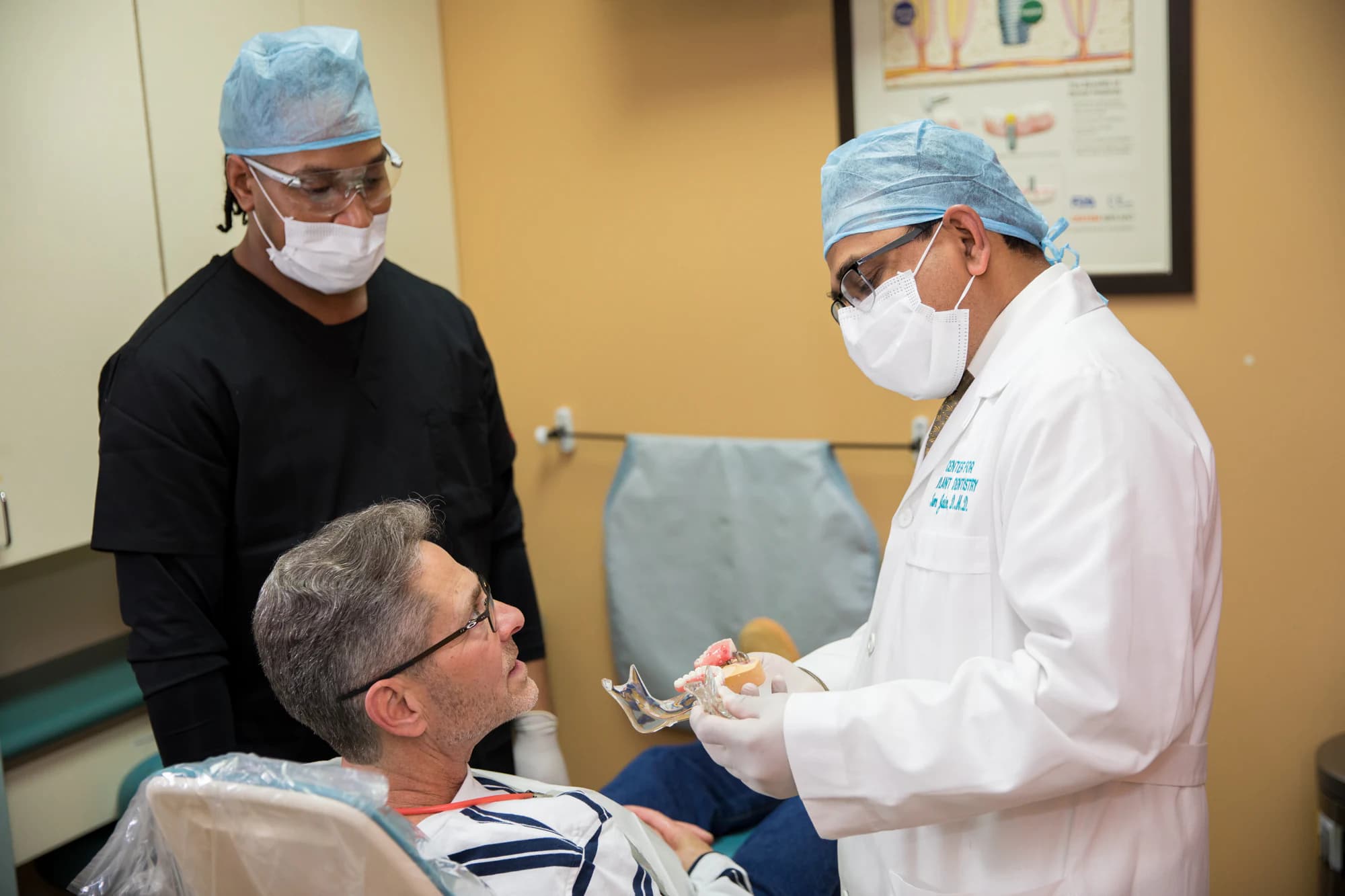
Your bite is a mechanical problem as much as a cosmetic one. Dr. Sam Jain holds both a dental degree (DMD) and a master's in mechanical engineering, so he plans each case around the actual forces your jaw generates — implant angle, depth, torque, and load — the same way an engineer designs anything built to carry weight for decades. In practice that means implants placed to distribute chewing force evenly, which is what keeps them stable and comfortable for the long run.
Still weighing your options? Learn more about full mouth dental implants or schedule a free consultation.
Still Curious? Get your questions answered by the surgeon, with a free 3D scan
Clinically reviewed by
 Dr. Sam Jain, DMD, MS
Implant Surgeon, Implantologist & Founder
 Dr. Arpana Gupta, DDS, MDS
Implant Surgeon & Implantologist
Their review covers the treatment description, candidacy, timelines, risks and aftercare.
- Your options can only be determined after an in-person examination and a 3D scan.