Sinus Problems After Upper Dental Implants: Congestion, Implants That Reach the Sinus, and When It Really Is a Sinus Infection
The upper back teeth sit just below the maxillary sinus, so it is natural to wonder whether an implant there is behind a blocked nose or a sinus infection. Usually it is not. When it is, the pattern is recognizable, and putting it right usually takes a dentist and an ear, nose and throat doctor looking at the same problem together.


Written and medically reviewed by Dr. Sam Jain, DMD, MS, and Dr. Arpana Gupta, DDS, MDS
Published
In this article
- 1Why upper implants and the sinus are close neighbors
- 2Common and short-lived: the first days after surgery
- 3An implant that reaches into the sinus is not automatically a problem
- 4When it is a sinus infection with a dental cause
- 5How dental sinusitis is treated, and why antibiotics alone rarely work
- 6When an implant is displaced into the sinus
- 7Zygomatic implants and the sinus
- 8Prevention starts with reading the sinus before the implant
Why upper implants and the sinus are close neighbors
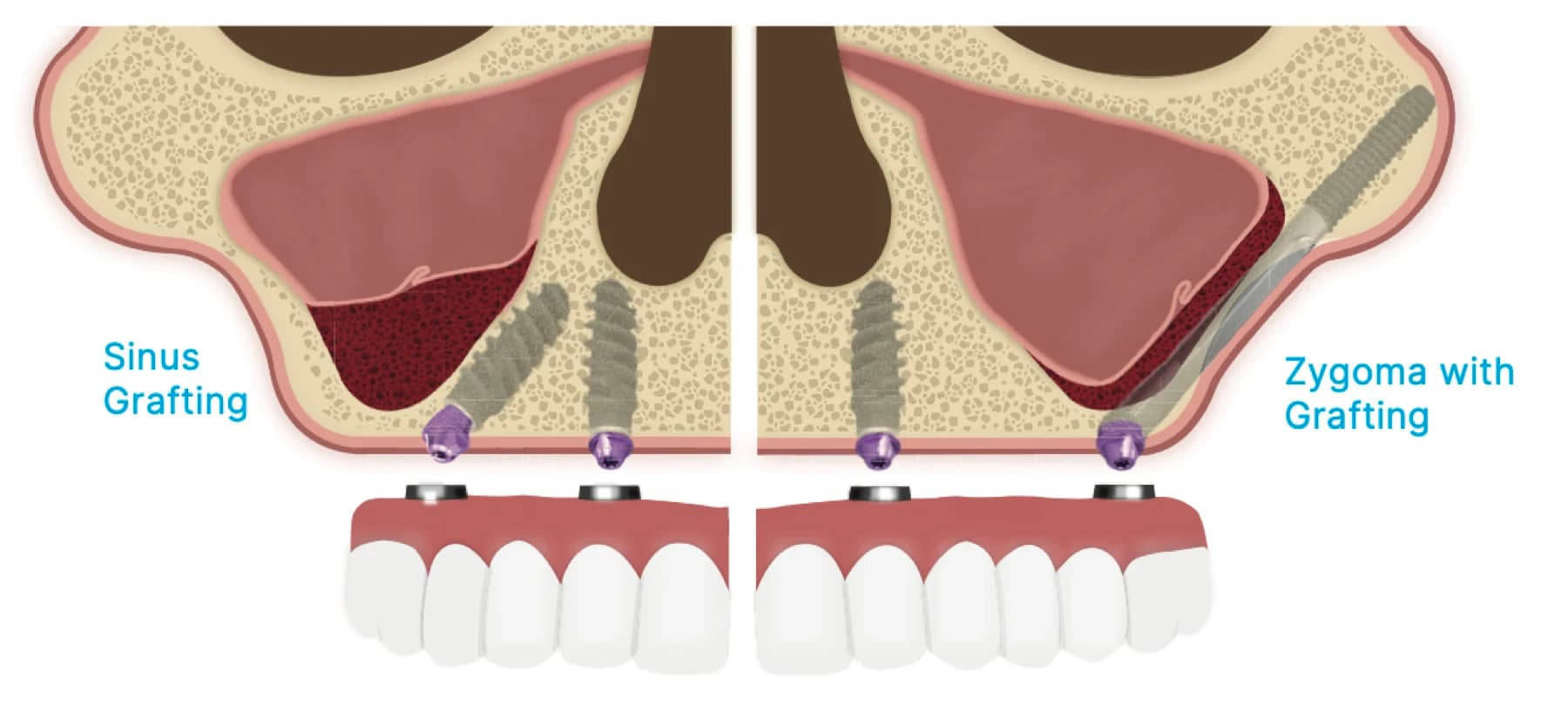
The maxillary sinuses are air spaces in the cheekbones, lined by a thin membrane, and their floor sits directly above the roots of the upper premolars and molars. After those teeth are lost, the bone below the sinus shrinks and the sinus tends to expand downward, which is why implants in the upper back jaw often need a sinus lift. Our sinus lift guide explains that procedure and its own risks in detail; this article is about the symptoms people notice afterward, and what they mean.
Three different situations get called a sinus problem after upper implants: short-lived effects of surgery near the sinus, an implant tip that extends into the sinus on a scan, and a genuine sinus infection with a dental cause. They look alike to a patient and very different on a scan, so it helps to separate them.
Common and short-lived: the first days after surgery
Surgery close to the sinus can cause a small nosebleed or blood-tinged mucus from the nose on that side in the first day or two, a feeling of pressure or congestion while swelling peaks, and some tenderness over the cheek. These usually settle over days. Protecting the area — sneezing with the mouth open, no forceful nose-blowing and no sucking through straws for the period you are given — prevents pressure changes from disturbing the healing site.
Symptoms that are not part of that normal course are worsening facial pain or swelling after the third day, fever, a foul smell or taste, thick discolored discharge from one nostril, or air or fluid passing between the mouth and the nose. Those deserve a call the same day.
An implant that reaches into the sinus is not automatically a problem
Patients are sometimes alarmed to see, on their own scan, the tip of an implant sitting beyond the sinus floor. The evidence on this is reassuring. A 2019 systematic review of implants that had penetrated the sinus floor without a sinus lift included 493 implants followed for an average of 52.7 months. Survival was 95.6%, and it did not differ between implants extending 4 mm or less and those extending further. Clinical complications occurred in 3.4%, the most frequent being nosebleeds. Radiographic findings, mainly thickening of the sinus lining, were seen in 14.8% — 5.29% with penetration of 4 mm or less and 29.3% beyond it, a difference that did not reach statistical significance.
A smaller study makes the same point from the patient's side: in nine patients with 23 implants extending more than 4 mm into the sinus, none had clinical signs of sinusitis six to ten months later, although the CT scans showed thickening of the sinus lining around 14 of the implants. A thickened lining on a scan, in other words, is a finding to be read in context, not a diagnosis. What matters is whether there are symptoms, whether they are on the implant's side, and whether anything else explains them.
That is not a reason to plan implants into the sinus. Implants in the upper back jaw are planned on a CBCT scan so their length matches the available bone, and a sinus lift is used where the bone is too short to hold them. But an implant tip that was placed through the floor and has been symptom-free is usually left alone.
When it is a sinus infection with a dental cause
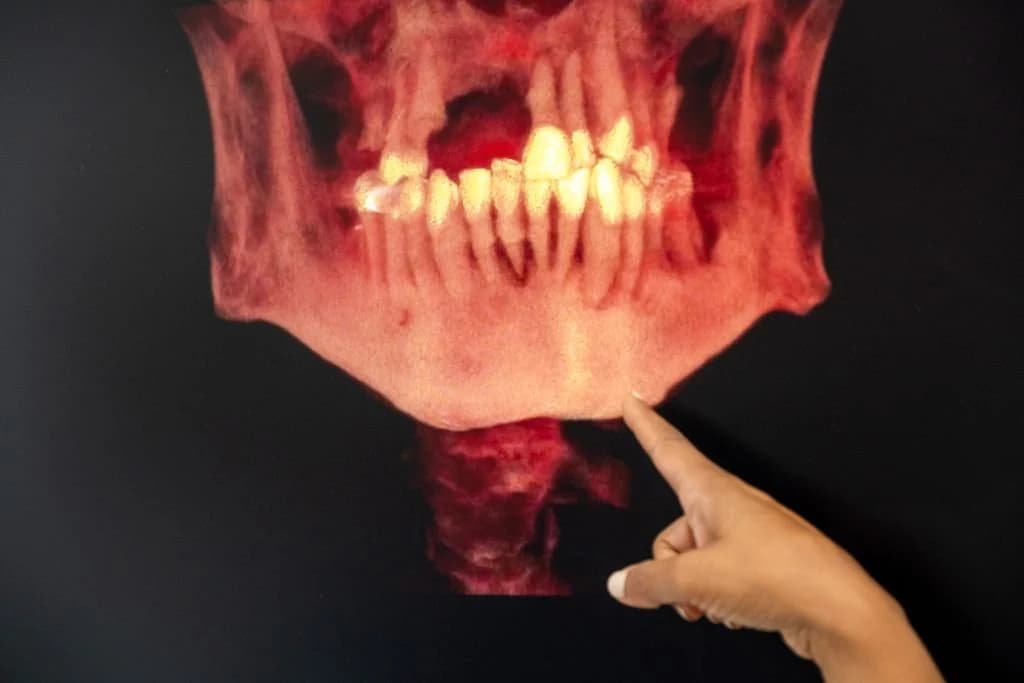
Sinusitis that starts from a tooth, an implant or dental surgery has a name — odontogenic sinusitis — and a recognizable profile. A 2022 review describes it as most commonly one-sided, and lists the features that should raise suspicion: symptoms on one side, one-sided clouding of the maxillary sinus on CT, visible dental disease on the scan, pus in the drainage channel of that sinus on nasal endoscopy, a foul smell, and mouth bacteria in sinus cultures. In a prospective study of 19 patients with sinusitis related to dental implants, foul odor and postnasal drip were the two most common complaints.
An implant is not always the source even when it is nearby. Infected or failing root canals are among the most common causes of dental sinusitis, and in a series of 121 patients treated surgically for it, 69 cases followed dental surgery of some kind — extractions, bone augmentation or implants — and 22.3% had foreign material displaced into the sinus. The neighboring teeth, any graft material and the implant itself all have to be examined before the cause is named.
The diagnosis takes two professions. An international consensus statement agreed that an ear, nose and throat doctor should confirm the sinusitis, mainly by looking into the nose with an endoscope, while the dental provider confirms the dental source by examination and imaging. When there are sinus symptoms and a dental cause is confirmed on the scan, the ear, nose and throat side is brought into the plan rather than the problem being treated from one side only.
How dental sinusitis is treated, and why antibiotics alone rarely work
The same 2022 review found that oral antibiotics are generally ineffective at resolving odontogenic sinusitis when there is a dental problem that can be treated, and that when both the dental cause and the sinusitis are addressed, it resolves in 90% to 100% of cases. Treating the dental source alone may be enough, but a significant proportion of patients still need endoscopic sinus surgery, a procedure performed through the nostril to open and clear the sinus's natural drainage.
For implant-related sinusitis specifically, the outcomes are good and often keep the implant. In the prospective study of 19 patients, four were successfully treated without surgery and 15 needed endoscopic sinus surgery, one of them twice; after two years all had recovered and every implant was still in place. A consensus statement on management recommends that the choice between dental treatment, sinus surgery or both be made jointly by the patient, the dental provider and the ear, nose and throat doctor, because the evidence does not support one fixed sequence for everyone.
When an implant is displaced into the sinus
Rarely, an implant is pushed fully into the sinus cavity. A series of 39 such patients collected over 25 years found that most displacements happened before the implant was loaded, during or after surgery; three happened after loading because the implant had never integrated, and three during placement into a fresh extraction socket. The authors identified too little bone below the sinus as a cause and advised a sinus lift before placement when bone height is minimal. All 39 implants were retrieved through an opening in the front wall of the sinus.
A displaced implant should not be left in place and watched, because it can block drainage and act as a source of infection. It is removed, by an approach through the mouth or through the nose with an endoscope, depending on where it lies, and the site is allowed to heal before any new implant is planned — often with a sinus lift, or with zygomatic implants where the upper jaw has little bone left. Our article on implant removal and replacement explains what rebuilding the site involves.
Zygomatic implants and the sinus
Zygomatic implants are long implants anchored in the cheekbone, and their path runs close to or through the sinus. A 2024 meta-analysis found sinusitis after zygomatic implant placement in 3.76% of patients, compared with 1.11% after sinus lifts, and the rate varied strongly with the surgical technique: 21.62% with the sinus-slot technique, 4.36% when the implant ran inside the sinus, and 0.00% in the studies of implants placed outside the sinus. If zygomatic implants are part of your plan, it is reasonable to ask how the implant's path relates to your sinus, and our zygomatic implants page explains who they suit.
Prevention starts with reading the sinus before the implant
The CBCT scan taken at the consultation shows more than bone height. It shows the sinus floor and any internal walls, the thickness of the lining, fluid or clouding, and the condition of the neighboring teeth. A thickened lining is not always a reason to stop: in a study of 46 patients whose sinus lining was thickened by infected upper molars, the thickness fell from an average of 19.44 mm before extraction to 4.16 mm after treatment, once the infected teeth were removed and the sinus drained during augmentation. But it is a reason to find the cause first, and a sinus that is already infected is treated before any lift or implant, with medical input where needed.
If your sinuses have been troublesome since upper implants were placed — here or elsewhere — the useful first step is a scan and an examination of the implant, the neighboring teeth and any graft, not another course of antibiotics. A second-opinion consultation includes the CBCT scan at no charge, and a sinus tract or gum boil near an upper implant is covered in our troubleshooting case on a late sinus tract.
Written and medically reviewed by Dr. Sam Jain, DMD, MS, and Dr. Arpana Gupta, DDS, MDS, who own this practice. Reviewed
This article is patient education, reviewed by Dr. Sam Jain, DMD, MS, and Dr. Arpana Gupta, DDS, MDS, and is not a substitute for an exam. Treatment recommendations are made only after an in-person consultation and 3D imaging.