Numbness After Dental Implant Surgery: What Is Normal, What Is Not, and Why Acting Early Matters
A numb lip for a few hours after implant surgery is expected. A lip that is still numb the next morning is a different matter. The difference between the two is worth understanding before surgery, because with a nerve problem, the response that helps most is the one taken early.


Written and medically reviewed by Dr. Sam Jain, DMD, MS, and Dr. Arpana Gupta, DDS, MDS
Published

In this article
Which nerve, and where it runs
Almost all implant-related nerve problems happen in the lower jaw. Inside the lower jawbone, beneath the roots of the back teeth, runs the inferior alveolar nerve, which carries feeling from the lower teeth, lip and chin. One clinical analysis described it as the nerve most commonly injured during implant treatment, at 64.4% of injuries. The nerve leaves the bone through a small opening on the outside of the jaw, the mental foramen, where it becomes the mental nerve and spreads into the lower lip and chin. On the tongue side of the lower jaw runs the lingual nerve, which carries feeling from the side of the tongue.
The anatomy varies more than people expect. A review of the mental foramen found it usually sits below the second premolar or between the premolars, but can lie anywhere from the canine to the first molar, and the nerve can loop forward inside the bone before it exits. That loop is inconsistently visible on ordinary X-rays, which gave both false positives and false negatives in the studies reviewed, while CT scans located the foramen more accurately.
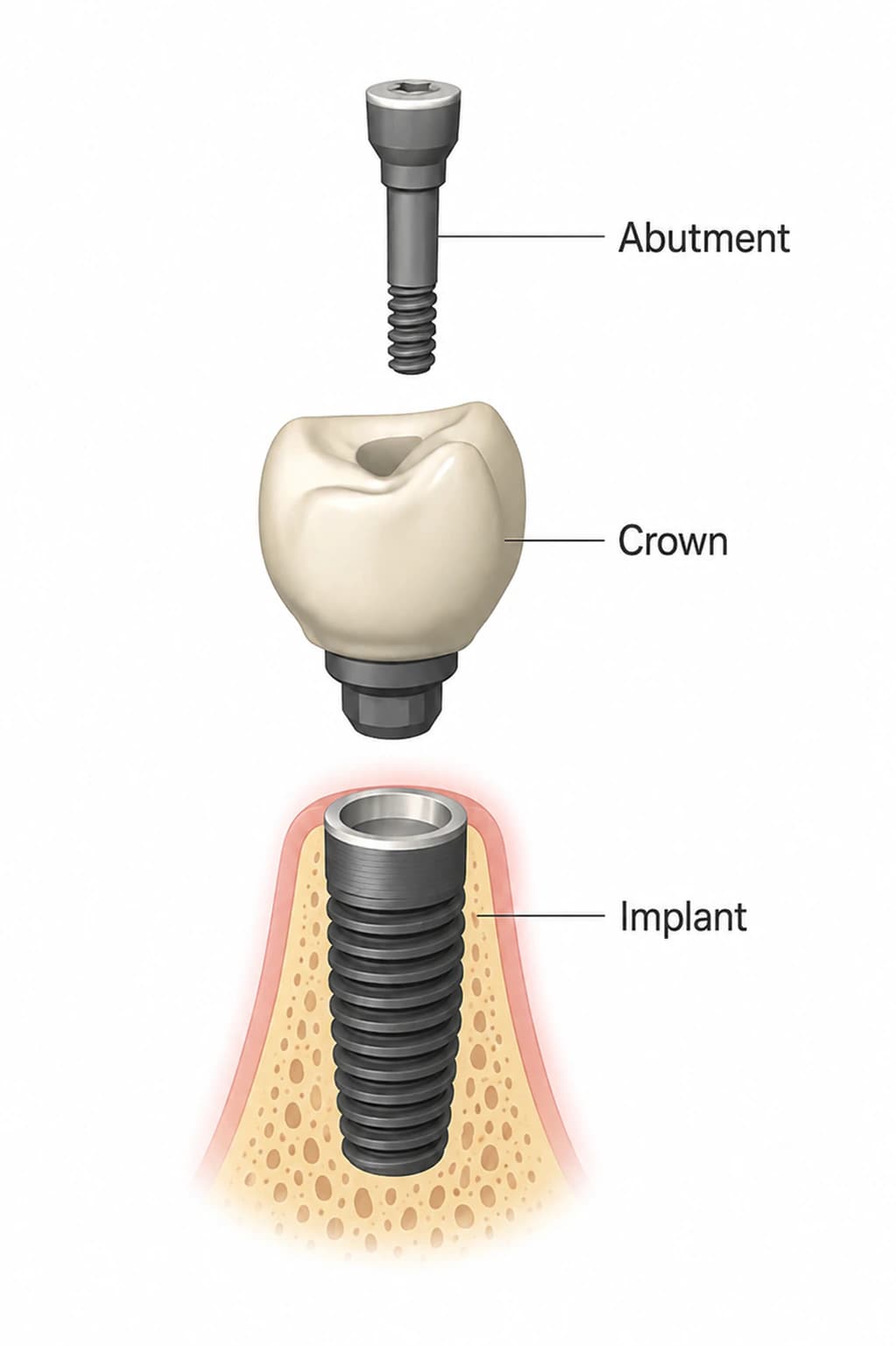
Normal: numbness from the anesthetic, and tingling that fades
Local anesthetic numbs the lip, chin and tongue for a few hours after surgery. That numbness should wear off the same day, as our post-operative instructions describe. Swelling and the surgery itself can also cause a mild, temporary change in sensation for a short time afterward.
Short-term changes are not rare. In a prospective study of 75 people who had two implants placed in the front of the lower jaw, in front of the openings where the nerve leaves the bone, about 24% reported some altered sensation in the lip or chin shortly after surgery, but testing found an objective change in only one person, and only about 1% still reported altered sensation a year later. In another study of 94 consecutive patients receiving 405 lower-jaw implants, 8.5% reported altered sensation at their first post-operative visit; none had painful or abnormal sensations, half had no measurable loss of function, and none had permanent changes. One patient was completely numb for two months and back to normal at four.
Not normal: numbness still there the next day
Numbness, tingling or a pins-and-needles feeling in the lower lip, chin or gums on one side that is still present the morning after surgery, when the anesthetic should long have worn off, needs to be reported the same day. So does a burning, electric or shooting pain in the lip or chin, and numbness on one side of the tongue. Do not wait for your next scheduled visit to mention it.
The usual causes are direct: the drill or the implant has reached or pressed on the nerve canal, bleeding in the bone has put pressure on the nerve, or swelling around it is compressing it. In one series of 16 patients with implant-related nerve injury, bleeding during bone preparation was the most frequent risk factor, present in half of them, and the injuries ranged from mild to severe in roughly equal thirds.
Why the first day or two matters
When an implant is sitting in or against the nerve canal, leaving it there keeps the nerve compressed. The clearest illustration comes from four patients seen at a London hospital's oral surgery department after implant-related nerve injury. The two whose implants were removed at 18 and 36 hours regained almost complete sensation; the two whose implants were removed at two and four days did not improve and were left with persistent nerve symptoms that affected daily life. Four cases cannot settle the question, but a systematic review of the diagnosis of these injuries reached the same conclusion from a broader base: early diagnosis and treatment matter.
So a numb lip the next day is treated as urgent. The assessment starts with a 3D scan to see exactly where the implant tip sits relative to the canal, a careful test and map of the area of changed sensation, and questions about pain. If the implant is in or against the canal, backing it out or removing it promptly is the usual recommendation, and anti-inflammatory medication may be prescribed. The numb area is then re-mapped at follow-up visits so recovery can be measured rather than guessed. If sensation is not returning as expected, referral to an oral and maxillofacial surgeon experienced in nerve injuries is part of that plan.
Prevention is a measurement: distance from the nerve
The risk depends almost entirely on how close the implant ends to the canal. A 2025 systematic review grouped patients by that distance. When the implant stopped 2 mm or more from the canal, the rate of sensory changes was 0%; between 1 and 2 mm it was also 0%; within 1 mm it rose to 68%; and for implants that entered the canal it was 53%. A literature review of the mental nerve recommended a 2 mm safety zone above the nerve and CT imaging whenever conventional X-rays leave its position unclear.
What causes injuries in practice points the same way. In a survey of 187 UK dentists, 80 had encountered an implant-related injury to the inferior alveolar nerve, and the most frequently cited cause, at 48%, was inaccurate identification of the nerve and its anatomical variations on imaging; the authors recommended CBCT for implants in the back of the lower jaw.
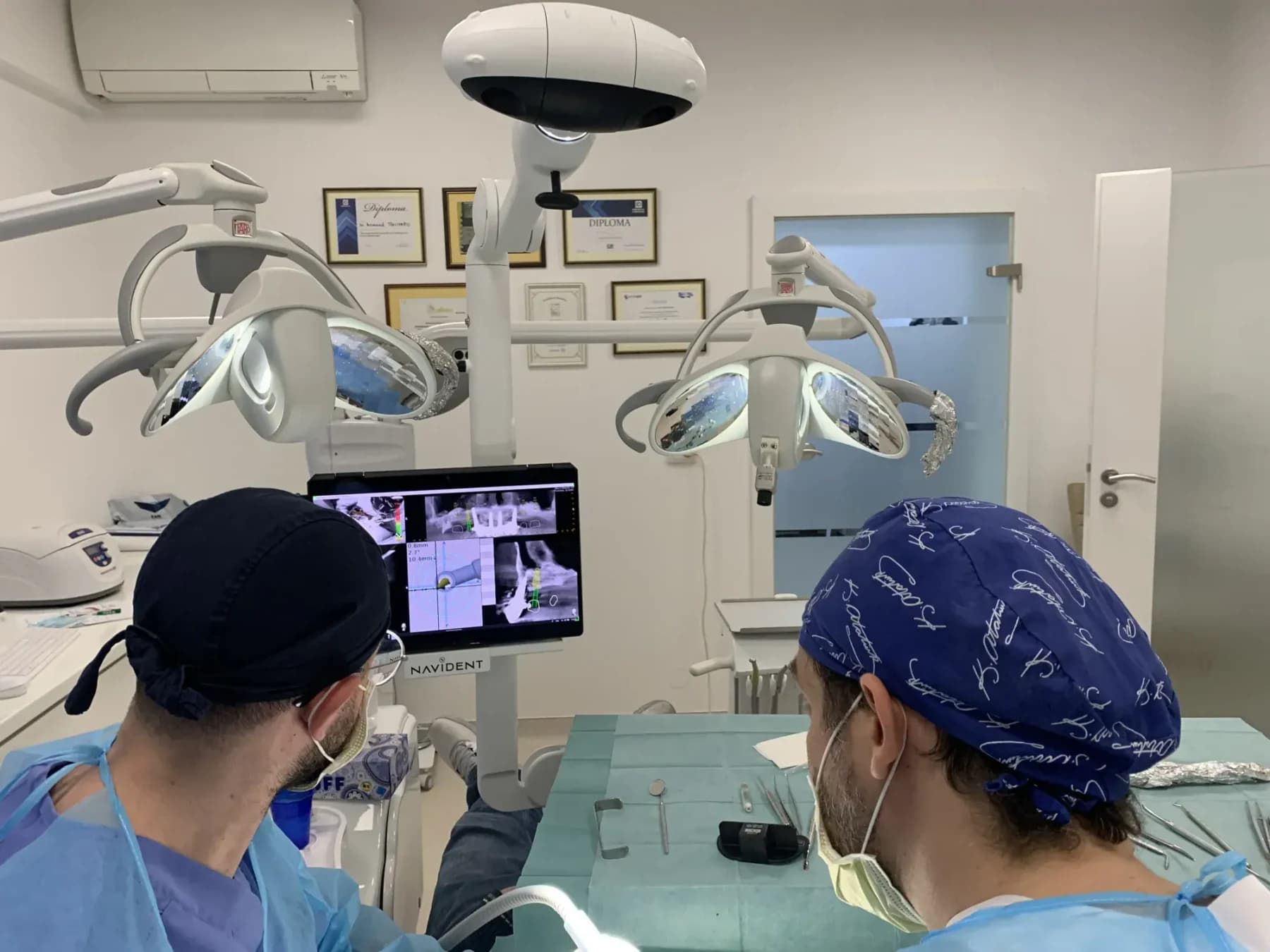
Every implant at our practice is planned on a CBCT scan, taken free at the consultation, so the canal, the foramen and any forward loop are measured in three dimensions before a drill length is chosen. The surgery is then performed with X-Guide or Navident EVO dynamic navigation, which shows the drill's position against the plan in real time. That does not make the risk zero — no technique does — but it replaces an estimate from a flat X-ray with a measured margin.

When there is not much bone above the nerve
Sometimes the bone above the canal is too short for a standard implant with a safe margin. The answer is not to use the margin anyway. Depending on the case, the options include a shorter implant, whose track record against bone grafting our short implants research review summarizes; placing implants in front of the foramen and designing a full-arch bridge around them; or rebuilding bone height before implants go in, as our bone grafting page describes.
Some surgeons move the nerve itself aside to make room, a procedure called nerve lateralization or transposition. It is worth knowing its trade-off if it is ever proposed to you: a 2025 meta-analysis of 20 studies found temporary sensory disturbances in 15% to 40% of cases, with most patients recovering within six months.
If numbness lasts
Many sensory changes improve over weeks to months, and the pattern of recovery at follow-up visits is the best guide to the outlook. A minority persist. In a university clinic's review of 1,012 implant patients, 0.3% developed painful nerve damage after implant placement and a further 0.5% had lasting nerve changes without pain; every affected patient was 60 or older.
Persistent altered sensation is managed with its own care — medication for nerve pain when needed, and in selected cases referral for surgical nerve repair — and its effect on daily life, from drinking to kissing to shaving, deserves to be taken seriously rather than dismissed. If you are living with numbness from an implant placed elsewhere, a second-opinion consultation can start with a scan of where that implant sits.
Written and medically reviewed by Dr. Sam Jain, DMD, MS, and Dr. Arpana Gupta, DDS, MDS, who own this practice. Reviewed
This article is patient education, reviewed by Dr. Sam Jain, DMD, MS, and Dr. Arpana Gupta, DDS, MDS, and is not a substitute for an exam. Treatment recommendations are made only after an in-person consultation and 3D imaging.