Dental Implant Removal and Replacement: How Removal Is Done, What Happens to the Bone, and When a New Implant Can Go In
Being told an implant has to come out feels like starting over. It rarely is. Removal is usually quicker and gentler than people expect, the bone often heals better than they fear, and a replacement can succeed — as long as the reason the first one failed is understood before the second one goes in.


Written and medically reviewed by Dr. Sam Jain, DMD, MS, and Dr. Arpana Gupta, DDS, MDS
Published

In this article
- 1Why an implant is removed
- 2Can an implant be repositioned instead of removed?
- 3How removal is done
- 4Does removing an implant hurt?
- 5What happens to the bone after an implant is removed
- 6Can a new implant go in the same spot?
- 7How soon can a failed implant be replaced?
- 8What removal and replacement cost
- 9How we handle a failed implant here
Why an implant is removed
An implant is removed when keeping it would do more harm than good. The clearest case is an implant that moves: it has lost its bond with the bone, and the International Congress of Oral Implantologists' consensus health scale places a mobile implant among failures. Other reasons are advanced peri-implantitis that keeps returning despite treatment, an implant that has fractured, internal threads damaged beyond repair, and an implant placed in a position where it cannot be restored well — too close to a neighboring tooth or nerve, angled so the crown can never look or function right, or too far out of the bone.
In a ten-year series of 95 removed implants that compared five removal techniques, the most frequent reasons for removal were loss of bone at the crest and peri-implantitis, the upper back jaw was the most common site, and most implants came out after more than a year in function. Removal, in other words, is not only for implants that never took. It is also how late problems are resolved, and our article on peri-implantitis treatment explains when treating an infected implant is still worthwhile and when it is not.
Can an implant be repositioned instead of removed?
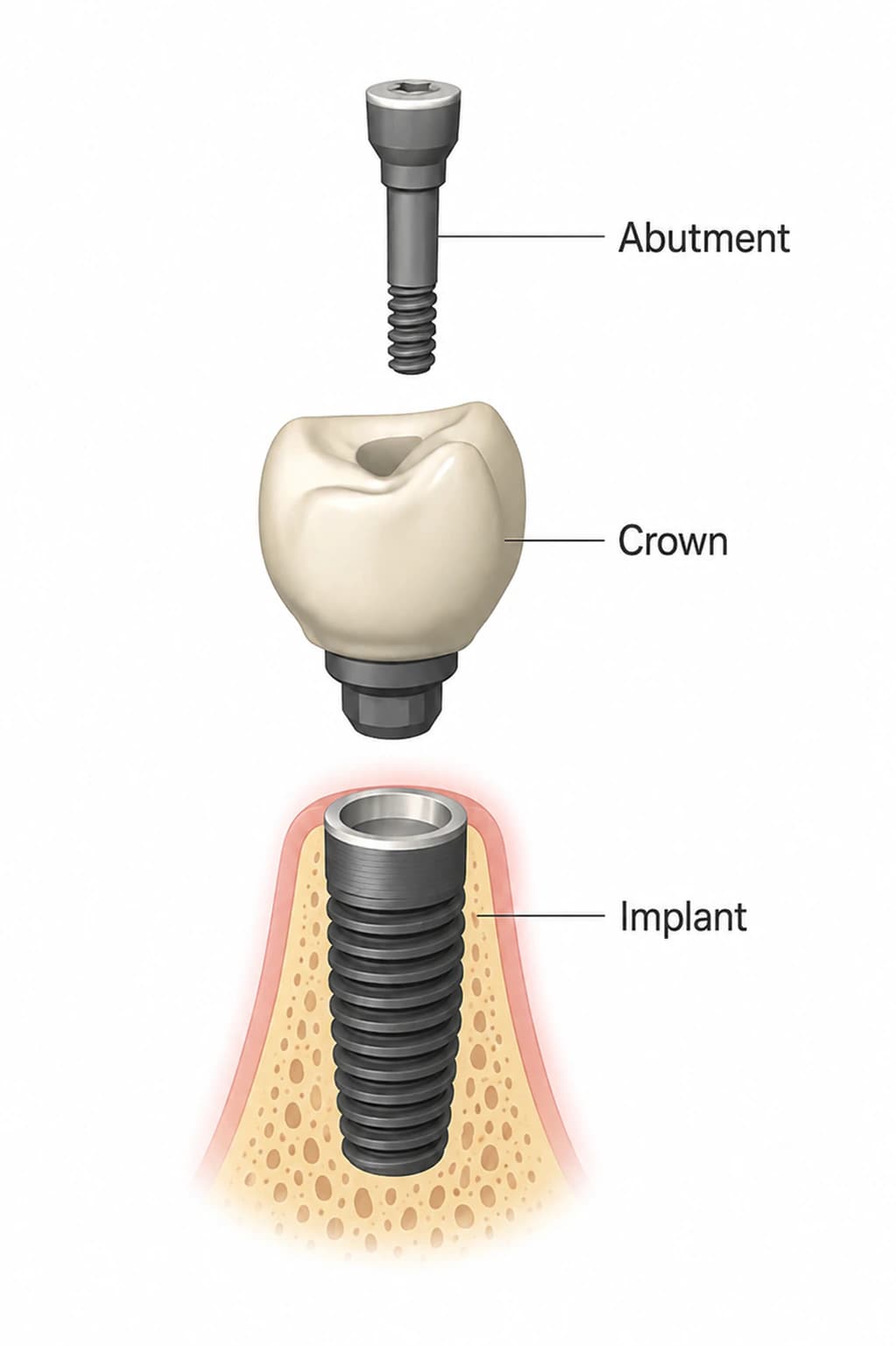
An integrated implant cannot be moved. Bone has grown into its surface, and there is no way to shift it a few millimeters or tilt it to a better angle. What can sometimes change is what sits on top of it. Angled or custom-milled abutments, and crowns with a redirected screw channel, can correct a moderate angulation problem so the tooth emerges where it should. A published case of a poorly positioned front implant made the point that the first question is always whether the implant can be restored acceptably, before anything is removed.
When the position cannot be corrected on top — the implant is too far toward the lip, too close to a tooth, or too shallow for a natural gumline — removal and replacement in the right position is the honest option. In those cases the new implant is planned on a 3D scan and placed with dynamic navigation, which our doctors use in the form of X-Guide and Navident EVO, so the second position is decided before surgery rather than during it.
How removal is done
An implant that is already mobile usually comes out with very little force; the bond with the bone is gone. A stable implant that has to be removed is a different task, and the technique chosen decides how much bone is left behind. The least destructive approach is counter-torque: a special key engages the implant and unscrews it with controlled force, breaking the bond between bone and implant surface rather than cutting the bone away. In a series of 749 non-mobile implants removed this way, 98.4% came out successfully, with complications in 1.3% — mostly small fissure lines at the top of the socket. In an earlier series, when an implant was too firmly fixed to unscrew within the tool's safe force, a shallow cut of 2 to 3 mm with a fine trephine freed it.
Other methods — a trephine that cores out a ring of bone around the implant, burs that thin the bone before the implant is loosened, or a high-torque wrench — remain useful when an implant is fractured or its connection is damaged. A review of the options proposed a decision tree based on the anatomy, the implant design, the condition of its connection, the bone quality and how much of the implant is still integrated. The goal in every case is the same: remove the implant while preserving as much bone as possible for what comes next.
Does removing an implant hurt?
Removal is done under local anesthetic, so the procedure itself should involve pressure rather than sharp pain. For patients who are anxious, or when removal is combined with grafting or a new implant, both of our doctors hold California moderate sedation permits and can provide IV sedation. The counter-torque approach is often brief.
Afterwards, the soreness is typically similar to a routine extraction and is managed with ordinary pain relief for a few days, although it depends on whether bone had to be removed or grafted. The post-op instructions for the first week are much the same as after an extraction: gentle rinsing, soft food, no smoking and no straws.
What happens to the bone after an implant is removed
People often imagine a crater where the implant was. The evidence is more reassuring. A 2023 study measured sites six months after implants were removed for persistent peri-implantitis. The part of the socket that had never been affected by the disease healed completely, bone filled in about 0.8 mm from the bottom of the old defect, and the bone crest dropped about 0.8 mm on average. The gum became about 0.4 mm lower and 0.7 mm narrower, with larger changes where the outer wall of bone was already missing.
The ridge still shrinks, as it does after any extraction; after tooth removal, width can fall by 29% to 63% within six to seven months without intervention. That is why the site is often grafted at the time of removal, especially when a new implant is planned. A graft does not make the site new again, but it holds the space and gives the replacement implant bone to sit in. Our bone graft materials review explains which materials are used and why.
Can a new implant go in the same spot?
Usually, yes — with an honest caveat. In most published series, replacement implants did less well than first implants. In one study, 79 replacement implants had a survival rate of 83.5% over a mean of about two and a half years, lower than reported for implants in untouched sites. In a larger clinic series, implants replacing lost ones survived at 73%, compared with 94% for implants placed for the first time, and replacements were more often lost in sites with little bone. A 2022 Korean study reported 89.4% one-year survival for 69 replacement implants; older age and smoking raised the risk of a second failure, and the three sites that failed a second time and were tried again all succeeded. Those authors concluded that patient factors mattered more than the earlier failure itself.
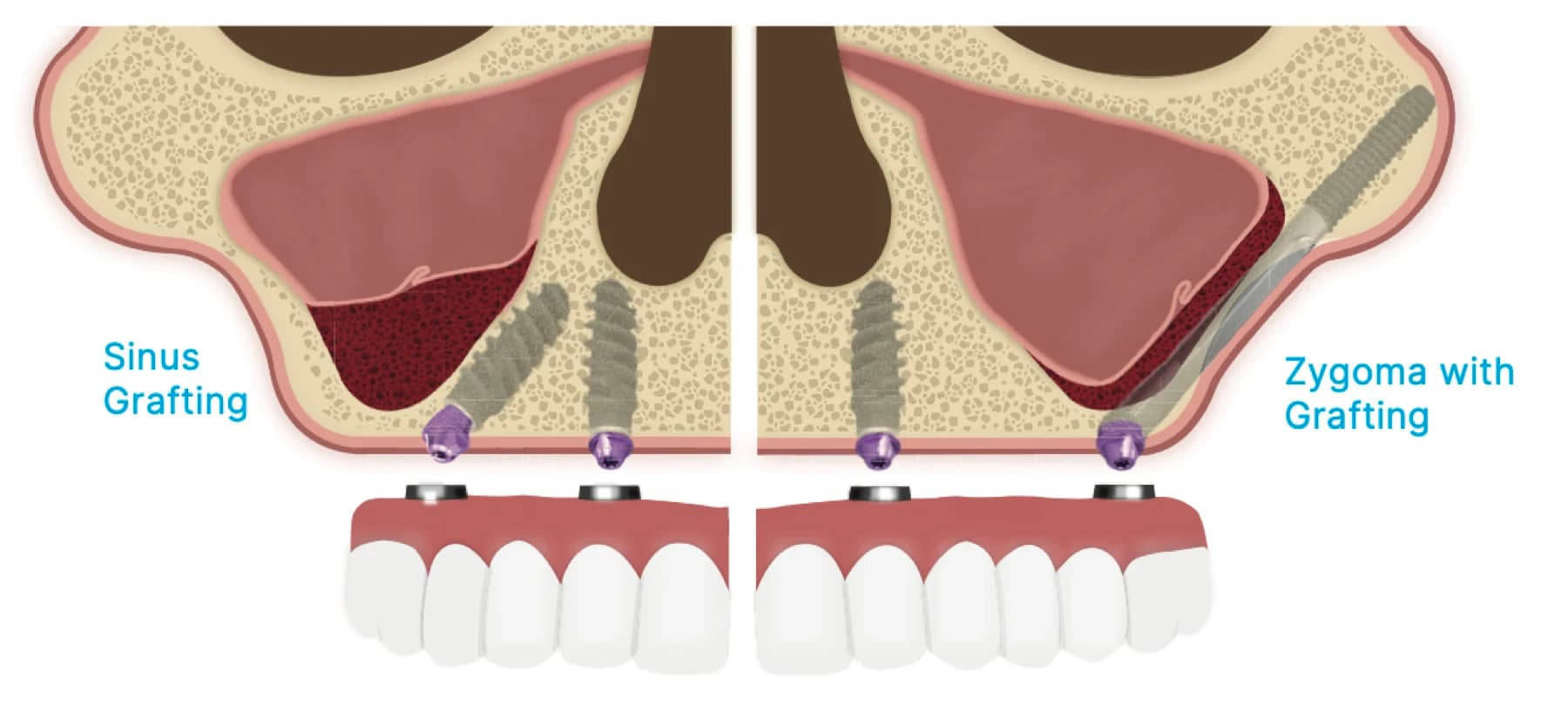
The authors of the first two studies suggested that something specific to the site may be at work. In practice, that means the second attempt should not simply repeat the first. We look for the reason the implant failed — infection, overload, grinding, an implant too short or narrow for the bone, a position that could not be cleaned, smoking, or a medical factor — and change the plan accordingly: more bone before placement, a different diameter or length, a different position, a new crown design, or a night guard. Sometimes the best replacement is not in the same spot at all, but in better bone nearby, or, in a severely resorbed upper jaw, a zygomatic implant anchored in the cheekbone.
How soon can a failed implant be replaced?
There are three timings, and the scan decides which one fits. When the implant comes out cleanly, there is no active infection, and enough bone remains to hold a new implant firmly, the replacement can sometimes be placed in the same visit; the counter-torque technique was described specifically with that possibility in mind. When there is infection or a bone defect, the usual plan is to remove the implant, clean and graft the site, and place the new implant once the graft has matured, which is typically a matter of months. And when a lot of bone has been lost, the rebuilding may itself take more than one stage.
Waiting longer is not automatically safer. A site that is left empty without grafting keeps losing volume, and a patient who postpones a replacement for years may need more grafting than they would have needed at the time of removal. Our article on the bone graft healing process explains what happens during that wait.

What removal and replacement cost
The cost is the sum of the steps a particular site needs: the removal itself and how difficult it is, any grafting, the new implant, abutment and crown, sedation if chosen, and, in a full-arch case, any change the bridge needs to fit the new implant. It is usually more than a single uncomplicated implant, because of the removal and grafting, and less than people fear when the site can be handled in one or two stages.
For an implant we placed that fails to integrate in the early healing period, what removal and replacement cost you is set by the warranty terms written into your treatment plan for the implant system used; the warranty page explains how those terms are set. For an implant placed elsewhere, you receive an itemized written quote after the examination and scan, with each option — including not replacing the implant — priced separately.
How we handle a failed implant here
Many of the removal and replacement cases we see started at another office, and helping with them is a routine part of our week. At a free consultation, a 3D CBCT scan shows the bone around the implant and the options for the site. If you would like to be heard before travelling, Dr. Sam Jain also offers second-opinion consultations by video during office hours.
Dr. Jain and Dr. Arpana Gupta carry out the removal, grafting and new placement themselves, with IV sedation available, and the new crown or bridge is designed and milled in our own lab. You leave the consultation with a plain-language explanation of why the implant failed, what the replacement plan changes, realistic odds, and the costs in writing. Our implant complications page explains more, and you can book here.
Written and medically reviewed by Dr. Sam Jain, DMD, MS, and Dr. Arpana Gupta, DDS, MDS, who own this practice. Reviewed
This article is patient education, reviewed by Dr. Sam Jain, DMD, MS, and Dr. Arpana Gupta, DDS, MDS, and is not a substitute for an exam. Treatment recommendations are made only after an in-person consultation and 3D imaging.