Implant Troubleshooting by Dr. Sam Jain: Failed Immediate Implant

Dr. Sam Jain in the clinic

Rescues are planned by the surgeon who performs them

Schedule Consultation

Implant Troubleshooting by Dr. Sam Jain: Failed Immediate Implant

A colleague sent over a case of an immediate implant that failed a few weeks after placement. Here is how Dr. Sam Jain reads it — the likely cause, the warning signs that were there, and what to do next.

Published April 16, 2019 · Updated July 9, 2026 · Current through August 6, 2026

Written and medically reviewed by Dr. Sam Jain, DMD, MS, and Dr. Arpana Gupta, DDS, MDS · How we write and review this

Dr. Sam Jain in the clinic
Rescues are planned by the surgeon who performs them

Why This Immediate Implant Probably Failed

Most immediate implants that fail in the first few weeks fail for one reason above all others: the implant never had enough grip in the bone on day one. When you place into a fresh extraction socket, the round socket walls don't match the threads of the implant, so your stability comes entirely from the bone below and around the socket — not from the socket walls themselves. If the surgeon couldn't engage 3 to 4 mm of solid native bone past the socket apex, or the final seating torque came in soft, the implant was moving under load before bone could ever grow to it. That micromotion, not "rejection," is what usually kills an early immediate case.

In the case a colleague sent over, the story fits that pattern almost exactly. Placement into an infected molar socket, a torque value that never got firm, an immediate temporary in contact during chewing, and a patient who smokes. Any one of those is a headwind. Stacked together, they're close to a setup for early failure. So the honest first answer isn't "you did something wrong" — it's that this site was asking for more primary stability than the bone could give, and the plan didn't account for that gap.

If you're a patient reading this after a failed implant elsewhere, the takeaway is the same in plain terms: an early failure almost always traces back to how well the implant was anchored and loaded at the start, not to your body being incapable of accepting one. The site can usually be rebuilt and re-implanted. Our dental implant complications page walks through what that rescue looks like.
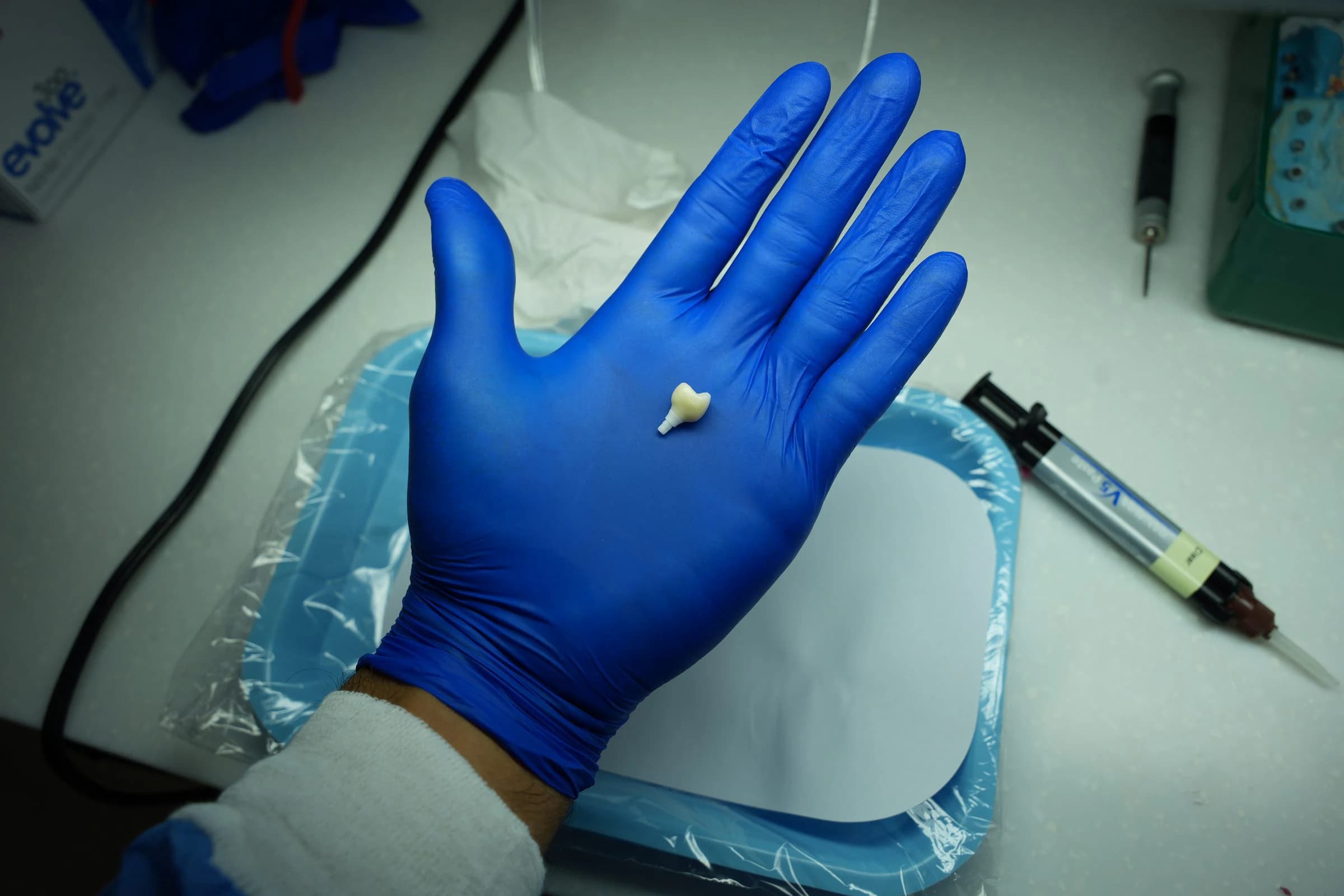
Clinical illustration of a tooth after extraction
A clear view of the tooth structure involved in an extraction

Reading This Specific Case: The Signals That Were There

Start with the socket. This was an immediate implant into a tooth that came out because of infection, and the radiograph showed a periapical lesion before extraction. Placing into a site with active or recent infection raises the early-failure risk unless the socket is thoroughly debrided down to bleeding, healthy bone and the granulation tissue is fully removed. If any of that soft, infected tissue stays behind, it sits between the implant and the bone you need it to fuse with. On the extraction and immediate implant side, the discipline of the debridement matters as much as the drilling.

Next, primary stability. The note said the implant "felt okay" but final torque was around 15 to 20 Ncm. For a delayed, buried implant left to heal untouched, that can still integrate. For an immediate implant carrying a temporary, it's thin. The literature generally points to roughly 35 Ncm or higher as the threshold where clinicians feel comfortable loading an implant right away, precisely because that torque corresponds to less micromotion at the bone interface — and bone tolerates only about 150 microns of movement before it lays down scar-like fibrous tissue instead of bone. A soft-torque immediate implant under a temporary is skating right at that edge.

Then the loading. If the provisional was in contact during chewing or in lateral excursions, every bite was tugging on an implant that hadn't yet earned the right to be loaded. Add a smoker — where implant failure runs materially higher than in non-smokers — and you have a site fighting on several fronts at once. None of these signals is subtle in hindsight. The value of a case review is spotting them before placement, which is exactly what a proper 3D workup on our advanced technology is for.

How I'd Handle the Rescue

First, remove the failing implant and treat the site as a wound that needs to heal, not as a hole to immediately refill. When an immediate implant fails, there's usually a defect in the bone around it, sometimes with lingering infection. The right move is often to explant, thoroughly clean the site, graft the defect to rebuild the ridge, and let it heal for a few months before going back in. That's slower than the patient wants to hear, but a rushed second attempt into compromised bone tends to fail the same way the first one did. Our bone grafting approach is built around rebuilding exactly these post-failure defects.

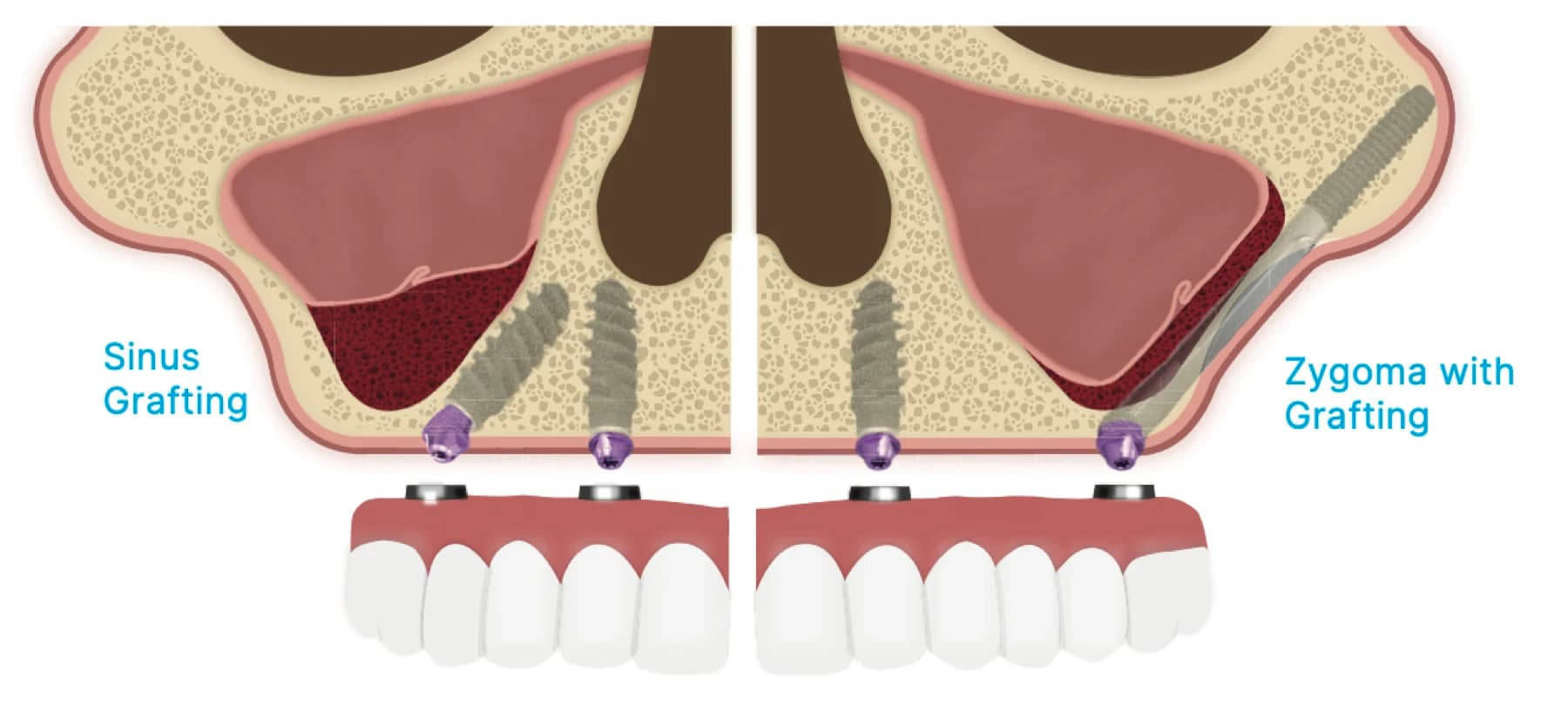
Second, change the mechanics for round two. If native bone below the socket was the limiting factor, plan a longer or wider implant to engage more solid bone, choose a delayed protocol so the implant heals unloaded, and keep any temporary completely out of contact. For a molar site with a stubborn bone deficit — or an upper case near the sinus — a sinus lift with staged immediate implant can create the anchorage the first attempt lacked. In the maxilla where bone is severely gone, zygomatic implants anchor in the cheekbone and sidestep the graft-and-wait entirely.

Third, address the patient factors honestly. Smoking is worth a frank conversation before re-implantation, because it narrows the margin on every point above. This is also where doing everything under one roof pays off: when the same surgeon plans, places, and restores the case — and mills the final tooth in-house — nobody is handing off a compromised site and hoping the next person catches it. That continuity is the whole argument on our why choose us page, and it's especially the point when you're rescuing someone else's failure.
A smiling implant patient wearing a gray cardigan
A real patient at Center for Implant Dentistry

The Preventable Version of This Case

Almost everything above is preventable at the planning stage. A free 3D CBCT scan shows the bone below the socket before you ever pick up a handpiece, so you know going in whether an immediate implant can get real primary stability or whether this site wants a staged approach. Guided surgery — we use X-Guide and Navident EVO — puts the implant into the densest available bone at the planned angle, rather than freehanding it and hoping the torque comes up. When the plan says "this socket won't hold an immediate," the disciplined answer is to graft and stage, not to force it.

The pattern I'd want any colleague to take from this case is simple: immediate implants are an excellent tool in the right socket and a liability in the wrong one, and the difference is almost always visible before surgery. Primary stability isn't luck — it's the product of site selection, debridement, drilling sequence, implant choice, and keeping the temporary off the bite. Get those right and immediate placement is predictable. Skip the workup and it becomes a coin flip. For patients weighing a same-day approach, our same-day dental implants page is candid about when it's appropriate and when it isn't.

If you had an implant fail somewhere else, this is the kind of case we take on regularly — Dr. Sam Jain and Dr. Arpana Gupta, both ICOI Masters, personally review the imaging, rebuild the site, and re-implant it themselves. The first visit, including the 3D scan, is free. You can schedule a consultation and bring whatever records you have; a second opinion on a failed implant costs you nothing but an hour.

This article is patient education, reviewed by Dr. Sam Jain, DMD, MS, and is not a substitute for an exam. Treatment recommendations are made only after an in-person consultation and 3D imaging — the first visit is free.

Still Wondering? Here's What People Ask Next.

Can a failed immediate implant be replaced, or is my mouth just not suited for implants?

In almost every case it can be replaced. An early immediate-implant failure is far more often about primary stability and loading than about your body rejecting the implant. The usual path is to remove the failed implant, clean and graft the site, let it heal for a few months, then place a new implant into rebuilt, solid bone — frequently longer or wider than the first, and often on a delayed protocol so it heals unloaded. Long-term implant survival is high once integration is achieved; your surgeon will confirm your specifics on a 3D scan.

How soon after an immediate implant would I know it failed?

Early failures typically show up within the first few weeks to a couple of months. Warning signs include persistent or worsening pain past the first week, swelling that doesn't settle, the implant or temporary feeling loose or mobile, a bad taste, or drainage around the site. Some discomfort right after surgery is normal; a trend in the wrong direction is not. If you notice any of these, be seen promptly — catching a struggling implant early gives the site the best chance to be rescued cleanly.

Why do immediate (same-day) implants fail more often than delayed ones?

Because an immediate implant has a harder job at the start. Placed into a fresh extraction socket, it can't grip the socket walls, so all of its early stability comes from the bone beyond the socket — and if that anchorage is thin, the implant can micro-move under a temporary before bone grows to it. Infected sockets, soft final torque, a temporary that hits the bite, and smoking all widen that gap. Done in the right site with proper planning and stability, immediate implants are very predictable; the failures cluster in cases that should have been staged.

I smoke — does that mean I can't get an implant after a failure?

It doesn't rule you out, but it's an honest factor to address. Studies consistently show implant failure is meaningfully more common in smokers than non-smokers, and smoking narrows the safety margin on an already-compromised site. Cutting back or pausing around the surgery and healing window measurably helps. Your surgeon will talk through timing and expectations with you rather than pretend it doesn't matter.

Readers Who Became Patients

Beyond The Article, What Patients Actually Say

Our patients wrote these, and we cannot edit a word. The rating beside them counts every review on our Google profile — not only the five-star ones shown here.

4.9from 472 reviews on our Google profile
  • Lady Gemini

    They did excellent work on my brother Bring your mother, your sister, your brother they do excellent work and they’re very patient and they make you look beautiful. There’s a picture.

  • Jessica To

    Amazing center I did my full mouth dental implant treatment long time 8 year almost no problem I am very happy this implant center is amazing they have in-house the power of making teeth I very very happy . Highly recommend if somebody wants implant

  • james wells

    I am very happy for this place I did my full mouth dental implant treatment from this place 5 year ago and result xame very good my teeth looks very natural I coming from all way from Sacramento the reason for choosing this place because they have everything under one roof every expertise under one roof engineering surgical experience manufacturing facility because this kind of treatment needs expertise who have good experience and dr jain and dr Gupta is amazing When I got my final teeth I feel like that moment is glimpse of eternity Very happy

  • Vincent Betar

    The entire staff here are really amazing from the receptionist to the doctors who perform an amazing transformation of my teeth and my facial expressions. I feel very grateful for the work done and very satisfied. I highly recommend center for Implant dentistry sincerely. Vince Betar.

  • T A

    Left a 5-star rating for Center for Implant Dentistry.

  • YIN OO

    I am very happy this place amazing somebody wants Inplant highly recommend at least go for Consultation de Jain and dr Gupta explain very well I did my immediate implant treatment result came out very good

  • Song Zhou

    Good service I like I did my couple implants very good place

  • Enedina Santaana lopez

    (Translated by Google) The doctors and their assistants are truly professional. They made me feel comfortable during my visit. For my first time seeing a dentist, coming to this clinic was the best decision I made. They were very efficient and quick with the process of placing my dental implants. I would definitely choose to come here again; I'm extremely satisfied with the results. (Original) Realmente los doctores son muy profesionales y sus ayudantes por igual, me hicieron sentir cómoda durante mi estancia , para ser mi primera vez viendo a dentistas ha sido la mejor elección venir a esta clínica, fueron muy eficientes y rápidos con el proceso para ponerme mis implantes dentales. Volvería a elegir venir aqui de nuevo, super satisfecha con los resultados.

  • Sayed Hasanzada

    It’s alway nice to come here get your teeth cleaned and make your smile right great staff clean and excellent experience Thank you everyone

  • Antonio Servantes

    Amazing Place I did my dental implant this place I am very happy they finish my treatment with natural tooth in 1 day I am very I feel confident before I loose my confident my smile is not good . Now I have pleasing and beautiful smile Amzing place they have manufacturing onsite they make my crown here . I wish give 10 star one discuss with dr Jain if anybody need implant I saw rating then I choose amzing very happy

  • Eric Tang

    I am writing this review truly from the bottom of my heart. My experience with the Center for Implant Dentistry in Fremont has been nothing short of life-changing. I cannot fully express how happy and grateful I feel after receiving my implants. From the very beginning, everyone at this facility has been incredibly friendly, caring, patient, and accommodating. Most importantly, they made me feel comfortable and confident throughout the entire process. I always felt that I was in good hands. This has been an amazing experience that I will remember for the rest of my life. Having my smile restored has given me back something that is difficult to put into words. I can now smile confidently without feeling self-conscious, enjoy the foods I want to eat, and simply enjoy the moment without constantly worrying about my teeth. It is more than just getting new teeth—it has truly changed my quality of life, my confidence, and the way I feel about myself every day. To everyone at the Center for Implant Dentistry in Fremont, thank you from the bottom of my heart for everything you have done for me. You didn’t just give me a beautiful new smile—you gave me a new chapter in my life, and that is something I will always be grateful for. For anyone who is struggling with their teeth and considering dental implants, I wholeheartedly recommend the Center for Implant Dentistry. If you are afraid or uncertain, I understand that feeling—but for me, taking this step was one of the best decisions I have ever made. This experience has truly changed my life in the best way possible. I can smile again, I can eat again, and most importantly, I can enjoy those moments with confidence. Thank you to the entire team for giving me something I will cherish for the rest of my life.

  • P. Chavez

    I couldn't have asked for a better experience or result! From Dr. Jain and Dr. Gupta and the entire staff, you are in absolutely great hands! I would wholeheartedly recommend them 100%, time and time again. They're absolutely amazing! Thank you so much C.f.I.D! 💯🙏❤️

Reviews are individual patient experiences, shown as posted. Results vary from person to person.

Have A Question About Your Own Mouth?

Book free consultation