Types of Dental Implants: Titanium, Zirconia, Zygomatic, Mini and More — How Each One Is Used
“Which type of implant should I get?” has no single answer, because implants differ in four separate ways — where they anchor, what they are made of, their size and shape, and what they carry. Here is how to read each one, and what the research says about it.


Written and medically reviewed by Dr. Sam Jain, DMD, MS, and Dr. Arpana Gupta, DDS, MDS
Published
In this article
- 1Four questions sort every dental implant
- 2Where it anchors: endosteal, zygomatic, pterygoid and subperiosteal
- 3What it is made of: titanium and titanium alloys
- 4What it is made of: zirconia, the ceramic implant
- 5The surface you cannot see
- 6Size and shape: standard, narrow, mini and short implants
- 7Design details that affect maintenance: connection and retention
- 8What it carries, and when
- 9How we choose among them for you
Four questions sort every dental implant
Patients often arrive with a list of names — zirconia, All-on-4, mini implants, zygomatic, ceramic, Straumann, Nobel — that sound like competing products. Most of them answer different questions. An implant can be titanium (a material), bone-level (a design), 4.1 mm wide and 10 mm long (a size), and carry a single crown (a restoration), all at once. Sorting the vocabulary into four questions makes the choices far easier to follow.
The four questions are: where does the implant anchor, what is it made of, what size and design is it, and what does it support, and when? Your anatomy answers the first and third, your health history and preferences inform the second, and the fourth depends on how many teeth are missing and what you want to be able to do with them. Everything below follows that order.
Where it anchors: endosteal, zygomatic, pterygoid and subperiosteal
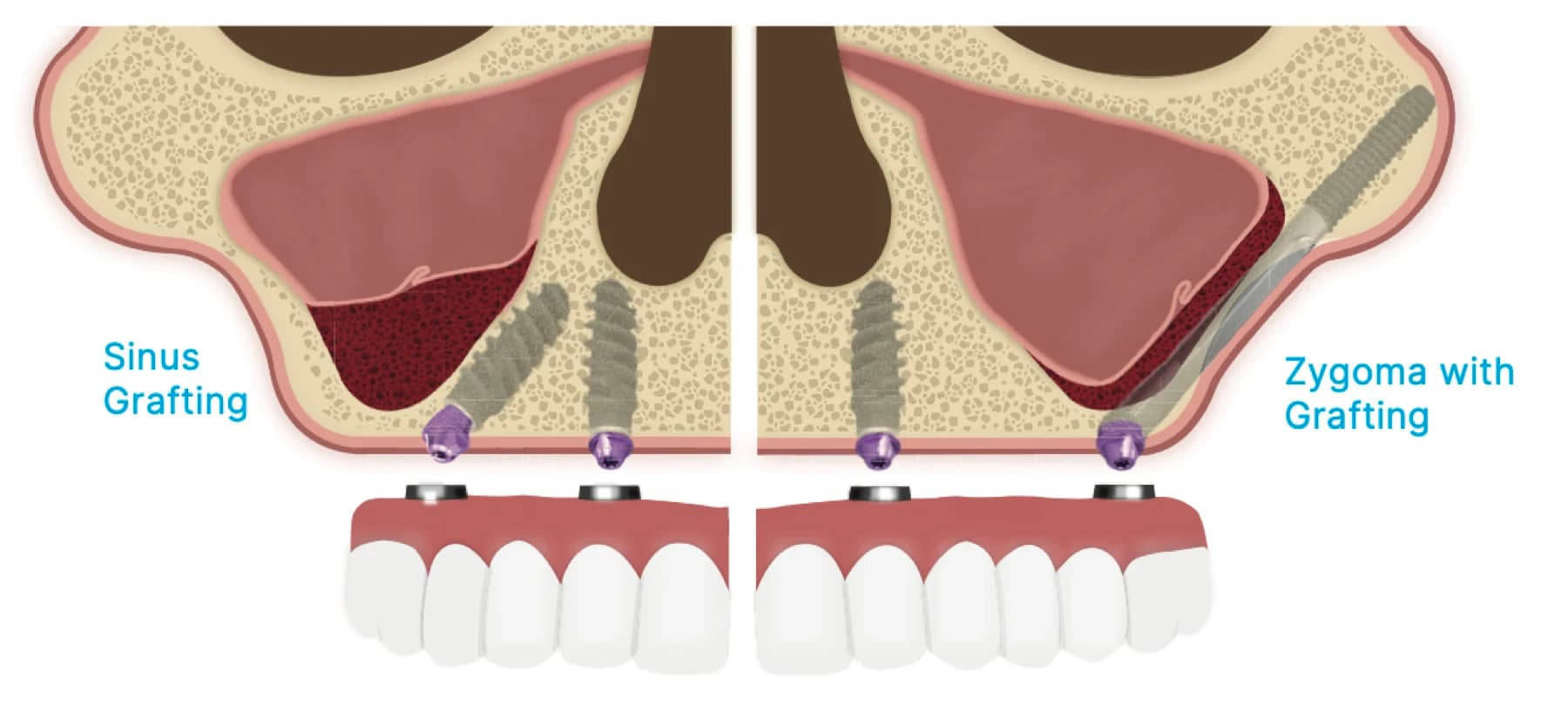
Almost every implant placed today is endosteal — a screw-shaped post placed into the jawbone where a root used to be. When people say “a dental implant,” this is what they mean, and it is what the decades of survival data mostly describe.
When the upper jaw has lost so much bone that an ordinary implant has nothing to hold, two longer designs reach bone further away. Zygomatic implants run from the upper jaw into the cheekbone. A systematic review drawing on 196 publications reported a cumulative success rate of 96.1% after more than five years, with soft-tissue problems and sinus inflammation among the most common complications. Pterygoid implants anchor at the very back of the upper jaw in the dense bone near the pterygoid plates; a 2023 systematic review of 911 modern roughened-surface pterygoid implants reported 95.5% cumulative survival at six years, with most failures happening in the first year before the implants were loaded.
Subperiosteal implants sit on top of the bone under the gum rather than inside it. The older cast versions largely disappeared from practice, but custom 3D-printed titanium frameworks have brought the idea back for severely resorbed jaws. A 2024 systematic review of 227 additively manufactured subperiosteal implants found 97.8% still in function at a mean of about 21 months, but also reported partial exposure of the framework in 25.6% — promising, early, and not yet supported by long-term data.
What it is made of: titanium and titanium alloys
Titanium has the longest record in implant dentistry, and it is still the default for most anatomies. Implants are made either from commercially pure titanium or from titanium alloys, which are stronger. That strength matters most for narrow implants, which are used where the ridge is thin or the space between teeth is small, because a narrow implant has less metal to resist bending. Titanium-zirconium alloy was developed for exactly that problem; a systematic review of 922 narrow titanium-zirconium implants reported survival of 97.7% at two years, comparable to regular-diameter titanium, while noting that long-term data was still needed.
Patients sometimes ask about titanium allergy. It exists, but it is rare. In a clinical study of 1,500 consecutive implant patients, 9 tested positive for titanium allergy — 0.6% — and the positive results were concentrated among patients who had already shown allergy-compatible symptoms or unexplained implant failures. For patients with a documented sensitivity, or a strong preference for no metal, there is an alternative.
What it is made of: zirconia, the ceramic implant
When patients ask about ceramic or metal-free implants, they are almost always asking about zirconia — zirconium dioxide, a white, very strong ceramic. Zirconia implants are chosen for three main reasons: a thin or receding gum through which a gray metal implant might show, a sensitivity to metals, or simply a wish to have no metal in the body. They come as one-piece implants, where the post and the part the crown attaches to are a single piece, and two-piece designs that behave more like conventional systems.
The evidence is encouraging but shorter than for titanium. A 2018 meta-analysis of commercially available zirconia implants reported survival of 98.3% at one year and 97.2% at two years, and found one-piece zirconia implants comparable to published titanium data over that time. A 2017 systematic review of 398 zirconia implants followed for up to five years found 95.6% survival at twelve months — most losses happened during healing — with very few losses after that. Both reviews concluded that longer follow-up is still needed.
In practical terms, zirconia behaves differently from titanium under load, it cannot be bent or adjusted in the mouth, and one-piece designs leave less room for correcting angles. That makes case selection more important, not less. We place both, so our recommendation comes from your gum thickness, bite and bone rather than from which system an office happens to stock. Our side-by-side titanium versus zirconia comparison goes further into that decision, and the full range we work with is on our implant materials page.
The surface you cannot see
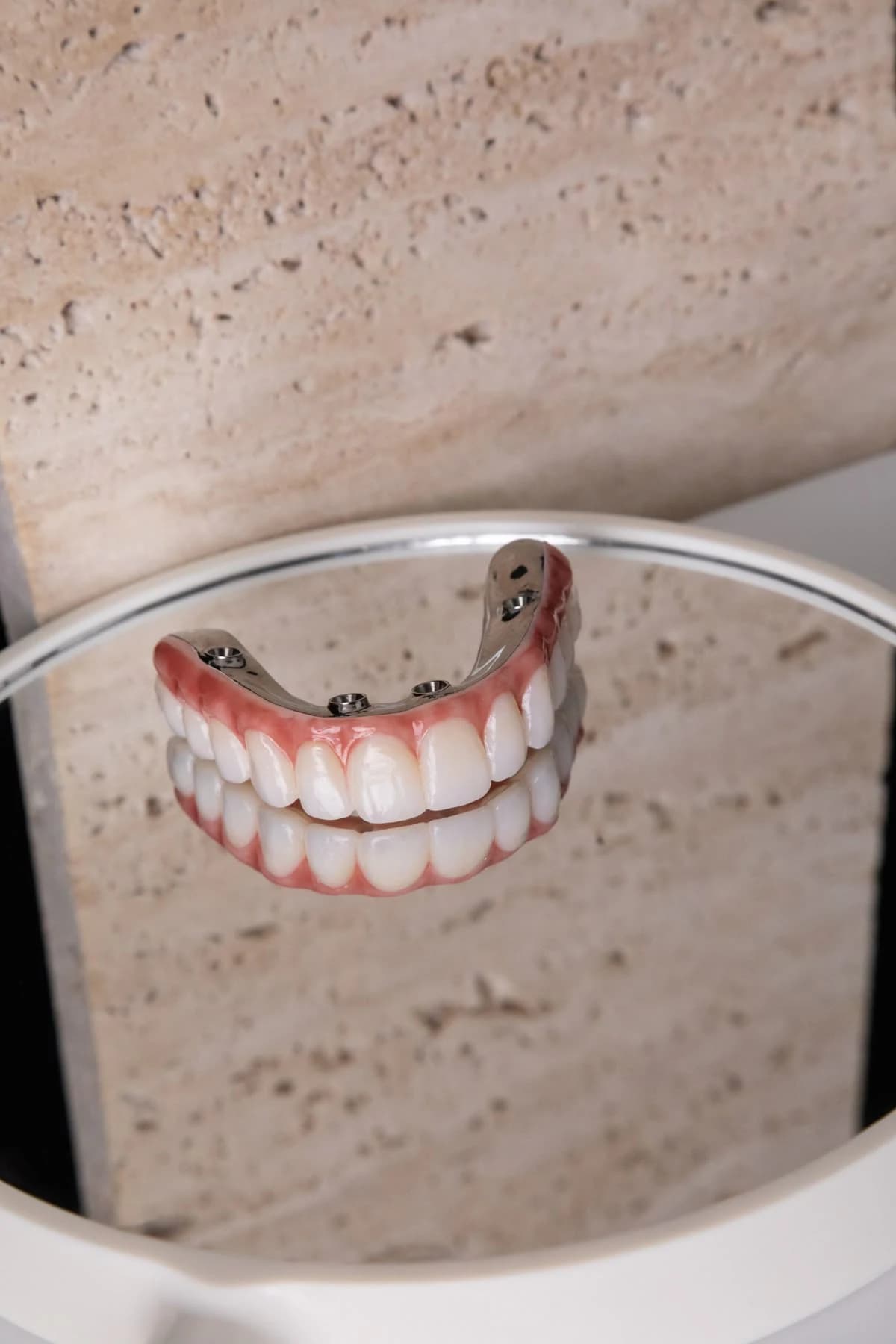
Two implants of the same material and shape can behave differently because of their surface. The first implants were machined smooth; modern implants are roughened at the microscopic level by blasting, etching or coating, which gives bone more surface to grow onto. A systematic review of surface topography concluded that surface texture at the micrometer level clearly influences how bone responds, while cautioning that many studies described their surfaces poorly.
The practical consequence shows up in long-term results. A ten-year study of 511 titanium implants with a sandblasted, acid-etched surface reported 98.8% survival and 97.0% success. Surface treatments such as hydroxyapatite and calcium-phosphate coatings are also used where bone quality is compromised. For a patient, the useful question is not the surface's brand name but whether the implant system has long-term published data — which is one reason we work with the Nobel Biocare, Straumann and Zimmer Biomet systems, all of which do.
Size and shape: standard, narrow, mini and short implants
Standard implants are roughly 3.5 to 5 mm wide and 8 to 13 mm long, and they carry most single teeth and bridges. Narrow implants, typically around 3 to 3.5 mm, fit thin ridges and small spaces such as lower front teeth. Mini implants, generally under 3 mm, are a different tool: they are most often used to hold a lower denture in place. A systematic review of 1,715 mini implants supporting lower overdentures reported 95.6% survival over a mean of about 28 months. They can be a reasonable way to stabilize a denture, but they are not a like-for-like substitute for standard implants supporting fixed teeth under heavy chewing forces.
Short and extra-short implants, 6 mm or less, have changed how bone loss is managed. A 2019 meta-analysis of randomized trials found no significant difference in survival between extra-short and longer implants at one and three years, with less bone loss, fewer biological complications, shorter surgery and lower cost for the short ones. In the upper back jaw, that can sometimes replace a sinus lift; in the lower back jaw, it can avoid working close to the nerve. The limit is the length of follow-up, which our research review on short implants versus grafting discusses in detail.
Design details that affect maintenance: connection and retention
Two-piece implants have a separate abutment — the connector between the implant and the tooth — and the joint between them is either internal (a conical or hexagonal connection inside the implant) or external. Bone-level implants sit at the level of the bone; tissue-level implants have a polished collar that rises through the gum. Each design suits certain situations, and a well-planned case uses whichever fits the site, the gum thickness and the restoration.
How the tooth attaches matters as much to you as the implant does. A cement-retained crown is glued onto the abutment; a screw-retained crown is fastened with a small screw and can be removed and reattached. Removable access makes repairs simpler, and it avoids a specific risk: in one endoscopic study, excess cement was found at 81% of implants with peri-implant disease, and inflammation resolved at most of those sites once the cement was removed. We generally prefer screw-retained restorations for that reason.
What it carries, and when
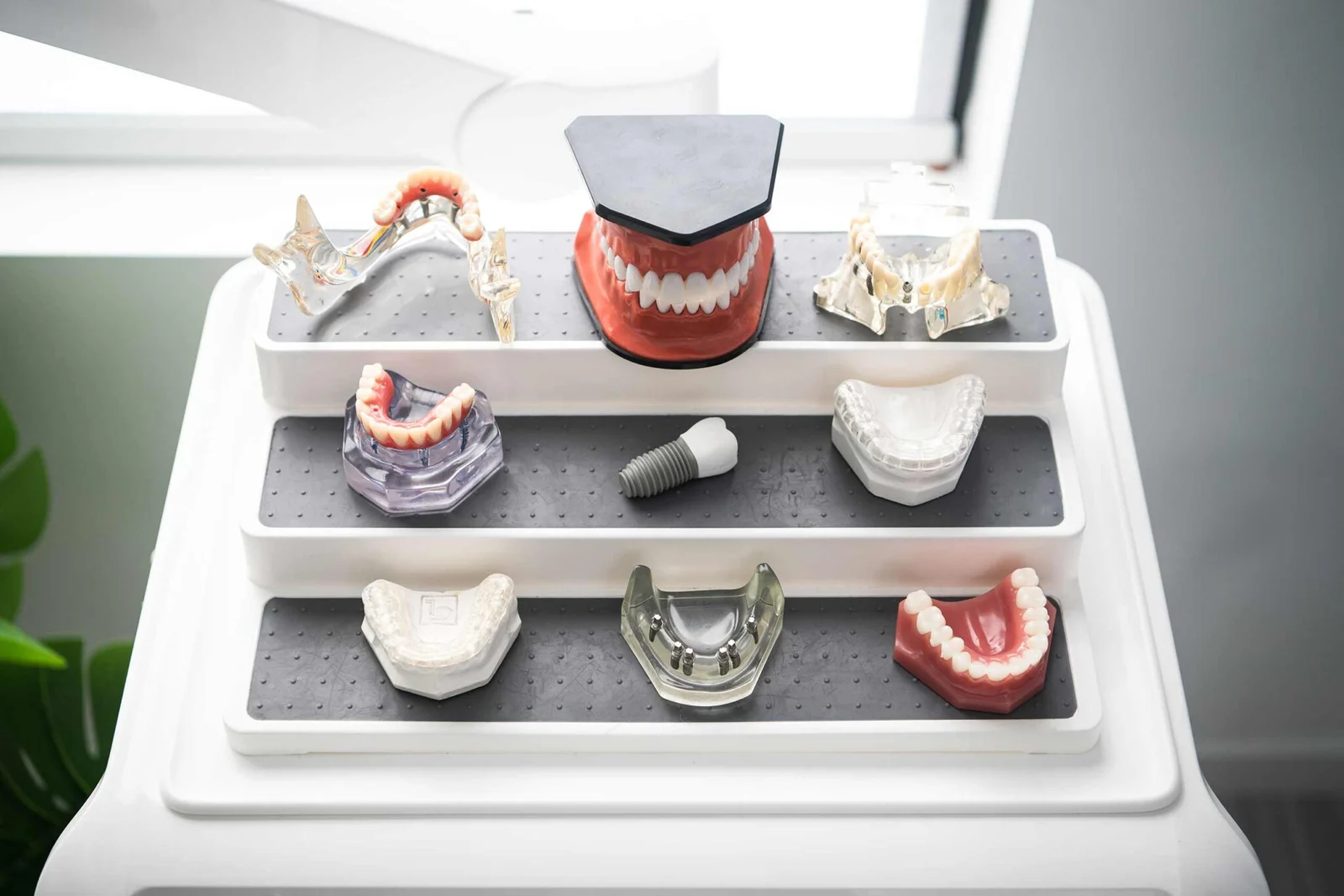
The last question is the restoration. One implant can carry one crown. Two or more implants can carry a bridge spanning several missing teeth. For a whole jaw, implants can hold a removable overdenture that clips on, or fixed full-arch teeth that stay in and are removed only by the dentist. Fixed full-arch designs are named by the number of implants: All-on-4 uses four, often with the back two tilted to avoid the sinus or nerve, and the All-on-8 Robust protocol Dr. Sam Jain developed uses more implants to spread the load — we place the number your bone and bite need.
Timing is its own set of choices. An implant can be placed immediately into an extraction socket, a few weeks later, or after the site has healed for months; it can carry a tooth the same day or only after it has integrated. A 2018 systematic review of placement and loading protocols in partially missing teeth reported survival between 96.0% and 100% across the combinations studied, while grading some combinations as better documented than others. What decides the timing is whether the implant is firmly held at insertion, which our research review on immediate loading explains. In qualifying single- and multiple-implant cases, our in-house lab can deliver final teeth in about 24 hours; full-arch patients typically receive their final custom-milled teeth in about 72 hours.
How we choose among them for you
Every recommendation starts with a 3D CBCT scan, which shows the height, width and density of bone, the position of the sinus and nerves, and the thickness of the gum — the measurements that rule designs in or out. Dr. Jain's training in mechanical engineering shapes how the bite forces are planned; the material is matched to those measurements and to your preferences; and the final teeth are designed and milled in our own lab.
You leave the consultation with the reasoning as well as the recommendation: which implant, at which site, in which material, carrying which restoration, and what it costs — in writing. If you are weighing options you have been given elsewhere, bring them. The best way to understand the types of implants is to see which ones your own scan allows, and you can book a consultation with a 3D scan here.
Written and medically reviewed by Dr. Sam Jain, DMD, MS, and Dr. Arpana Gupta, DDS, MDS, who own this practice. Reviewed
This article is patient education, reviewed by Dr. Sam Jain, DMD, MS, and Dr. Arpana Gupta, DDS, MDS, and is not a substitute for an exam. Treatment recommendations are made only after an in-person consultation and 3D imaging.