Immediate Loading: The Evidence for Teeth on the Day of Surgery
Brånemark's rule was three to six months without load. The literature now supports loading on the day of surgery — under conditions that are specific, measurable and not negotiable.

Written and medically reviewed by Dr. Sam Jain, DMD, MS, and Dr. Arpana Gupta, DDS, MDS
Published
From a rule of months to a question of movement
The original protocol from Gothenburg was unambiguous. Adell's 1981 report of fifteen years of osseointegrated implants named a long, load-free healing period as one of the three conditions for success, alongside gentle surgery and sensible load distribution. For two decades that meant three to six months of an implant sitting under the gum with nothing attached to it, and a patient wearing a denture over the top. The rule was not arbitrary; it was what had worked in the series that made the treatment credible, and nobody wanted to be the surgeon who broke it.
The rule began to be questioned properly in 1998, when Szmukler-Moncler and colleagues reviewed the experimental literature to see whether the load-free period was actually supported by it. Their conclusion reframed the question. Early loading in itself was not found to be detrimental. What caused fibrous encapsulation — the soft-tissue sleeve that is the histological signature of failure — was excessive micromotion at the bone-implant interface. The threshold was not zero; it lay between 50 and 150 microns. The implication was that an implant could carry load from day one, provided it did not move more than that while the bone remodelled around it. The rule of months became a rule of microns.
The question then became how to know, at the chair, whether an implant will stay under the threshold. Ottoni's 2005 randomized trial supplied the answer that is still used. Forty-six single implants in 23 patients were placed with a minimum insertion torque of 20 Ncm; one in each patient received a provisional crown within 24 hours and the other healed conventionally. Ten of the immediately restored implants failed, nine of them placed at exactly that minimum torque, against one failure in the conventional group. Each additional 9.8 Ncm of insertion torque reduced the relative risk of failure by about 20%. Torque became the number that decides.
Full arches: where the evidence is strongest
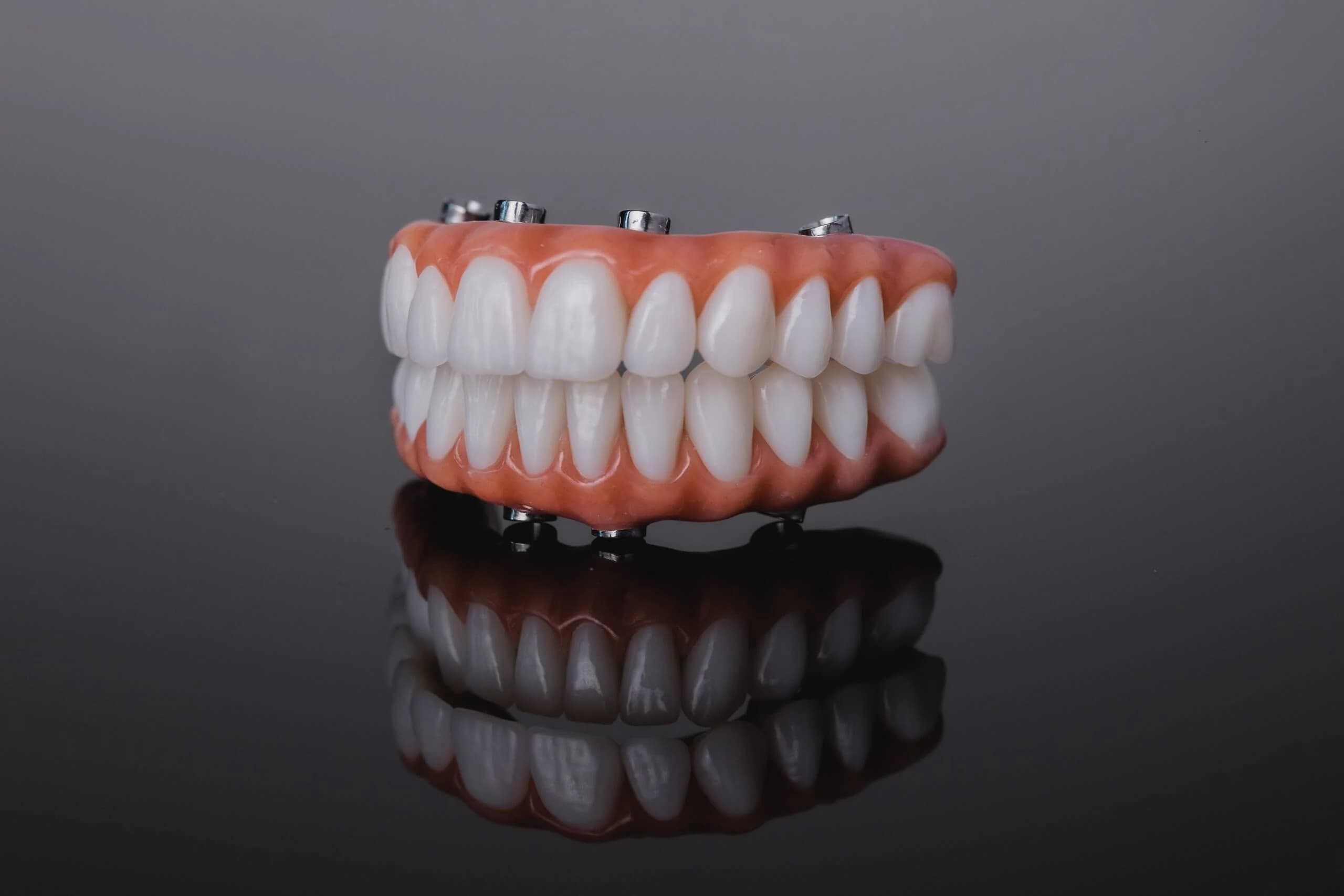
The completely toothless jaw is where immediate loading has its deepest evidence base, for a mechanical reason: several implants joined by a rigid bridge share load and restrain one another, so each implant's micromotion is held down by the others. Maló's 2003 paper, the origin of the All-on-4 concept, reported 44 patients with 176 implants placed in the front of the lower jaw and loaded with a fixed acrylic bridge within two hours. Five implants were lost before the six-month review, for cumulative survival of 96.7% in the development group and 98.2% in the routine group; no prosthesis was lost. It was a retrospective series from one clinic, and it needed the reviews that followed.
Papaspyridakos and colleagues provided the most comprehensive of them in 2014. Sixty-two studies — four randomized trials, two case-control studies, 34 prospective and 22 retrospective cohorts — yielded 2,695 patients, 2,757 edentulous arches and 13,653 rough-surface implants. Forty-five of the studies dealt with immediate loading. With conventional open-flap surgery, immediately loaded implants survived at between 90.1% and 100% and prostheses at between 93.75% and 100% over one to ten years; early loading and conventional loading produced the same ranges. Estimated one-year implant survival exceeded 99% with all three protocols, with no difference between upper and lower jaws. Most of the included studies recommended a minimum insertion torque of 30 Ncm. The authors' conclusion, with the caveats a good review carries, was that in carefully selected cases immediate loading of fixed full-arch prostheses produces survival equivalent to waiting.
Two other reviews sit alongside it. Del Fabbro's 2006 systematic review of 10,491 immediately loaded implants in 2,977 patients found overall survival of 96.39%, best documented for the edentulous lower jaw and for single crowns in the upper jaw, with rough surfaces outperforming machined ones in every category and 97.1% of failures occurring within the first twelve months. And the 2013 Cochrane review by Esposito's group is the skeptical reference. It pooled 26 randomized trials, 1,217 participants and 2,120 implants followed for four months to a year; only three trials were at low risk of bias, and the mean implant failure rate across all of them was 2.5%. Across the fifteen trials comparing immediate with conventional loading there was no evidence of a difference in prosthesis failure or implant failure in the first year, and a very small reduction in bone loss favoring immediate loading — 0.10 mm — that the authors doubted was clinically important. The review stopped short of declaring the protocols equivalent, because the trials were too small and too short to prove it. I quote all three because a patient deserves the range, not the best line.
Single teeth and partial cases: the picture is more conditional
For a single implant with no neighbours to share the load, the question is harder, and the 2018 ITI systematic review by Gallucci, Hamilton, Zhou, Buser and Chen is the right place to look. It classified every combination of placement timing and loading timing in partially edentulous patients and weighted the survival figures from 69 publications by follow-up and implant count. Immediate placement into an extraction socket with immediate loading — the true same-day tooth — had a weighted survival of 98.4%. Immediate placement with conventional loading had 96.0%. Placement into healed bone with immediate loading had 97.9%, and with conventional loading 97.7%. Every figure is high. The difference between them is in how much evidence sits behind each: the review rated conventional loading after immediate, early or late placement as scientifically and clinically validated, and immediate loading after immediate or late placement as clinically documented — a grade lower, reflecting fewer and shorter studies rather than worse numbers.
The socket itself carries a cost that has nothing to do with loading. Chrcanovic's 2015 meta-analysis of 73 studies compared 8,241 implants placed into fresh extraction sockets with 19,410 placed into healed sites: failure rates of 4.00% and 3.09%, a relative risk of 1.58. Lang's 2012 review of 46 prospective studies of immediate placement found an annual failure rate of 0.82%, a two-year survival of 98.4%, and — the finding that surprised me when I first read it — that a course of post-operative antibiotics was the only one of five factors examined that significantly affected survival. In the front of the upper jaw the cost is aesthetic: Chen and Buser's 2014 review found recession of the gum margin of more than 1 mm at between 9% and 41% of immediately placed single implants, with a median of 26%, against none in the two studies of early placement, and found the facial bone wall undetectable on a scan in 36% and 57% of immediately placed sites in two studies. Immediate placement in the smile zone is not wrong. It is a technique for thick tissue and an intact socket wall, and the review says so.
The 2018 ITI consensus statement by Morton and colleagues drew the practical line: placement and loading protocols must be chosen together, not separately. A same-day tooth in a back socket with high torque and no neighbours to protect the site is a different proposition from the same procedure in a thin-tissued front socket, and a surgeon who quotes the 98.4% figure without the second half of that sentence is quoting it wrongly.
The conditions under which I load on the day
Everything above collapses into a short checklist that is applied at surgery, not at the consultation, because the decisive numbers do not exist until the implant is in. Insertion torque must reach my threshold — the literature's floor is 30 Ncm and I plan for more — on every implant that will carry the provisional. For a full arch, the provisional is rigid and joined across the whole arch, with no cantilever extending past the last implant, so that each implant restrains the others. For a single tooth, the provisional is shaped out of contact with the opposing teeth in every direction, so that it fills the space without receiving the bite. And the patient understands that a soft diet during the stability dip is not advice but a condition of the protocol.
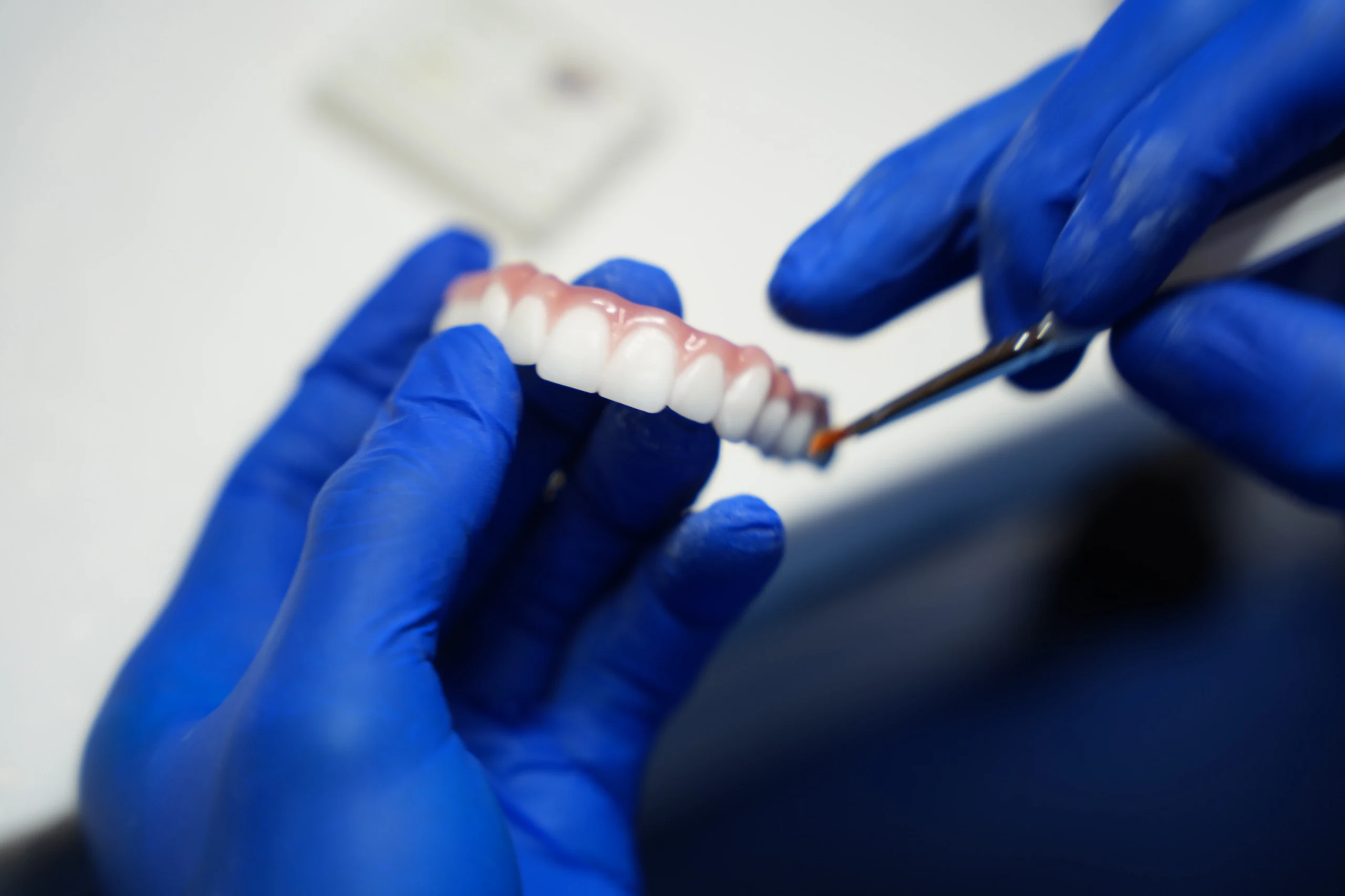
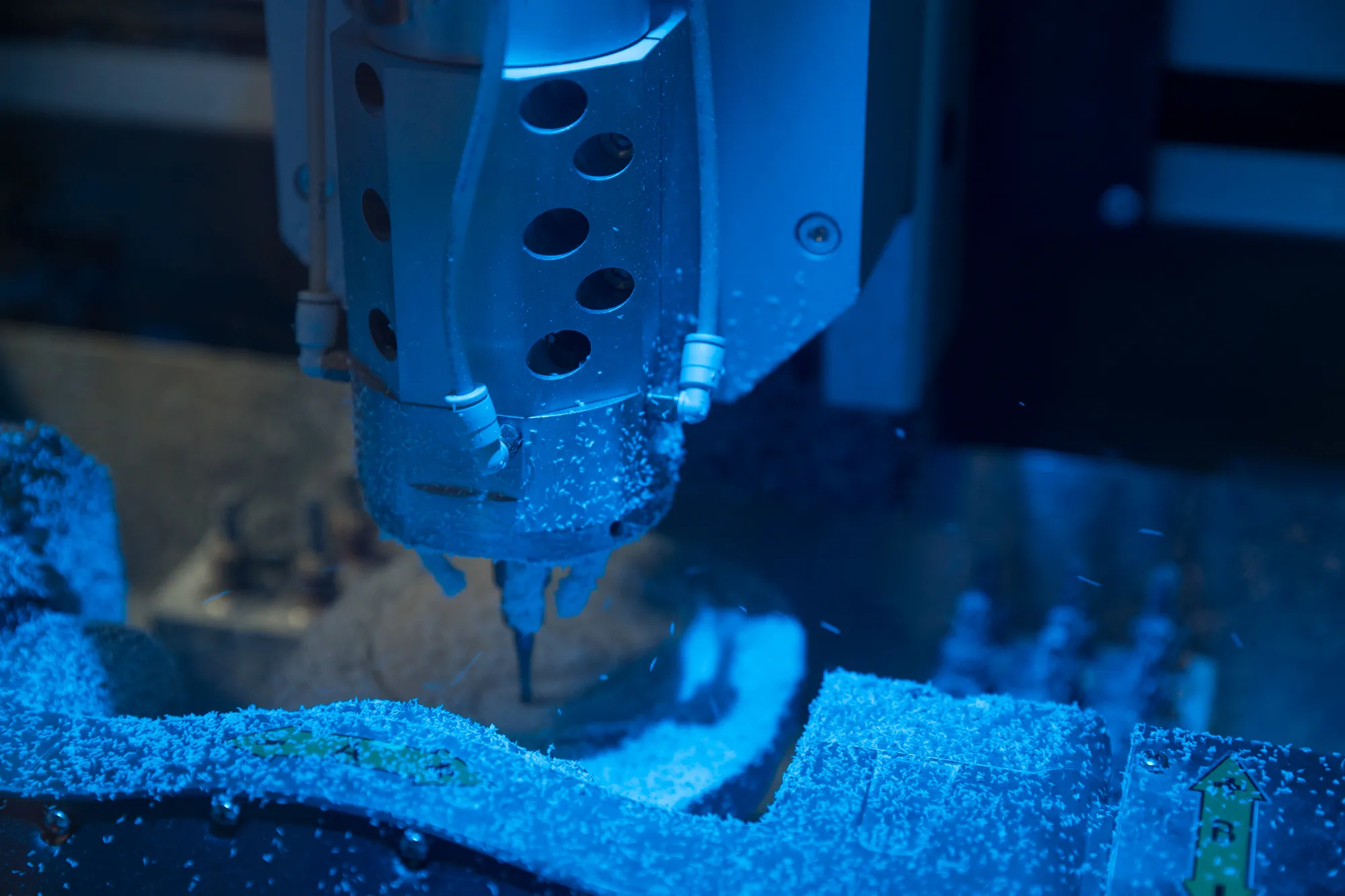
The exclusions are as specific as the inclusions. An implant that falls short of the torque threshold is submerged and left to heal, and the patient goes home with a provisional that is not attached to it — a change of plan that is explained before surgery as a possibility, so that it is never a surprise. Untreated bruxism is a reason to stage, because a grinder's overnight load on a healing implant is exactly the micromotion Szmukler-Moncler's threshold forbids. Heavy smoking, uncontrolled diabetes and a thin front-tooth socket each push a case toward staging for the reasons documented on their own pages. The provisional teeth themselves are milled in our own laboratory, which is what lets a full arch be delivered within the 72-hour window we describe and lets a single provisional be adjusted the same day rather than the same week.
Patients considering it can read how the same-day process works, who tends to qualify and what an extraction-and-implant appointment involves. The point of all three pages is the same as this one: the day-of-surgery tooth is a well-supported protocol under conditions that are measured, and a poorly supported one when the conditions are assumed.
What the evidence does not yet settle
The randomized evidence remains thinner than the cohort evidence, which is why Cochrane's caution has not been retired. Most trials are small, follow patients for a year or two, and come from experienced centers, so the true difference between protocols in ordinary hands over ten years is not known. Patient-reported outcomes — comfort, chewing, confidence — are the reason patients choose immediate loading, and they are measured far less often than survival. And for the front of the mouth, the long-term stability of the gum margin around an immediately placed implant remains the outcome that decides whether the technique was worth its convenience, and it needs longer studies than the one-to-three years Chen and Buser could find.
None of that changes my practice today, because the conditions under which immediate loading is well documented are the conditions under which I do it. The biology behind the thresholds is set out in the osseointegration review, and the long-term figures that frame every protocol are in the survival-rate review.
Written and medically reviewed by Dr. Sam Jain, DMD, MS, and Dr. Arpana Gupta, DDS, MDS, who own this practice. Reviewed
This article is patient education, reviewed by Dr. Sam Jain, DMD, MS, and Dr. Arpana Gupta, DDS, MDS, and is not a substitute for an exam. Treatment recommendations are made only after an in-person consultation and 3D imaging.