Guided, Navigated or Robotic: How Accurately Can an Implant Actually Be Placed?
Every system claims precision. The meta-analyses put numbers on it — and the numbers say a two-millimeter safety margin is still the rule, whichever screen the surgeon is looking at.
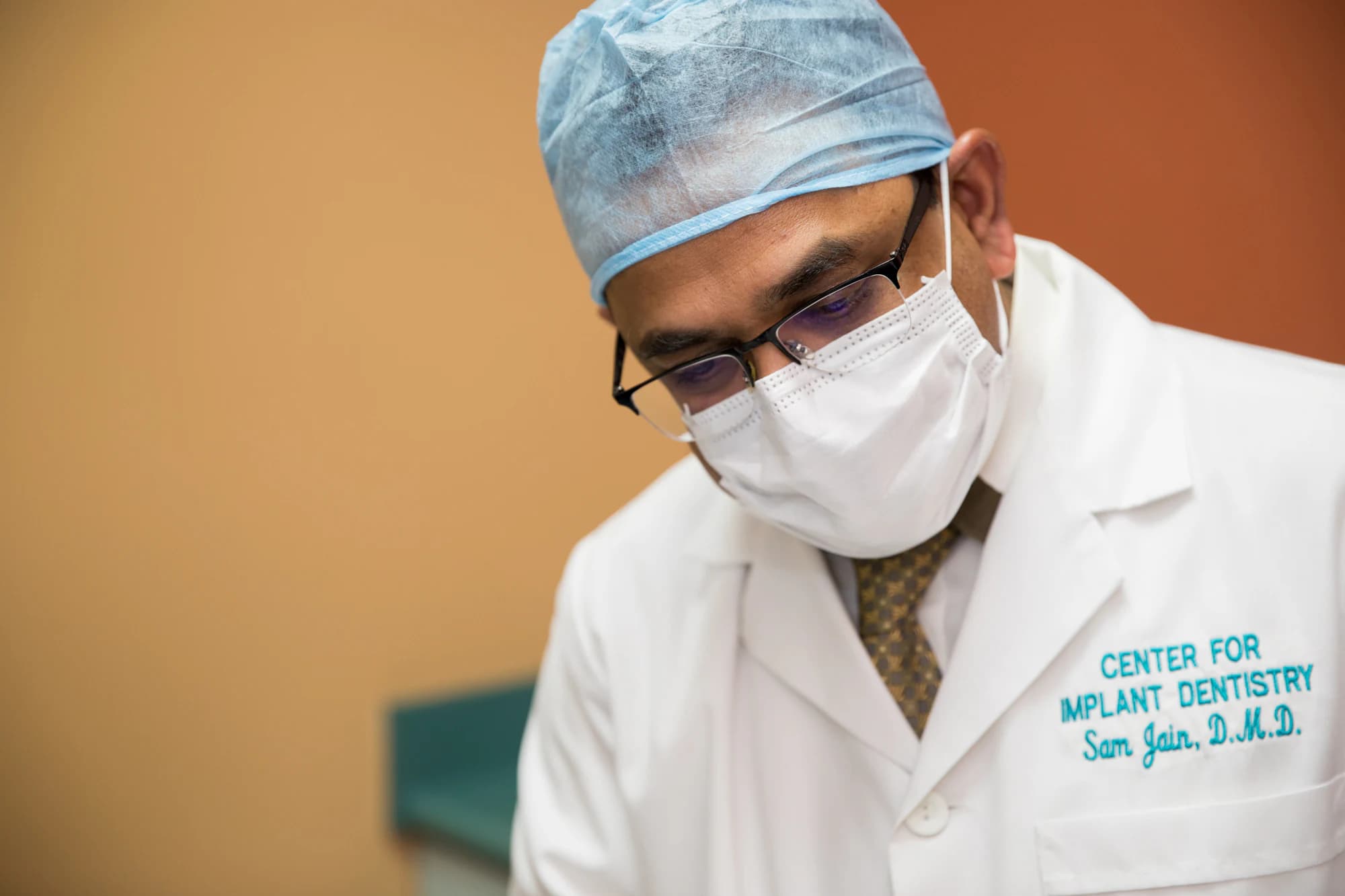

Written and medically reviewed by Dr. Sam Jain, DMD, MS, and Dr. Arpana Gupta, DDS, MDS
Published
Why a millimeter matters
An implant is planned in three dimensions against structures that do not forgive: the nerve canal in the lower jaw, the sinus floor in the upper, the roots of neighbouring teeth, and the thin plate of bone on the cheek side that decides whether the gum will stay where it is. It is also planned against a tooth that does not exist yet. The crown that will eventually sit on the implant has an ideal position, and every degree the implant tilts away from it is a compromise the laboratory has to absorb with an angled abutment or a thicker bridge. Accuracy, in other words, is not a luxury; it is the difference between a restoration that was designed and one that was improvised.
All of the technologies in this article begin with the same thing: a cone-beam CT scan on which the implant is planned virtually. Bornstein's 2014 systematic review of CBCT in implant dentistry is worth reading before the accuracy papers, because it makes a point that gets lost in the enthusiasm. The effective radiation dose across different CBCT machines varied by a factor of nearly a hundred, and reducing the field of view to the region that actually matters produced significant dose reductions. A scan is justified when it changes the plan. A second scan after surgery, which is how every accuracy study measures its result, is not something I order routinely on a patient just to admire the fit.
The measurements the studies report are the same across all of them and are worth learning. Entry deviation is the distance, in millimeters, between where the implant's platform was planned and where it ended up. Apical deviation is the same for the tip of the implant, and it is usually larger because a small angle at the top becomes a bigger displacement at the bottom. Angular deviation is the difference, in degrees, between the planned and the actual long axis. When I quote a number below, it is a mean across many implants; the maximum in the same study is often several times larger, and the maximum is what the safety margin exists for.

Static guides: fifteen years of meta-analyses
A static guide is a printed or milled template, seated on the teeth, the gum or the bone, with metal sleeves that constrain the drill to the planned path. Jung's 2009 review for the ITI, pooling 19 accuracy studies across 29 systems, reported a mean error of 0.74 mm at the entry point and 0.85 mm at the apex — with maxima of 4.5 mm and 7.1 mm. Schneider's review the same year, restricted to eight clinical accuracy studies, found 1.07 mm at the entry and 1.63 mm at the apex, and documented the price of the technology in its early years: early surgical complications in 9.1% of cases, early prosthetic complications in 18.8%, and late prosthetic complications in 12%.
Tahmaseb's two reviews, five years apart, show the field settling. The 2014 analysis of 24 accuracy studies and 1,530 implants found 1.12 mm at the entry point and 1.39 mm at the apex, a mean implant failure rate of 2.7% across 14 survival studies, and intraoperative or prosthetic complications in 36.4% of treated cases — template fractures during surgery, plans changed because of poor primary stability, unexpected grafting, screw loosening and misfit among them. The 2018 update, based on 20 clinical studies of 2,238 implants in 471 patients, found 1.2 mm at the entry, 1.4 mm at the apex and 3.5 degrees of angular deviation, with significantly better accuracy in partially edentulous patients — where the guide can rest on teeth — than in fully edentulous ones, where it rests on gum or bone. Its conclusion is the sentence I keep in mind: accuracy is within the clinically acceptable range in most situations, and a safety margin of at least 2 mm should be respected.
The one randomized trial that compares guided surgery with a surgeon's judgment in the same patients is Vercruyssen's, from 2014. Seventy-two fully edentulous jaws in 59 patients, each needing four to six implants, were randomized to one of four guided systems, to freehand placement by a surgeon holding the plan in mind, or to a simple pilot-drill template. The guided systems achieved a mean entry deviation of 1.4 mm, an apical deviation of 1.6 mm and an angular deviation of 3.0 degrees. Freehand placement produced 2.7 mm, 2.9 mm and 9.9 degrees; the pilot template produced 3.0 mm, 3.4 mm and 8.4 degrees. Whether the guide rested on bone or on gum made no measurable difference. That trial is the cleanest evidence that guidance is not a marketing feature: it roughly halves the positional error and cuts the angular error by two-thirds against an experienced surgeon's eye.
Dynamic navigation: seeing the drill in the scan
Dynamic navigation replaces the physical template with a screen. A tracking array is attached to the patient and another to the handpiece, and the surgeon watches the drill move through the CBCT volume in real time, with the planned position shown as a target. It removes the guide's weaknesses — no sleeve to limit irrigation or access at the back of the mouth, no fracture, no manufacturing delay, and the plan can be changed during surgery — at the cost of a learning curve and a dependency on the tracking staying registered. Block's 2017 prospective study of three surgeons using the X-Guide system found deviations from the virtual plan similar to those published for tooth-borne static guides, better accuracy than freehand placement, and a learning curve: proficiency, measured as stable accuracy, arrived by about the twentieth case.
Jorba-García's 2021 meta-analysis of 24 studies across nine navigation systems put clinical numbers on it: a mean angular deviation of 3.68 degrees and a mean entry deviation of 1.03 mm, with no significant differences between systems. Against static guides, navigation was slightly more accurate in angle, by 0.86 degrees on average; against freehand placement, it was more accurate by 4.33 degrees. The review's clinical note is the same as Tahmaseb's: deviations above 1 mm were observed, so a 2 mm safety margin still applies. Laboratory studies on models reported better figures — about 2 degrees and 0.46 mm — which is a reminder that a jaw with a tongue, saliva and a breathing patient is not a model.
The most recent synthesis is Werny's 2025 meta-analysis of 55 studies, which lined every approach up on the same three measures. Freehand placement: 7.46 degrees, 1.56 mm at the entry, 2.22 mm at the apex. A pilot-drill guide that constrains only the first drill: 5.94 degrees, 1.13 mm and 1.43 mm. A fully guided static template that constrains every drill and the implant itself: 2.57 degrees, 0.72 mm and 0.88 mm. Dynamic navigation: 3.67 degrees, 1.01 mm and 1.36 mm. The authors concluded that both static and dynamic guidance improve markedly on freehand surgery, that fully guided static surgery produced the highest accuracy in their data, and that apical deviations of one to two millimeters mean the 2 mm safety margin remains mandatory for all of them.
Robots: the newest entrant, with the smallest numbers
A surgical robot holds the handpiece in an articulated arm and constrains it to the planned path physically, while the surgeon guides it by feel; some systems also drive the osteotomy autonomously. Khaohoen's 2024 meta-analysis of 67 clinical studies is the first to place static, dynamic and robotic systems side by side. Across all computer-assisted approaches, mean deviation was 1.11 mm at the entry, 1.40 mm at the apex and 3.51 degrees. The robotic subgroup showed the lowest figures: 0.81 mm at the entry, 0.77 mm at the apex and 1.71 degrees. The review also confirmed, across static guidance, that a fully guided protocol is significantly more accurate than a pilot-only one and no different from a partially guided one, and found no difference in navigation accuracy between upper and lower jaws or between flap and flapless surgery.
The robotic data, however, are early and small. Bolding and Reebye's 2022 study, the first clinical accuracy report for a haptic robot in completely edentulous arches, involved five patients and 38 implants. It found a mean angular deviation of 2.56 degrees, a platform deviation of 1.04 mm, an apical deviation of 0.95 mm, and implants sitting on average 0.42 mm shallower than planned, with no adverse events. Those are good numbers from a careful team. They are also 38 implants, and the authors themselves called for longer and larger studies before differences from non-robotic methods can be claimed. A meta-analysis subgroup built on a handful of such series inherits their promise.
My reading is that robots are a genuine step in the same direction rather than a different kind of thing. They remove the surgeon's hand tremor and enforce the planned path in a way navigation only displays. What they cannot yet do is remove registration error — the mismatch between the scan and the patient on the day — and in an edentulous jaw, where the reference splint must be fixed to bone, that error is the one that matters. The technology I will adopt is the one whose ten-year outcome data exist, and for robots that data does not yet exist.
How I choose between them for a given case
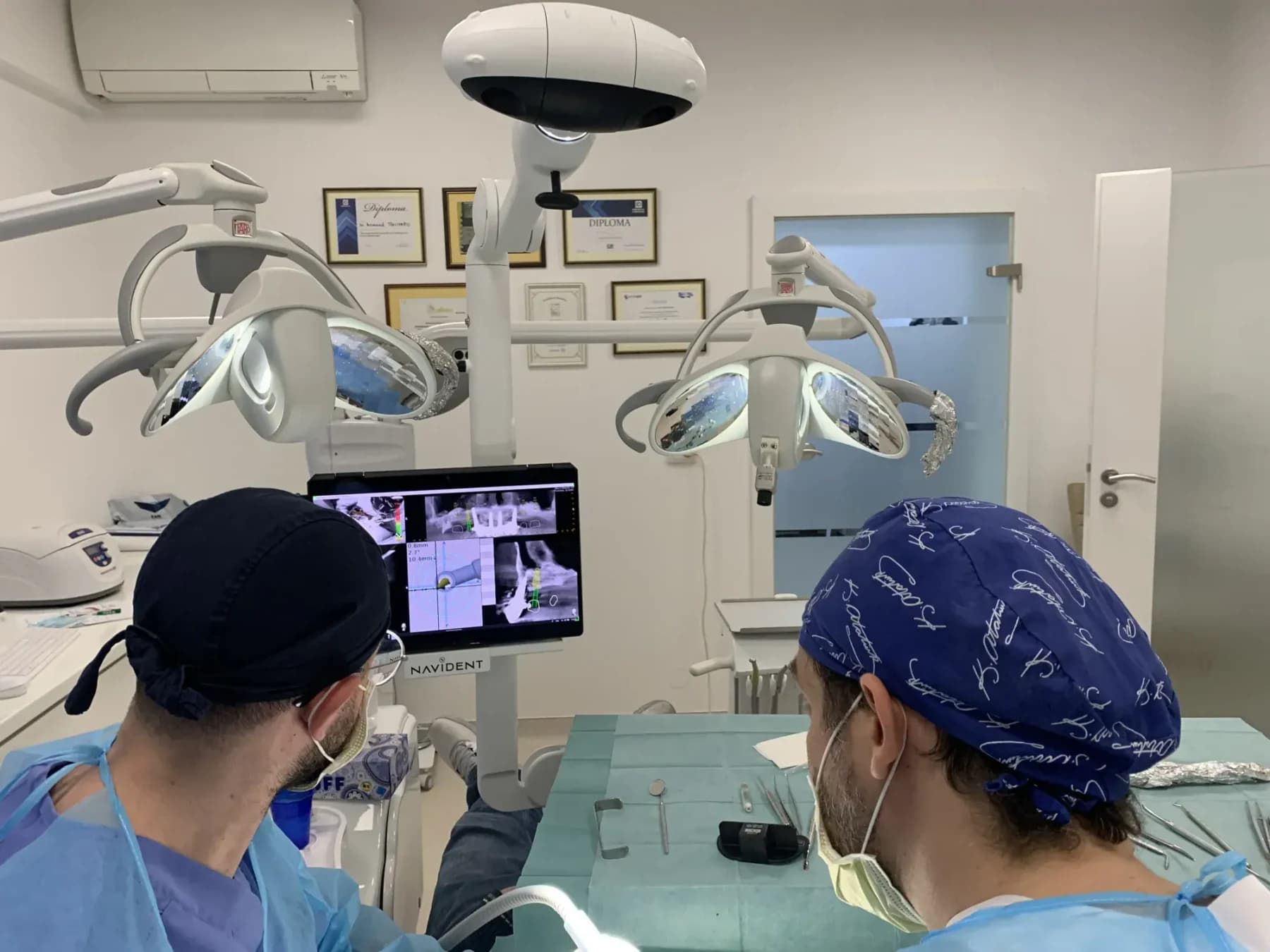
Two dynamic navigation systems are in daily use in our operating rooms, X-Guide and Navident EVO, and printed static guides are made in-house for the cases that suit them. The decision follows the evidence above. For a full arch in an edentulous jaw, where Tahmaseb's data show static guides at their least accurate because there are no teeth to seat them on, I favor navigation registered to bone-fixed markers, with the plan adjustable if the bone turns out softer or thinner than the scan suggested. For a single implant between healthy teeth, a tooth-borne fully guided template is as accurate as anything published and adds nothing to surgical time. For the back of the mouth in a patient who cannot open widely, a template with its stack of sleeves may not physically fit, and navigation wins by default.
Freehand placement — the 7.46-degree, 2.22-mm-at-the-apex option in Werny's table — is reserved for the few situations where neither technology can be registered reliably, and even then the plan on the screen remains the reference. What matters more than the choice of system is the discipline around it: a CBCT with a field of view matched to the region, a virtual plan that starts from the tooth and works backwards to the implant, a 2 mm margin from every structure that cannot be touched, and a post-placement check when the anatomy warranted it. Patients who want to see how this fits into a surgical day can read the hour-by-hour account of a full-arch surgery.
One more number belongs in this section. Block's study found that dynamic navigation reached stable accuracy at around the twentieth case. Every system has a version of that curve, and it is worth asking any surgeon who describes their technology how many cases they have done with it. The accuracy in the meta-analyses belongs to operators past the curve, not to the machine.
What is unresolved
Accuracy is a surrogate. No trial has yet shown that a 1 mm implant is a longer-lived implant than a 2 mm one, and Tahmaseb's 2014 review closed with the question the field still owes an answer to: long-term data are needed to justify the extra radiation, effort and cost of computer-assisted surgery in each indication. Guided surgery's own complication rates — the template fractures and plan changes reported in over a third of cases in that review — have fallen with better materials and workflows, but they are a reminder that a technology can be accurate and still add risk of its own.
The robotic literature needs randomized comparisons against navigation and static guidance in the same hands, longer follow-up, and honest reporting of registration failures. Navigation needs simpler, more robust registration for edentulous jaws. And every accuracy study would benefit from reporting the maximum deviation as prominently as the mean, because the mean is what the brochure prints and the maximum is what the safety margin has to cover. The reasons an implant fails after it has been placed accurately are covered in the survival-rate review; the biology that happens after the drill stops is in the osseointegration review.
Written and medically reviewed by Dr. Sam Jain, DMD, MS, and Dr. Arpana Gupta, DDS, MDS, who own this practice. Reviewed
This article is patient education, reviewed by Dr. Sam Jain, DMD, MS, and Dr. Arpana Gupta, DDS, MDS, and is not a substitute for an exam. Treatment recommendations are made only after an in-person consultation and 3D imaging.