How Long Do All-on-4 Dental Implants Last?
There are two clocks running on every All-on-4 case — the titanium in your jaw and the teeth on top — and knowing which is which explains the whole lifespan question.


Written and medically reviewed by Dr. Sam Jain, DMD, MS, and Dr. Arpana Gupta, DDS, MDS
Published · Updated

Two Different Clocks
For most patients, the four titanium implants that anchor an All-on-4 last 20 years or more — and often the rest of your life. The bridge of teeth attached to them is a separate, replaceable part that typically lasts 10 to 20 years depending on what it's made of. So when someone asks how long All-on-4 lasts, the accurate split is: the foundation is usually permanent; the visible teeth are a wearing part you may refresh once over the decades, the way a car outlasts its tires.
That distinction matters more than any single number. Long-term studies back it up — research following All-on-4 patients has reported implant survival in the mid-90-percent range at 10 years, and one retrospective series found roughly 96% of implants still in service at a mean of 15 years. Those are the metal posts. The teeth on top follow their own timeline, and that's the part your daily habits and material choice actually control.
None of this is a promise for your specific mouth — bone quality, bite force, and health history all move the number, and your surgeon will give you a realistic estimate after seeing your 3D scan. But the framing holds for almost everyone: plan for the implants to stay, and budget for the teeth to be serviced.
Why the Implants Themselves Can Last Decades
The titanium fixtures fuse directly to your jawbone in a process called osseointegration — living bone grows into the surface of the implant and grips it like a natural root. Once that bond forms in the first few months, it doesn't wear out with age. A well-integrated implant at year one is, mechanically, about as sound at year twenty. That's why the fixtures so often outlast every other component.
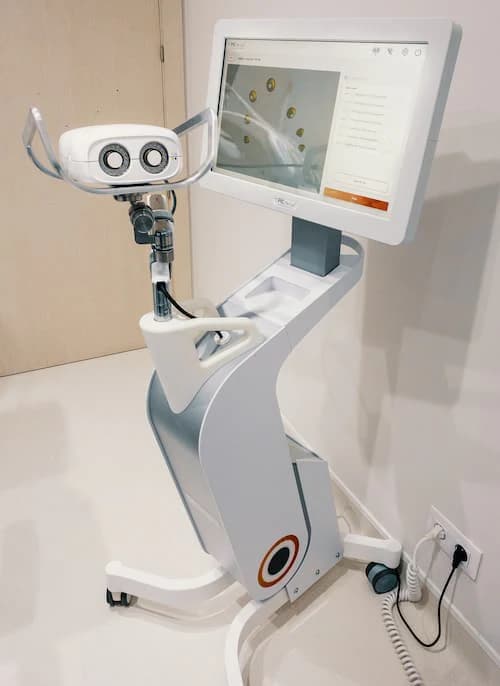
What decides whether they reach that point is largely how they were placed. Angle, depth, and how the four implants share your bite load are engineering problems as much as surgical ones — and getting them wrong is what causes the small percentage of failures the studies record. At our center, cases are planned in 3D on a free CBCT scan and placed with guided-surgery systems (X-Guide and Navident EVO) so the implant goes exactly where the plan says. Dr. Sam Jain, who holds a master's in mechanical engineering alongside his dental degree, treats load distribution as a structural calculation, not a guess. For patients with very little bone, that same thinking extends to zygomatic implants or bone grafting — options that let people keep a fixed arch instead of settling for a denture.
One more factor decides the fixtures' fate: the same surgeon should plan, place, and restore the case. When a fly-in surgeon places implants and disappears, no one owns the long-term result. Because our surgeons do all three steps and see you for follow-ups, the bite gets adjusted before an overloaded implant becomes a failed one.
Why the Teeth on Top Are the Part That Wears
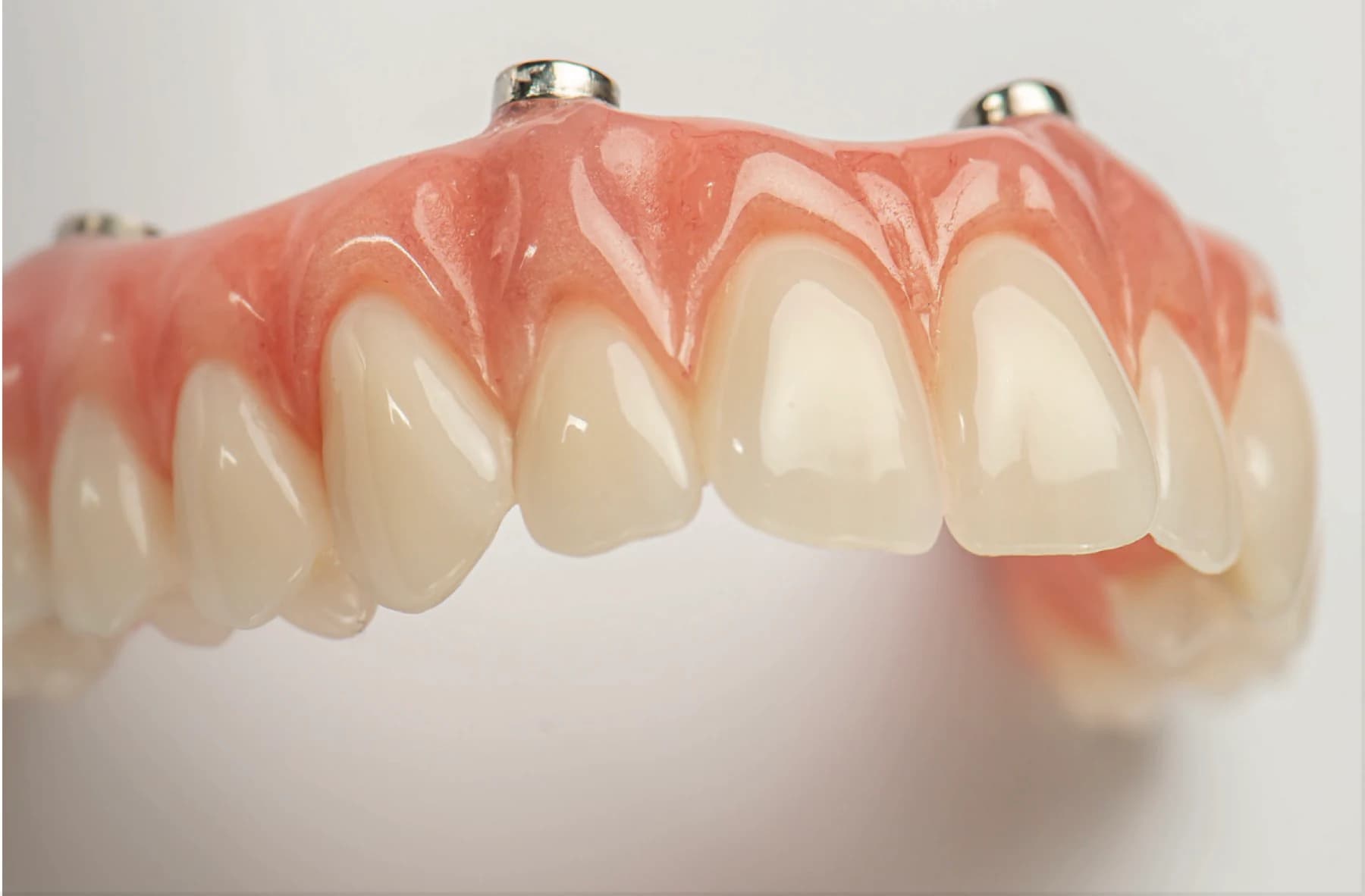
The bridge is where the material choice shows up in the lifespan. Acrylic-hybrid teeth — the common, less-expensive option — chew and look fine but are softer: they stain, wear down, and occasionally chip, so many patients replace or refurbish them somewhere around 10 to 15 years. Full-contour zirconia is a denser, glass-hard ceramic that resists staining and wear far better; clinical data on monolithic zirconia full-arch bridges shows survival near 98% out to roughly six years, and many last 15 to 20 years or beyond with good care.
This is where an in-house lab quietly changes the math. Most offices outsource the bridge and take whatever the outside lab sends. We mill final teeth on our own CAD/CAM mill, run by engineer Andy Jain, which means the material, the fit, and the bite are controlled under one roof — and if the bridge ever needs service years later, the shop that made it is the same one you walk back into. It's also why we can deliver custom-milled final teeth in about 72 hours for a full arch rather than leaving patients in temporary plastic for six to eight months. If you want the sturdiest version of the concept, ask about the All-on-8 Robust protocol Dr. Jain developed, which adds implants to spread the load and take pressure off any single post.
Because the teeth unscrew from the implants, replacing a worn bridge is straightforward and doesn't touch the foundation underneath. That's the whole point of the two-clock design: the expensive, permanent part stays put, and the wearing part is serviceable. Where this fits into the overall cost is a fair question to raise at your consultation — a zirconia bridge costs more upfront but usually stretches the interval before any rework.
What Actually Shortens (or Extends) the Lifespan
Time is rarely what ends an All-on-4 — biology and habits are. The leading cause of late failure is peri-implantitis, a gum-and-bone infection around the implant that's essentially gum disease's cousin; it's driven by plaque left at the gumline, and it can quietly erode the bone the implants depend on. Smoking is the other big lever — it meaningfully raises failure risk — and uncontrolled diabetes slows the healing and bone response that keep implants stable. None of these disqualify you from treatment, but they change the odds, which is why an honest candidacy assessment comes first.
The good news is that most of the longevity-shortening factors are the ones you can influence. Daily cleaning under the bridge, not skipping the hygiene visits that catch peri-implantitis early, wearing a nightguard if you grind, and returning for periodic bite checks are what carry an All-on-4 from a good decade into a great two or three. Compared with a traditional denture — which sits on shrinking gum and lets the jawbone continue to melt away — a fixed arch on implants actually preserves bone, one reason the implant-versus-denture math favors implants over the long run.
If you already have an arch that's failing — loose, painful, or done poorly somewhere else — that isn't automatically a lost cause either. Rescuing and rebuilding compromised full-arch work, including failing implants placed at other offices, is a routine part of what our center does. The lifespan clock can often be reset.
Written and medically reviewed by Dr. Sam Jain, DMD, MS, and Dr. Arpana Gupta, DDS, MDS, who own this practice.
This article is patient education, reviewed by Dr. Sam Jain, DMD, MS, and Dr. Arpana Gupta, DDS, MDS, and is not a substitute for an exam. Treatment recommendations are made only after an in-person consultation and 3D imaging.