The History of All-on-4 Dental Implants
A Portuguese surgeon and a hunch about geometry changed full-arch dentistry — here's where All-on-4 came from and how it became what it is today.
Written and medically reviewed by Dr. Sam Jain, DMD, MS, and Dr. Arpana Gupta, DDS, MDS
Published · Updated
Who Invented All-on-4, and When?
All-on-4 was developed by Dr. Paulo Maló, a Portuguese dentist and researcher, working in partnership with the Swedish implant company Nobel Biocare. A pilot study began in 1993, the working protocol took shape through the late 1990s (it's commonly dated to 1998), and the term "All-on-4" was formalized and trademarked in the early 2000s. Nobel Biocare then helped spread it worldwide from around 2004 onward. So when people ask who invented All-on-4, the short answer is Maló — with an implant maker funding the science and a good deal of clinical follow-up behind it.
Maló was solving a specific, stubborn problem. Patients who had lost most or all of their teeth often had very little jawbone left to anchor implants into, because bone shrinks once the tooth roots are gone. The standard fix at the time was to rebuild that bone with grafts and sinus lifts, then wait months, then place six, eight, or more implants per jaw. It worked, but it was slow, expensive, and hard on people who were already worn down by years of failing teeth or ill-fitting dentures.
His question was blunt: what's the fewest implants that can reliably hold a full, fixed set of teeth — and can we place them in the bone people already have, without grafting? The answer he arrived at was four.
The Idea Behind the Name: Why Four, and Why Angled
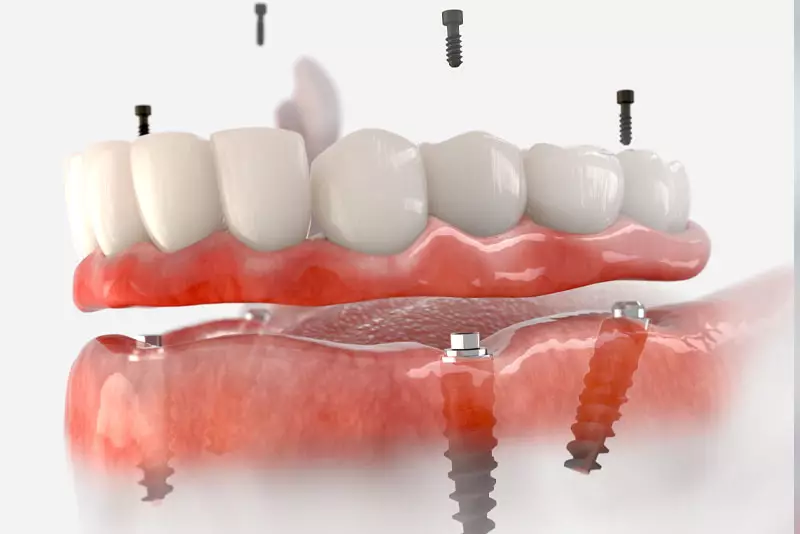
The breakthrough wasn't really the number four. It was the angle. Maló's protocol places two implants straight up-and-down at the front of the jaw, where bone tends to stay denser and more available, and two more tilted toward the back — historically up to about 45 degrees. That tilt is the whole trick.
Angling the rear implants does two things at once. It steers them clear of anatomy you don't want to hit — the maxillary sinus in the upper jaw and the nerve that runs through the lower jaw — which is exactly what used to force grafting. And it lets those implants engage more bone along a longer path, while spreading the four supports farther apart across the arch. A wider spread means the bite load is shared more evenly and the bridge on top flexes less. For a surgeon like Dr. Sam Jain, who holds an MS in mechanical engineering alongside his dental degree, that load geometry is the point: four well-placed implants can carry a full arch precisely because of where and how they're angled, not in spite of using fewer of them. You can see how that thinking plays out in a modern All-on-4 treatment.
This is why the technique matters historically. Before All-on-4, "not enough bone" often meant months of grafting or a flat refusal. Maló's geometry reframed the problem: use the bone that's there, more cleverly.
How the Protocol Evolved After Maló
The original protocol was a starting point, not a finish line. Over the past two decades it has been refined by the tools around it more than by the core idea, which has held up well. The single biggest change is planning. Early cases relied on 2D X-rays and a surgeon's judgment; today a 3D CBCT scan maps the exact bone, nerves, and sinuses before anyone touches the mouth, and computer-guided systems help place each implant on the planned path. That's the difference between estimating an angle and executing one — see our advanced dental technology page for the systems involved.
Materials and timing evolved too. Early full-arch teeth were acrylic and often stayed "temporary" for six to eight months while the implants fused, with the final teeth milled later. Modern zirconia is stronger and more lifelike, and in-house digital milling has compressed that timeline dramatically. At our center, because planning, surgery, sedation, and a CAD/CAM zirconia mill all sit under one roof, final custom-milled teeth for a full arch can be ready in about 72 hours rather than half a year of provisional plastic — the workflow is on our same-day dental implants page.
The concept also branched. When four implants genuinely can't find anchorage — severe upper-jaw bone loss, for instance — surgeons developed extensions of the same logic, like zygomatic implants that anchor into the cheekbone for people told they have "no bone." And for jaws with heavy bites or generous bone where more support is the smarter call, Dr. Jain developed the All-on-8 Robust protocol, adding implants for a sturdier foundation. The through-line from Maló's original insight is the same: match the number and angle of implants to the specific jaw, rather than forcing every case into one template.

Why This History Still Matters at the Chair
The reason the backstory is worth knowing is that it shapes what a good outcome depends on. All-on-4 was never a shortcut or a budget version of "real" implants — it's an engineering solution, and like any engineering solution, it lives or dies on precise planning and placement. Everything rides on four supports, so the angle, depth, and spacing of each implant carry more weight, not less. That's an argument for having the surgeon who plans the case also place the implants and design the teeth, which is how Dr. Sam Jain and Dr. Arpana Gupta, a married team of ICOI Masters, work — no fly-in surgeons handing your bite off to someone else. Our why choose us page lays out who does the work.
The clinical record has also earned the technique its reputation. Full-arch implant restorations built on this approach show high long-term survival — studies commonly cite figures around 95% over ten years — though your own results depend on your bite, your hygiene, your health, and honest maintenance, and your doctor will give you a realistic picture for your mouth. Two-plus decades of follow-up is a big part of why All-on-4 went from one surgeon's idea to a mainstream standard. If you're weighing your own options, the most useful next step isn't more reading about history — it's a look at your actual jaw. A free consultation with a 3D CBCT scan (a $499 value) is where a plan for your case actually starts; you can schedule a consultation when you're ready.
Written and medically reviewed by Dr. Sam Jain, DMD, MS, and Dr. Arpana Gupta, DDS, MDS, who own this practice.
This article is patient education, reviewed by Dr. Sam Jain, DMD, MS, and Dr. Arpana Gupta, DDS, MDS, and is not a substitute for an exam. Treatment recommendations are made only after an in-person consultation and 3D imaging.