Are All-on-4 Dental Implants Safe?
The short answer is yes, for most healthy patients — but "safe" depends less on the technique than on who plans and places it. Here's the honest version.
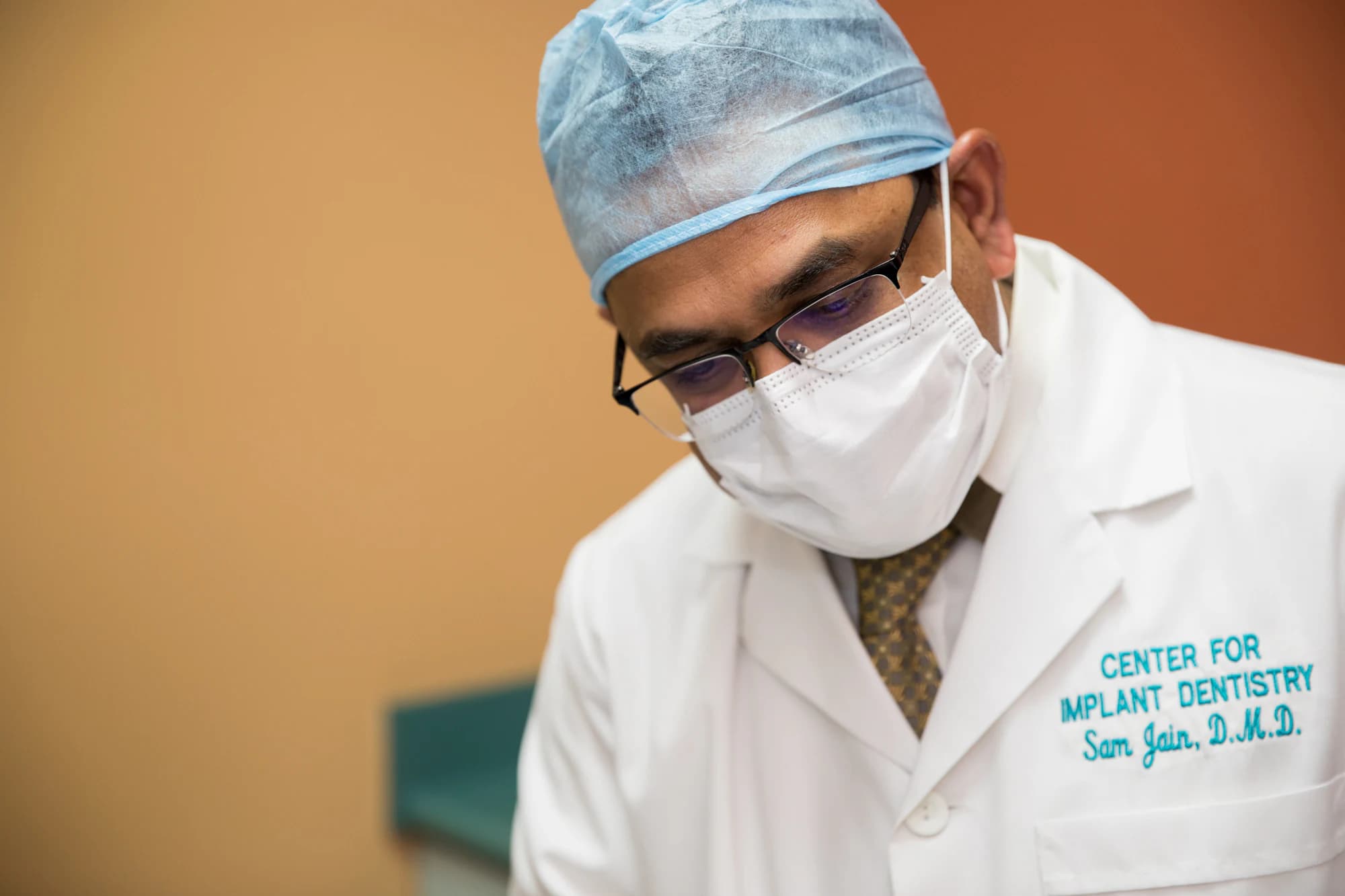

Written and medically reviewed by Dr. Sam Jain, DMD, MS, and Dr. Arpana Gupta, DDS, MDS
Published · Updated
Yes, for Most Healthy Patients
All-on-4 is one of the most studied full-arch treatments in dentistry, and the safety record is strong. Large long-term studies commonly report implant survival around 95% or higher over ten years, and some cohorts followed for 15 to 17 years land in the same range. That puts a full arch on four implants in the same reliability class as a single implant — this is a mature, well-documented procedure, not an experiment.
That said, "safe" is not a property of the technique alone. A dental implant is minor oral surgery, and like any surgery it carries real risks: infection, nerve irritation, sinus involvement in the upper jaw, and, over the long run, gum-and-bone inflammation around the implants. What separates a smooth case from a complicated one is usually planning and execution — how precisely the implants are placed, how well your health was screened beforehand, and who is actually in the room. So yes — All-on-4 is safe for most healthy adults, with the caveat that the surgeon matters more than the brand name on the procedure.
If you want the full picture of how the four-implant technique works and who qualifies, our companion All-on-4 guide covers that ground. This page is about the part people actually lie awake over: what can go wrong, how often, and how a careful team keeps the odds in your favor.

What the Real Risks Actually Are
Let's name them plainly instead of glossing over them. The most common issues after full-arch implant surgery are infection at the surgical site and, later, peri-implantitis — inflammation of the gum and bone around an implant, usually driven by plaque that isn't cleaned away. Across large studies these run in the single-digit to low-double-digit percentages, which is why maintenance is not optional. In the upper jaw, implants placed near the sinus can cause sinus problems if bone height is misjudged. In the lower jaw, placing an implant too close to the inferior alveolar nerve can cause numbness or tingling. Outright early implant failure — one implant not fusing to bone — happens in roughly 2 to 5% of cases and is typically manageable when caught early.
Two things make those numbers reassuring rather than alarming. First, most of these risks are predictable, which means they're preventable. Nerve and sinus complications come down to knowing exactly where those structures sit before the drill ever touches bone — a job for a 3D scan, not a flat X-ray. Peri-implantitis is largely a hygiene-and-follow-up story you control at home with your team's coaching. Second, certain factors raise your personal risk and deserve an honest conversation up front: uncontrolled diabetes, active gum disease, and heavy smoking all slow healing. A good surgeon flags these before surgery, not after. Our complications page goes deeper on what can go wrong and how it's handled.
One risk that gets talked about less is mechanical: a full bridge rides on just four supports, so if the load geometry is off, you can see a screw loosen or, rarely, an implant overstressed over time. This is exactly why Dr. Sam Jain — who holds an MS in mechanical engineering alongside his dental degree — plans each case around how bite force is distributed, and why some jaws are better served by more than four implants. For heavy bites or generous bone, his All-on-8 Robust protocol adds supports for a sturdier foundation. The right number of implants is a safety decision, and your written quote shows the fee for the number your scan calls for.
How Modern Planning Lowers the Odds of a Complication
Most of the serious risks above trace back to one thing: placing an implant without truly seeing what's underneath. That's where the technology in the room changes the math. Every consultation here includes a free 3D CBCT scan (a $499 value) that maps your bone, your sinuses, and your nerves in three dimensions before any decision is made. Your surgeon measures the actual bone available rather than estimating from a two-dimensional film — the single biggest factor in avoiding nerve and sinus complications.
From that scan, the case is planned digitally and executed with guided surgery using X-Guide and Navident EVO navigation, which keep each implant on its planned angle, depth, and position in real time. Guided placement is one of the most effective ways to steer clear of critical anatomy and to seat implants where the bone is densest and the bite load is best shared. You can see the technology we use and how it fits together. For patients who feel anxious about the surgery itself, in-house IV sedation means you're comfortable and monitored throughout — anxiety shouldn't be the reason someone avoids fixing their teeth.
There's also a safety argument for keeping everything under one roof. Because planning, surgery, sedation, and our in-house CAD/CAM zirconia mill all live in the same building, your final custom-milled teeth are ready in about 72 hours for a full arch — not six to eight months in temporary acrylic. Less time in provisional teeth means fewer adjustment visits and a bite that's dialed in correctly, sooner. And when a case is genuinely hard — severe bone loss, or an implant that failed at another office — the same team handles it, whether that means zygomatic implants that anchor in the cheekbone or targeted bone grafting. Taking the difficult cases is only possible when the people planning them also place and restore them.

Why the Surgeon Matters More Than the Procedure
Here's the part most safety articles skip. A large share of the complications we're asked to rescue didn't come from All-on-4 being unsafe — they came from cases where the person who planned the implants wasn't the person who placed them, or the person who placed them handed off the final teeth to someone else. Every hand-off is a place where the bite, the load, and the plan can drift. At many high-volume centers, a fly-in surgeon places implants and moves on. That model can work, but it removes the continuity that catches small problems before they become big ones.
At the Center for Implant Dentistry, the same two owner surgeons — Dr. Sam Jain and Dr. Arpana Gupta, a married team of ICOI Masters — personally plan, place, and restore every case. There are no fly-in surgeons. If something needs adjusting at your follow-up, the person who designed your bite is the one adjusting it. Over 15,000 patients, a 4.9-star Google rating and 600-plus reviews across Google and Yelp reflect what that continuity buys you. It's also why we're comfortable rescuing failed implants placed elsewhere: fixing another office's complication requires understanding the whole arch, not just the loose screw.
None of this means All-on-4 is risk-free — no surgery is, and any surgeon who promises zero complications is overselling. What it means is that the risks are well understood, largely preventable with proper imaging and planning, and best managed by a team that owns your case start to finish. If you're weighing this against a removable option, our implants vs. dentures comparison is a useful next read, and the honest way to settle your own case is a free consultation with that 3D scan — schedule one here.
Written and medically reviewed by Dr. Sam Jain, DMD, MS, and Dr. Arpana Gupta, DDS, MDS, who own this practice.
This article is patient education, reviewed by Dr. Sam Jain, DMD, MS, and Dr. Arpana Gupta, DDS, MDS, and is not a substitute for an exam. Treatment recommendations are made only after an in-person consultation and 3D imaging.