All-on-4 Bridge Repair: Chipped, Cracked, Loose or Worn Full-Arch Teeth, and When Repair Becomes Replacement
A fixed full arch is a working machine that chews thousands of times a day, and it needs servicing. Here is what the long-term studies show breaks, how each problem is repaired, and how to decide whether a bridge is worth fixing again or ready to be replaced.

Written and medically reviewed by Dr. Sam Jain, DMD, MS, and Dr. Arpana Gupta, DDS, MDS
Published
In this article
- 1Full-arch bridges need maintenance, and the studies say so plainly
- 2What breaks depends on what the teeth are made of
- 3Chipped, cracked or broken teeth on the bridge
- 4A bridge that feels loose or rocks
- 5Framework and cylinder problems
- 6Problems that call for a redesign rather than a patch
- 7Repair or replace: how the decision is made
- 8What an All-on-4 repair costs, and why quotes differ
- 9Bringing a damaged full-arch bridge to us
Full-arch bridges need maintenance, and the studies say so plainly
The implants under an All-on-4 or other full-arch bridge usually last well. In Paulo Maló's study of 245 patients with All-on-4 in the lower jaw, 99.2% of the bridges were still in service at up to ten years. Survival, though, is not the same as a trouble-free decade. A systematic review of fixed full-arch implant bridges followed for at least five years counted complications at a rate of 24.6 per 100 restoration-years, and estimated that only 29.3% of bridges were entirely free of complications at five years and 8.6% at ten.
The review's authors made the point that matters to patients: these events occur continuously over time as a result of fatigue and stress, and most of them do not end in failure — but they do add up to repairs, visits, time and cost. A full arch is less like a crown you forget about and more like a car you service. Our article on how long All-on-4 implants last explains why the implants and the teeth on top run on two different clocks.
What breaks depends on what the teeth are made of
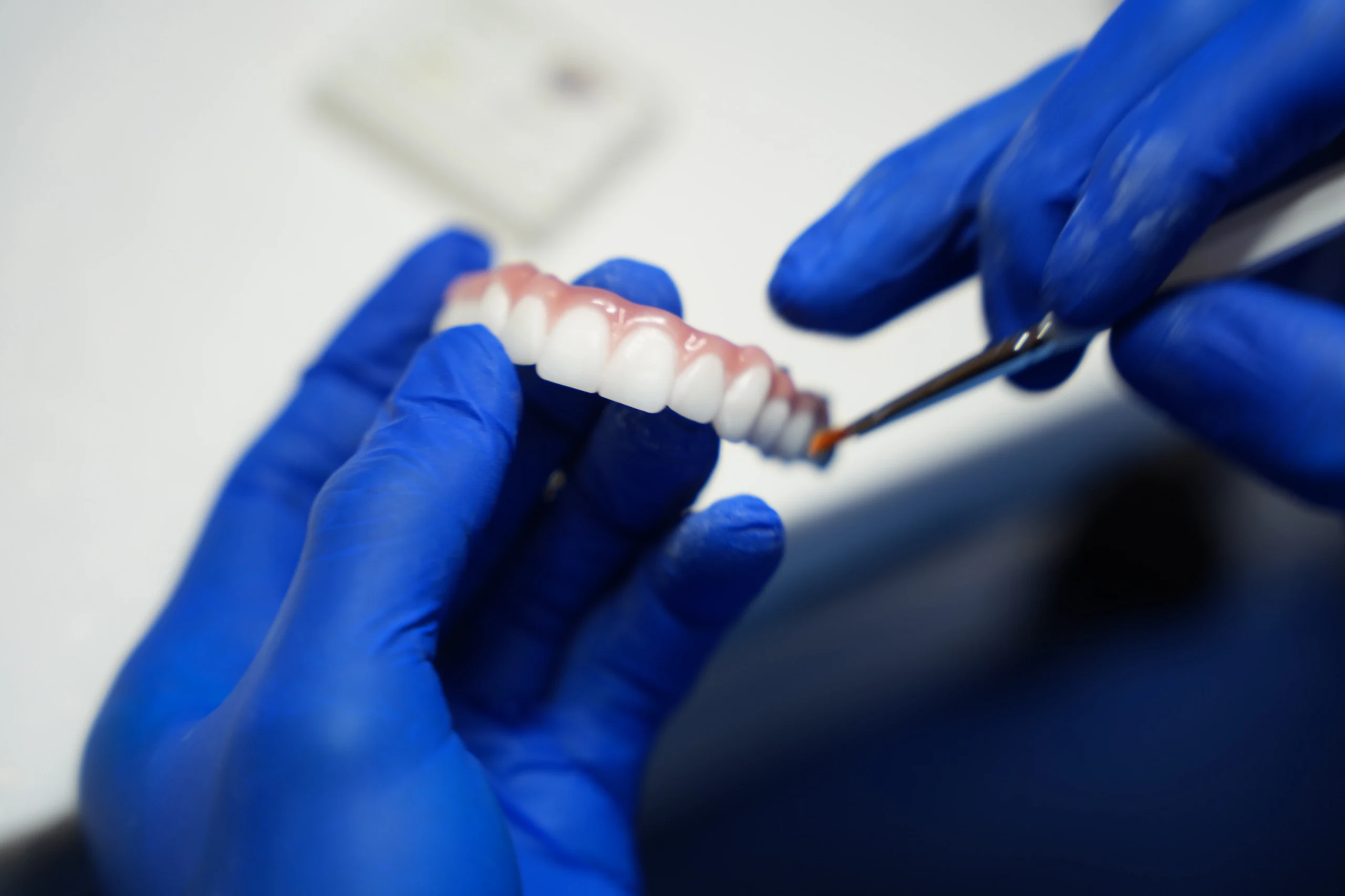
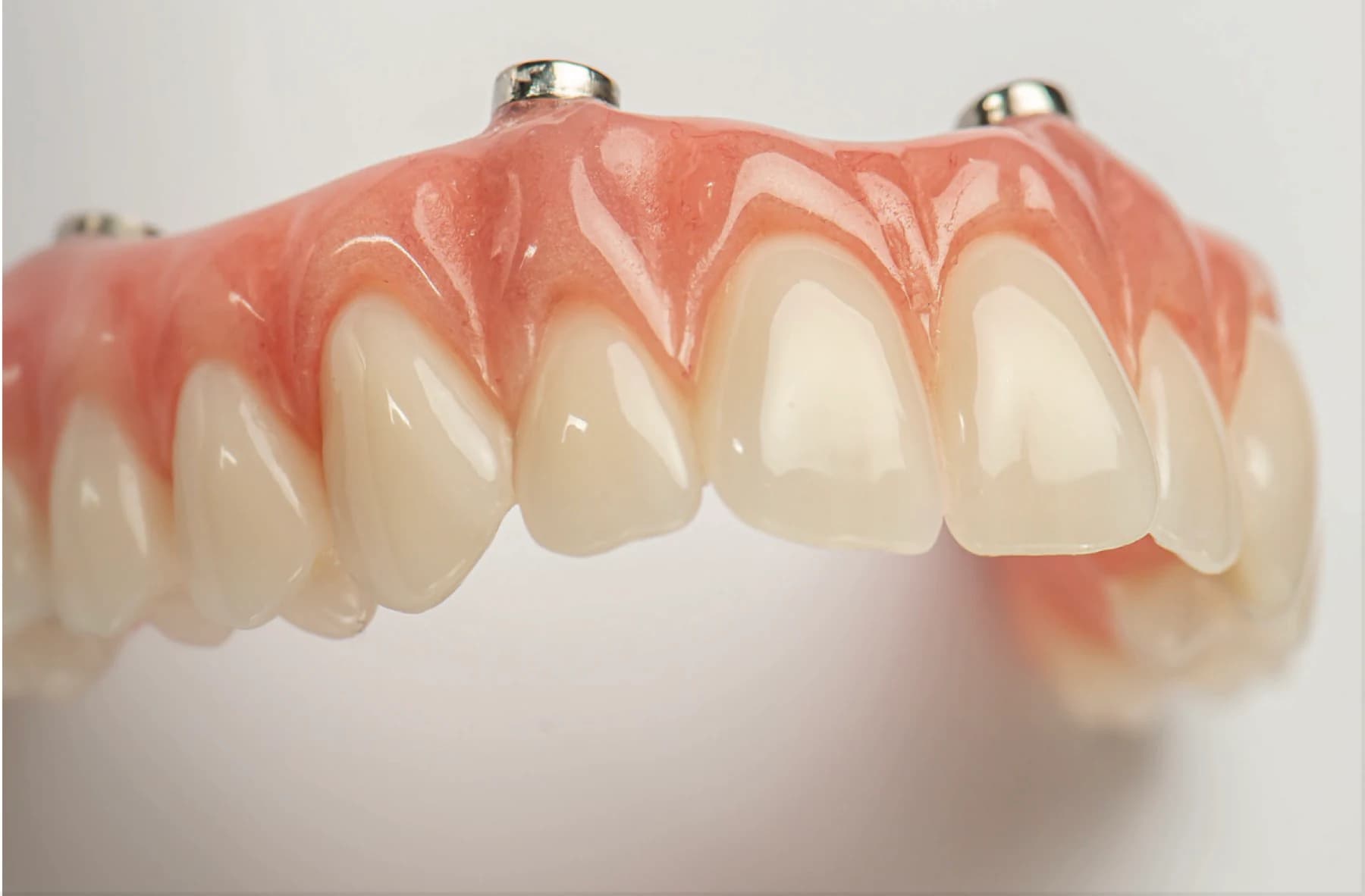
Most repairs come back to the material. Traditional full-arch bridges — often called hybrids — are acrylic denture teeth and pink acrylic processed onto a metal framework. They are comfortable, forgiving and inexpensive to repair, and they wear. In a study that followed lower metal-acrylic bridges for a mean of 18.5 years, 45.8% of patients had an acrylic tooth fracture and 75% showed wear. A 2023 study of 87 patients found two-thirds had at least one complication, with the first appearing at a mean of 23 months; acrylic problems were the most frequent, followed by screw loosening, screw fracture and framework fracture. In a private practice series, whole sets of teeth had to be replaced for wear in eight of 45 patients between five and twelve years.
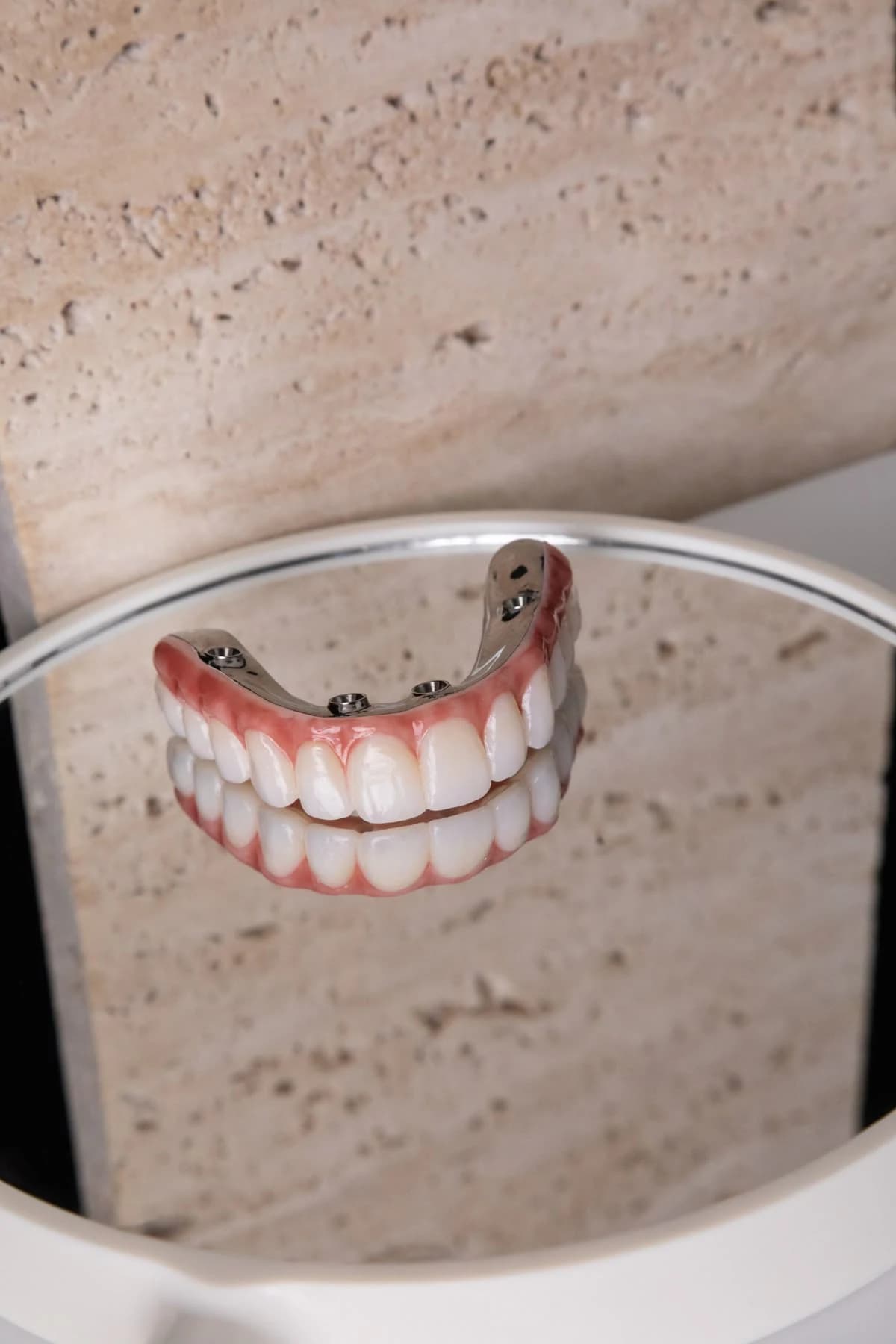
Porcelain layered over a zirconia or metal framework looks natural, but the layer can chip. The systematic review estimated chipping or fracture of veneering material in 33.3% of full-arch bridges at five years and 66.6% at ten. Monolithic zirconia — the arch milled from a single block, with pink porcelain limited to the gum area or absent — changed that picture. In 2,039 such bridges made by one laboratory, six fractured, for a five-year survival of 99.3%. A 2026 meta-analysis of 2,841 zirconia arches found 99% still in function at 12 to 62 months, with technical complications of 1% to 3% for monolithic designs compared with up to 27% for veneered ones, while rating the certainty of the evidence as low because most studies were retrospective.
That is why our premium full-arch teeth are monolithic zirconia. It is not that acrylic is wrong — for some patients it is the right interim or even final choice — but that the repair profile of each material is very different, and patients deserve to know it before choosing. Our implant materials page compares the options.
Chipped, cracked or broken teeth on the bridge
A chipped or broken acrylic tooth is usually the simplest repair. The damaged tooth is removed from the bridge and a new one is bonded and processed in place, often without replacing anything else. When many teeth are worn or stained, the bridge can be re-toothed on its existing framework. The limit comes when the framework itself is bent or cracked, or when the acrylic has worn so far that the bite has collapsed.
On a layered zirconia bridge, a small porcelain chip can often be polished smooth. A larger chip can be patched with bonded composite, which is a reasonable short-term fix but does not have the strength of the original porcelain. A crack through a zirconia arch is different: zirconia cannot be reliably welded back together, so a fractured arch is remade. Because the design of every arch we make is stored digitally, a replacement can be milled in our lab from that file, adjusted for whatever caused the break.
And something usually does cause it. Fractures cluster where the bridge is too thin for the space available, where a cantilever extends too far behind the last implant, where a patient grinds, or where the bridge does not sit passively on its implants. In one published case, a lower zirconia arch cracked at the midline because implant components from different manufacturers had left it slightly misfitting. Repairing the tooth without correcting the cause invites the same break again.
A bridge that feels loose or rocks
A full-arch bridge is held by small screws into abutments on each implant. When one of those screws loosens or breaks, the bridge can click, rock or feel high on one side. Screw problems are among the most common full-arch complications: the systematic review found screw fracture in 10.4% of bridges at five years and 20.8% at ten, and the 18.5-year study recorded loosening of 8.1% and fracture of 11.3% of retaining screws.
A rocking bridge should be seen promptly rather than chewed on for weeks. With one screw loose, the bite is carried by fewer implants, the remaining screws take more of the load, and a loose screw that breaks is harder to deal with than one that is simply retightened. We remove the bridge, check every screw and abutment, retrieve any broken fragment, test each implant for stability and check the bone on imaging. A rocking bridge is usually a screw problem; occasionally it is an implant that has failed, and it is important to know which before anything is tightened.
Grinding is a strong multiplier here. A 2025 meta-analysis found bruxism associated with about 3.4 times the odds of prosthetic screw loosening, 7 times the odds of screw fracture and 4.5 times the odds of prosthesis mobility. For a patient who grinds, a night guard is part of the repair.
Framework and cylinder problems
Inside many bridges is a structural element: a cast or milled metal bar in acrylic hybrids, and titanium cylinders bonded into the zirconia where the screws pass through. Metal frameworks can crack, most often behind the last implant; in the private practice series, cantilevered frameworks opposing fixed teeth in the other jaw were at high risk of fracture, while none of those opposing removable dentures broke. In zirconia arches, the titanium cylinders occasionally come unbonded: of the 2,039 zirconia bridges, six were returned for cylinder debonding and three for cylinder fracture.
A debonded cylinder can often be re-bonded. A cracked framework generally means a new bridge, and that is the moment to reconsider the design — the length of the cantilever, the number and spread of implants supporting it, and the material. Where more support would make the next bridge more durable, adding implants may be part of the conversation; our approach to that is described in our comparison of All-on-4, All-on-6 and All-on-8.
Problems that call for a redesign rather than a patch
Some complaints about a full-arch bridge are not breakages at all. Food packing under the bridge, a bad smell that returns however well you brush, gum tissue that grows up against the underside of the bridge, a lisp that never settled, and a bite that has dropped as acrylic teeth wore are all common. The systematic review found overgrowth of the gum tissue around full-arch bridges in 13.0% of cases at five years and 26.0% at ten.
These are usually design problems — a bridge whose underside cannot be reached with a water flosser or brush, a gap between bridge and gum that traps food, a contour that interferes with speech, or teeth that were never set to the right height. Cleaning and adjusting help for a while; lasting relief often means reshaping or replacing the bridge so it can be kept clean. Because we design and mill arches in-house, we can redesign the underside and the tooth positions around the specific problem instead of repeating the original shape.
Repair or replace: how the decision is made
The first question is always the foundation. If the implants are stable and the bone around them is healthy, the bridge is the only part in question. If an implant has failed or is losing bone, that has to be addressed before any new bridge is made, or the new bridge will simply move the problem.
After that, the decision is practical. A single chipped acrylic tooth on an otherwise sound bridge is repaired. A bridge with repeated fractures, a cracked framework, badly worn teeth, a collapsed bite, poor fit, or an underside that cannot be cleaned is usually a candidate for replacement, because the next repair buys little time. The age of the bridge, how often it has already been fixed, and whether it was designed as a temporary also matter. Many patients who started with acrylic choose to move to monolithic zirconia at this point, because the repair history changes the arithmetic.
A replacement bridge can often be made on the existing implants without surgery, using a new scan of the implant positions. While it is designed and milled, the patient keeps wearing their existing bridge whenever it is still serviceable.
What an All-on-4 repair costs, and why quotes differ
There is no single price, because "repair" covers everything from retightening a screw to milling a new arch. The cost is driven by what failed, how many parts must be replaced, whether original components are available for the implant system, how much laboratory work is needed, and whether any implant needs treatment first. A bridge made elsewhere adds a step: the implant system and abutments must be identified, and if the original design file is not available, a new digital record has to be taken.
For arches we made, chips, wear, loosened screws and bite adjustments are handled here, in our own lab, under the warranty terms written into your treatment plan for the material you chose; our warranty page explains how those terms are set. For a bridge made elsewhere, we examine it, image the implants, and give you an itemized written quote for each reasonable option — repair, re-make on the existing implants, or treatment of the implants first — so the choice is made on numbers rather than on the word "repair".
Bringing a damaged full-arch bridge to us
If your bridge has chipped, cracked, loosened or simply never felt right, keep any broken pieces, avoid hard food on that side, and do not try to glue or unscrew anything yourself. Full-arch rescues, including bridges placed at other offices, are a regular part of our work. At a free consultation with a 3D scan, Dr. Sam Jain and Dr. Arpana Gupta check the implants and the bridge, explain what failed and why, and put the options and their costs in writing. You can book here, or read about our approach to implant complications.
Written and medically reviewed by Dr. Sam Jain, DMD, MS, and Dr. Arpana Gupta, DDS, MDS, who own this practice. Reviewed
This article is patient education, reviewed by Dr. Sam Jain, DMD, MS, and Dr. Arpana Gupta, DDS, MDS, and is not a substitute for an exam. Treatment recommendations are made only after an in-person consultation and 3D imaging.