Fixed or removable? Choose the freedom that fits your everyday life.
Dental Implants vs. Dentures: An Honest Comparison
Hear from patients who made the switch from dentures
Schedule ConsultationThe Comparison Everyone Deserves To See
Dentures Manage The Problem. Implants End It.
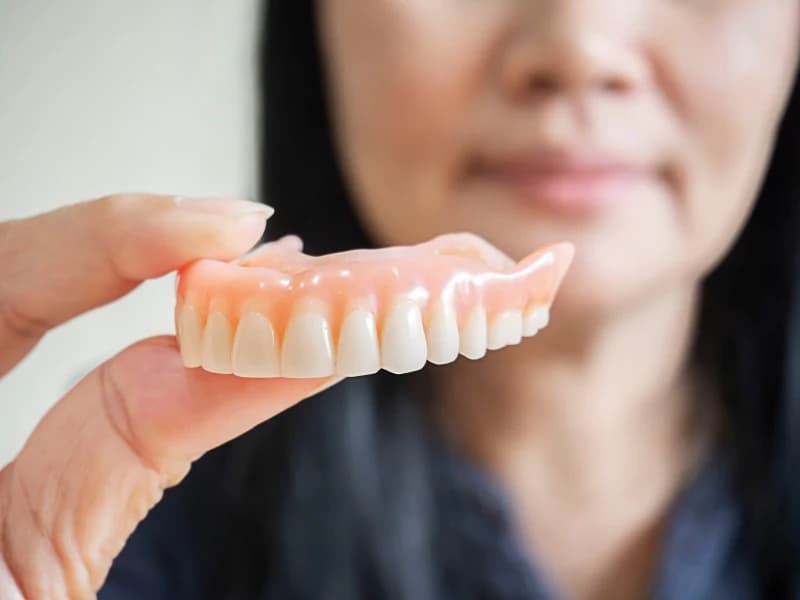
For seventy years, dentures were the only answer to major tooth loss — and dentistry got very good at making them. But 'good denture' is still a compromise: a prosthetic that rests on shrinking gums, borrows stability from suction and glue, and asks you to take your teeth out every night.

Dental implants changed the question entirely. Instead of covering the problem, they replace the roots themselves — titanium anchors the bone accepts as its own, holding teeth that never come out, never slip, and never sit in a glass.
Below is the same side-by-side we walk denture patients through in the consult room — category by category, with the denture column filled in honestly. Look it over, then bring your questions to a free consultation.
Six Categories. One Honest Ledger.
How permanent implants and traditional dentures compare where it actually matters — day to day and decade to decade.
Stability
Permanent dental implantsFixed and secure — anchored in bone like natural roots. They don't move when you bite, laugh, or sneeze.
Traditional denturesCan slip and slide, especially the lower plate — with adhesives fighting a losing battle against physics.
Comfort
Permanent dental implantsFeel like your own teeth. No plate covering the palate, no rubbing, nothing to 'get used to' after healing.
Traditional denturesPressure on the gums causes sore spots and irritation, and a covered palate dulls the taste of food.
Chewing power
Permanent dental implantsNear-natural bite force — steak, apples, crusty bread, corn on the cob all return to the menu.
Traditional denturesA fraction of natural bite force. Menus shrink toward soft foods, and nutrition often shrinks with them.
Jawbone & facial support
Permanent dental implantsImplants stimulate the bone like roots, preserving jaw structure and the natural shape of your face.
Traditional denturesBone recedes steadily beneath the plate — dentures loosen, faces sink, and each reline fits worse.
Longevity
Permanent dental implantsThe implants themselves can last decades — often a lifetime — with long-term success rates commonly reported around 95%.
Traditional denturesTypically replaced every 5–7 years as the jaw changes shape underneath them.
Daily maintenance
Permanent dental implantsBrush and floss like natural teeth. No soaking, no adhesives, no nightly glass on the nightstand.
Traditional denturesDaily removal and soaking, messy adhesives, and careful handling — drop one on a tile floor once and you'll know.
Time to teeth
Permanent dental implantsFixed teeth the day of surgery for qualifying patients — with final custom-milled teeth in about 72 hours from our on-site lab, never months in removable plastic.
Traditional denturesImmediate dentures go in the day teeth are pulled, then need relines and replacements as the gums shrink beneath them.
Individual results vary with bone health, medical history, and home care. Comparison reflects conventional full or partial removable dentures.
What Dentures Quietly Cost Beyond The Price Tag
What A Free Implant Consultation Looks Like Here
The hardest costs of dentures never appear on a receipt. Research associates long-term tooth loss with higher observed rates of heart disease, cognitive decline, and poor nutrition — associations, not verdicts, but ones with a plausible mechanism: chronic oral inflammation and a soft-food diet ripple through the whole body. The studies are collected on our research page.
And there's the arithmetic of the jaw itself: bone that isn't working is bone that's leaving. The longer dentures rest on a shrinking ridge, the harder — though rarely impossible — the eventual switch to implants becomes.
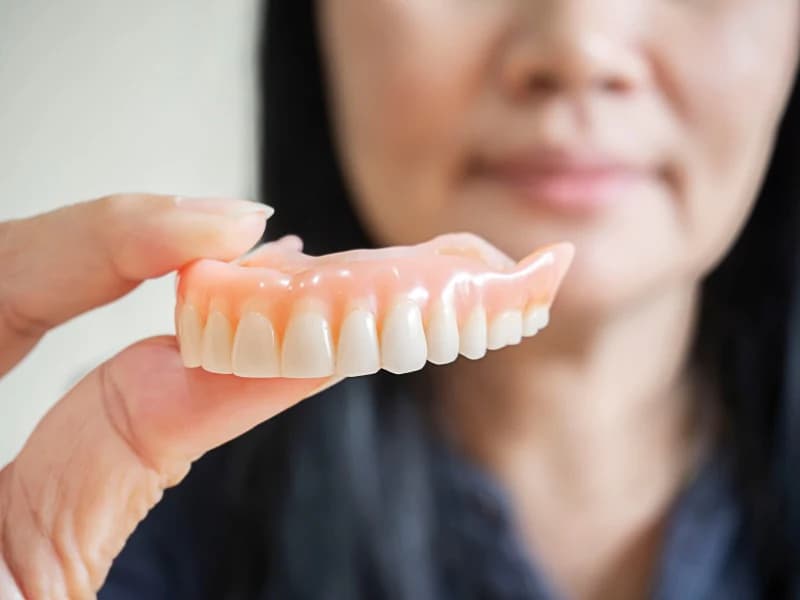
If you're weighing the change, weigh it with real data: a free 3D CBCT scan of your actual bone, an honest conversation about what you'd qualify for, and numbers in writing. The switch is a big decision. Make it with your eyes open.
Life On The Other Side Of The Nightstand Glass

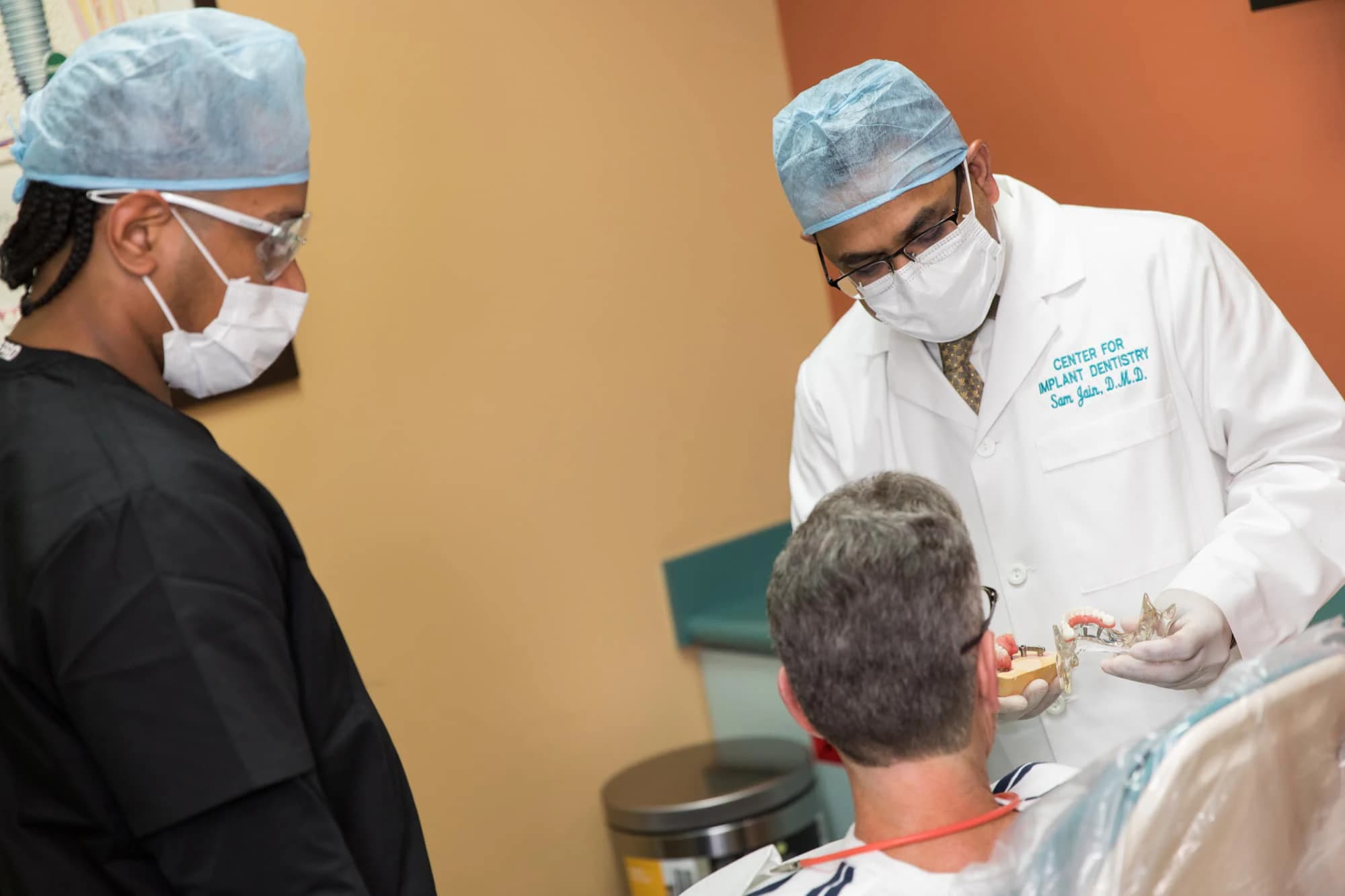
From Dentures To Fixed Teeth — Inside Our Practice
Ask our former denture wearers what changed and they rarely lead with teeth. They talk about ordering ribs without scouting the menu for backup options. Laughing without a hand at their mouth. Kissing a grandchild goodnight without a locked bathroom ritual first.
For most, the destination is fixed full-arch teeth — implants supporting a permanent, non-removable arch that's brushed like natural teeth and never spends a night outside your head. For some, implant-supported snap-in dentures are the right stepping stone. Both live under this roof, and the choice gets made on your scan, not on a script — dental implants after dentures walks through what the switch involves.
Since 2008, our family-owned practice — led by Dr. Sam Jain (DMD, plus a master's in mechanical engineering) and Dr. Arpana Gupta (DDS, MDS) — has helped Bay Area patients out of dentures year after year, including many who'd been told they 'didn't have enough bone.' A free 3D scan shows what yours actually allows.
Implants Or Dentures?The Questions That Settle It
I've worn dentures for years. Can I still switch to implants?
Usually, yes — and you're exactly who we built this practice for. Long-term denture wear does shrink the jawbone, but techniques like bone grafting, angled implant placement, and zygomatic implants anchored in the cheekbone let most long-time denture wearers qualify. Your free 3D CBCT scan gives a definitive answer based on your anatomy — including many patients told 'no' elsewhere.
What's the real difference in daily life?
Dentures are something you manage: adhesives in the morning, caution at lunch, soaking at night, and a corner of your mind always monitoring whether they'll hold through a laugh. Implants are something you forget. They're fixed in the bone, cleaned by ordinary brushing and flossing, and strong enough for the foods most denture wearers give up — apples, steak, corn on the cob. When patients come back for a checkup, the change they mention first usually isn't their teeth — it's that they've stopped thinking about them at all.
Do dentures really cause bone loss?
Yes — not because dentures are badly made, but because of what they can't do. Bone stays dense only where tooth roots stimulate it. Dentures rest on top of the gums, so the jaw underneath steadily shrinks; that's why dentures loosen over time, why faces develop the sunken look, and why each reline fits worse than the last. Implants are the only replacement that puts working roots back into the bone and stops the cycle.
What is an implant-supported denture — the middle option?
It's a denture that snaps onto two or more implants: far more stable than a suction-fit plate, kinder to the bone at each implant site, and often a sensible stepping stone. But it's still removable, still needs nightly care, and still lets bone shrink where there are no implants. Most patients who can qualify choose fixed full-arch teeth instead — permanent, non-removable, and cleaned like natural teeth. We offer both and will show you honestly, on your own scan, what each would mean for you.
What does it cost to stabilize a denture with implants — and what about 'All-on-4 dentures'?
Two different things hide inside that question. Snap-in stabilization — a few implants holding your existing or a new overdenture — uses fewer implants and less lab work, so it costs meaningfully less than fixed teeth; the exact number depends on how many implants your bone needs, which the free 3D scan settles. What people call 'All-on-4 dentures' is actually the other thing: fixed full-arch teeth that never come out — here one fixed, all-included fee of $14,999 per arch, with an arch that needs six or eight implants quoted in writing. At your consultation we quote both options side by side, itemized, so you're comparing real numbers instead of guessing which category you're shopping in.
Aren't implants much more expensive than dentures?
Up front, yes; over a decade, the math often reverses. Dentures carry a forever tab — adhesives, relines every few years, replacements every five to seven, and the compounding costs of a shrinking jaw. Implants are a one-time investment that can last decades: a fixed full arch here is quoted with every cost itemized in writing, and about 92% of our full-arch patients use a monthly payment plan sized to their quote, the lender, and the term. See our honest cost page, then get your real number at a free consultation.
Still weighing your options? Learn more about full mouth dental implants or schedule a free consultation.
Ready To Stop Managing Dentures? A Free 3D Scan Shows Exactly What You Qualify For
Clinically reviewed by
Updated
 Dr. Sam Jain, DMD, MS
Implant Surgeon, Implantologist & Founder
 Dr. Arpana Gupta, DDS, MDS
Implant Surgeon & Implantologist
Their review covers the treatment description, candidacy, timelines, risks and aftercare.
- Treatment details change as our protocols and materials do.
- Your options can only be determined after an in-person examination and a 3D scan.