Good decisions start with evidence you can understand.
The Clinical Evidence Behind Dental Implants
Peer-reviewed research, translated into plain English
Schedule ConsultationReviewed By Dr. Sam Jain & Dr. Arpana Gupta · Updated July 2026
We'd Rather Cite Than Sell
Every claim on this page links to a peer-reviewed study in the National Library of Medicine's PubMed database — the same literature we read, and the same standard we hold our own work to. No study is ours, none was paid for by us, and none of the links earn us anything.

We've translated each paper into plain English, and we've kept the honesty the originals deserve: where research shows an association rather than proof of cause, we say so. You deserve the real state of the science, not a highlight reel.
Questions about how any of this applies to your mouth specifically? That's what the free consultation — and your own 3D scan — are for.
The Practice
This Practice, At A Glance
Each figure is drawn from the peer-reviewed studies cited on this page; population statistics describe groups, not individual outcomes. Your doctor will discuss what the evidence means for your specific case.
How Long Implants Last, According To The Data
Longevity is the whole argument for implants, so it deserves better support than a brochure promise. Two independent systematic reviews — pooling thousands of implants followed for a decade or more — put long-term survival in the mid-90s.
Across 23 studies and 7,711 implants followed for an average of 13.4 years, dental implants showed a cumulative survival rate of about 94.6%.
A 2019 meta-analysis found about 96.4% of dental implants still functioning at the 10-year mark — most implants comfortably outlast their first decade.
Fixed Teeth Right Away, Validated — Not Just Marketed
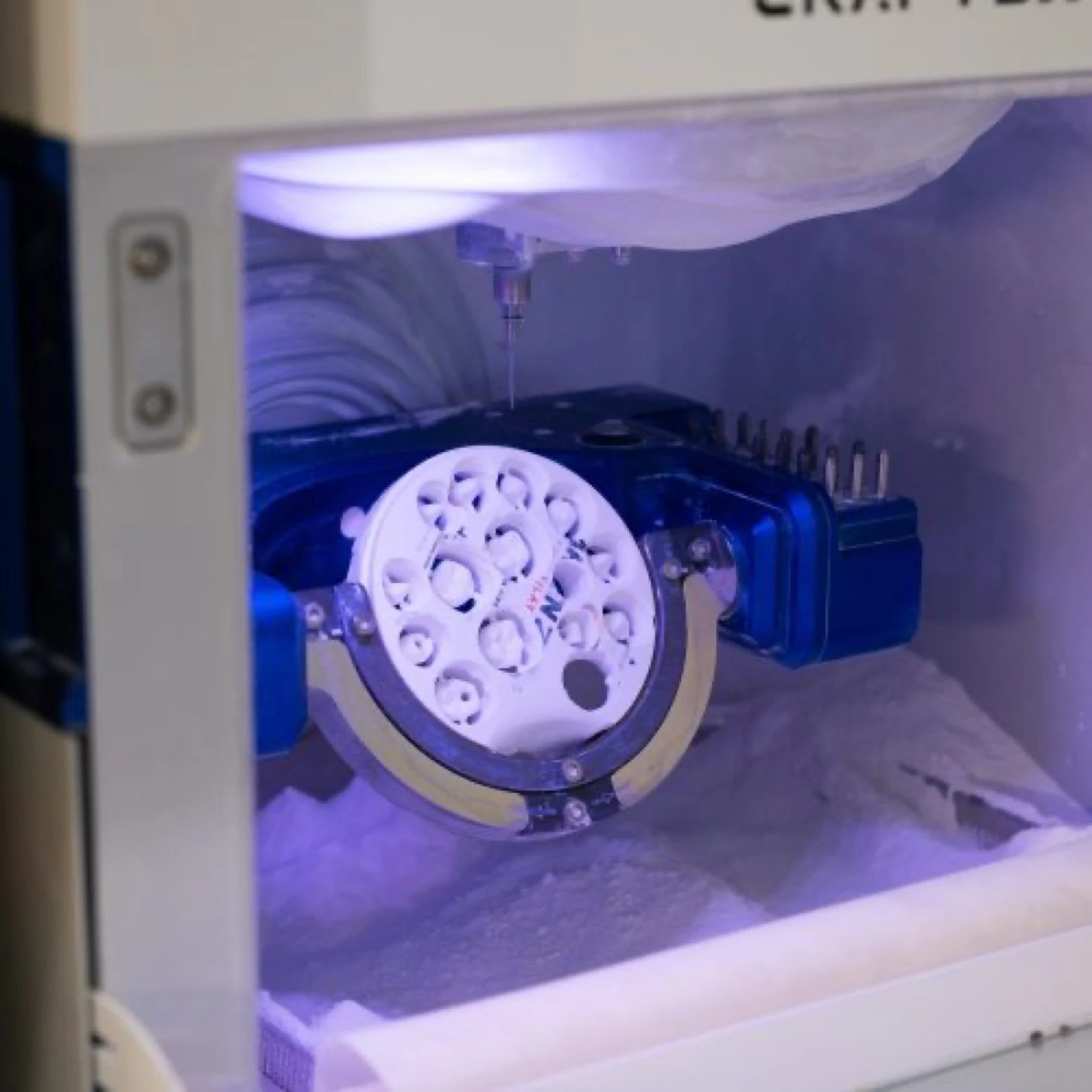
Chewing on fixed teeth days after surgery sounds like advertising until you read the loading-protocol literature. It's also why we never send full-arch patients home in removable dentures — our All-on-8 Robust protocol delivers final custom-milled teeth in about 72 hours.
In patients receiving fixed full-arch teeth, immediate loading — teeth attached right away — achieved implant survival above 99%, essentially matching the traditional wait-months approach.
Why Waiting Is The Expensive Option
The jawbone exists to hold teeth; remove the tooth and the bone starts leaving too. This is the single best-documented reason not to postpone replacement — and why we so often place the implant the same day a tooth comes out.
After a single tooth extraction, the width of the jawbone ridge shrinks by roughly 50% within 12 months — with two-thirds of that loss in the first three months alone.
Your Mouth, Connected To Everything Else
None of the studies below prove that missing teeth cause these conditions — honest science rarely hands out certainties. What they show, consistently and across large populations, is that tooth loss and oral infection travel together with the health outcomes that matter most.
A joint consensus of the European Federation of Periodontology and the World Heart Federation found strong, independent evidence linking severe gum disease to higher cardiovascular risk.
Pooling 14 studies of over 34,000 adults, more missing teeth meant higher dementia risk — about 1.4× for those with no teeth — and notably, the added risk faded in people whose teeth were replaced.
Tooth loss was associated with higher all-cause and circulatory mortality — and the review found suggestions that replacing missing teeth may lower that risk.
Older adults without natural teeth consumed significantly less protein, calcium, iron, fiber, and vitamin C than those who kept their teeth — when chewing narrows, nutrition follows.
The Engineering Case For More Implants
Long before it became our protocol, the mechanics were in the literature: bridges that hang past their last supporting implant behave like levers. It's the published physics behind why All-on-8 Robust avoids cantilevers and spreads your bite across more anchors.
Finite element stress modeling showed peak stress at the bone–implant junction rises significantly as a bridge's cantilever gets longer — longer unsupported spans mean more load on implants and prosthesis.
When The Upper Jaw Has 'No Bone' Left
Patients told they can't have implants usually have an upper jaw that has resorbed after years of dentures. Zygomatic implants anchor in the dense cheekbone instead — and the long-term evidence behind them is substantial.
Across 4,556 zygomatic implants, the 12-year survival rate was about 95.2% — a dependable option for severely resorbed upper jaws where standard implants aren't possible.
The Research Series: Ten Questions, Read At Length
The summaries above fit on a page. The questions behind them do not, so each of these reviews goes back to the primary studies — survival registries, histology, randomised trials, consensus reports — and reads them the way a surgeon reads them before a case, with every figure tied to its source.
Dental Implant Success Rates: What Sixty Years of Data Actually Show
One percentage gets quoted everywhere. Here is where it comes from, what it leaves out, and how I use the real numbers when I plan a case.
Osseointegration: How Bone Actually Bonds to a Titanium Implant
Bone does not grow onto an implant the way glue sets. It first resorbs the very bone that holds the implant, then rebuilds. Understanding that sequence explains almost every rule I follow.
Peri-Implantitis: How Common It Really Is, What Causes It, and What the Evidence Says Prevents It
It is the complication nobody mentions at the consultation and the one most likely to bring a patient back years later. Here is what the literature actually shows, and what I do about it.
Immediate Loading: The Evidence for Teeth on the Day of Surgery
Brånemark's rule was three to six months without load. The literature now supports loading on the day of surgery — under conditions that are specific, measurable and not negotiable.
Guided, Navigated or Robotic: How Accurately Can an Implant Actually Be Placed?
Every system claims precision. The meta-analyses put numbers on it — and the numbers say a two-millimeter safety margin is still the rule, whichever screen the surgeon is looking at.
Dental Implants and Diabetes: What the Studies Show About Survival, Healing and Long-Term Risk
Diabetes used to be listed as a contraindication. The evidence now separates three questions — will it integrate, how fast, and what happens ten years later — and answers each differently.
Short Implants Versus Bone Grafting: What the Randomized Trials Found When They Compared Them
For years the answer to thin bone was to build more bone. The trials that finally compared that with simply using a shorter implant did not come out the way most surgeons expected.
Bone Graft Materials for Dental Implants: Autograft, Allograft, Xenograft and Synthetic, Compared on the Evidence
The graft material with the most new bone on a biopsy is not the one most often used, and for good reason. Here is how the histology and the survival data fit together.
Antibiotics and Dental Implant Surgery: What the Trials Say About Who Needs Them
Two well-conducted analyses of the same question reach different answers a decade apart. The difference is in who was studied, and it is the difference that decides whether you get a prescription.
The Future of Dental Implants: Seven Lines of Research, Graded by How Close They Are to Your Mouth
Some of this is already in the operating room. Some of it is a decade away. The useful thing is to know which is which, and the literature is clearer about that than the marketing is.
A Note On Reading Health Research
Association Is Not Causation
Large population studies can show that two things travel together — tooth loss and heart disease, for example — without proving that one causes the other. We cite them because the pattern is consistent and worth knowing, not to alarm you.
What is beyond debate: missing teeth change how you chew, jawbone shrinks without tooth roots to stimulate it, and chronic oral infection is never neutral for the rest of the body. Those three facts alone justify taking tooth replacement seriously.
This page is educational and isn't a substitute for an exam. Treatment recommendations here are made only after an in-person clinical examination, imaging review, and consultation with your doctor — the first one is free.
See What The Evidence Means For Your Smile
Clinically reviewed by
Updated
 Dr. Sam Jain, DMD, MS
Implant Surgeon, Implantologist & Founder
 Dr. Arpana Gupta, DDS, MDS
Implant Surgeon & Implantologist
Their review covers the summaries of published research below and the clinical claims drawn from them.
- Your options can only be determined after an in-person examination and a 3D scan.