Are Dental Implants the Right Choice for Me?
For most people missing one tooth or many, the answer is yes — the real question is what your specific jaw, health, and goals call for, and how to confirm it.

Written and medically reviewed by Dr. Sam Jain, DMD, MS, and Dr. Arpana Gupta, DDS, MDS
Published · Updated

The Answer, Up Front
If you're missing a tooth, several teeth, or all of them — and you're generally healthy — you are very likely a candidate for dental implants. That's the honest starting point, and it's true for far more people than expect it to be. Implants replace the root of a tooth with a small titanium or zirconia post that fuses to your jawbone, then carry a crown, bridge, or full arch on top. Long-term survival is high: peer-reviewed studies commonly report around 95% at ten years, and many implants last far longer. The question worth asking isn't usually "can I get implants at all" but "which approach fits my jaw and my life."
The things that actually rule someone out are narrower than most people fear. Not enough bone doesn't disqualify you — bone can be rebuilt, or bypassed entirely. Being in your 70s or 80s doesn't disqualify you — health matters far more than the number on your license. What genuinely gives a surgeon pause is a short, specific list, and even most of those are manageable rather than final. So before you assume you've been ruled out by something you read online, it's worth understanding what the real criteria are.
What Actually Makes Someone a Good Candidate
Three things carry most of the weight. First, reasonably good general health, because an implant is a minor surgical procedure and your body needs to heal around it. Second, healthy gums, or gum disease that's being treated and brought under control — implants sit in the same tissue your teeth did, and that tissue has to be sound. Third, enough jawbone to hold the implant, or a clear plan to add or work around what's missing. Most healthy adults meet all three, or can get there with a step or two of preparation.
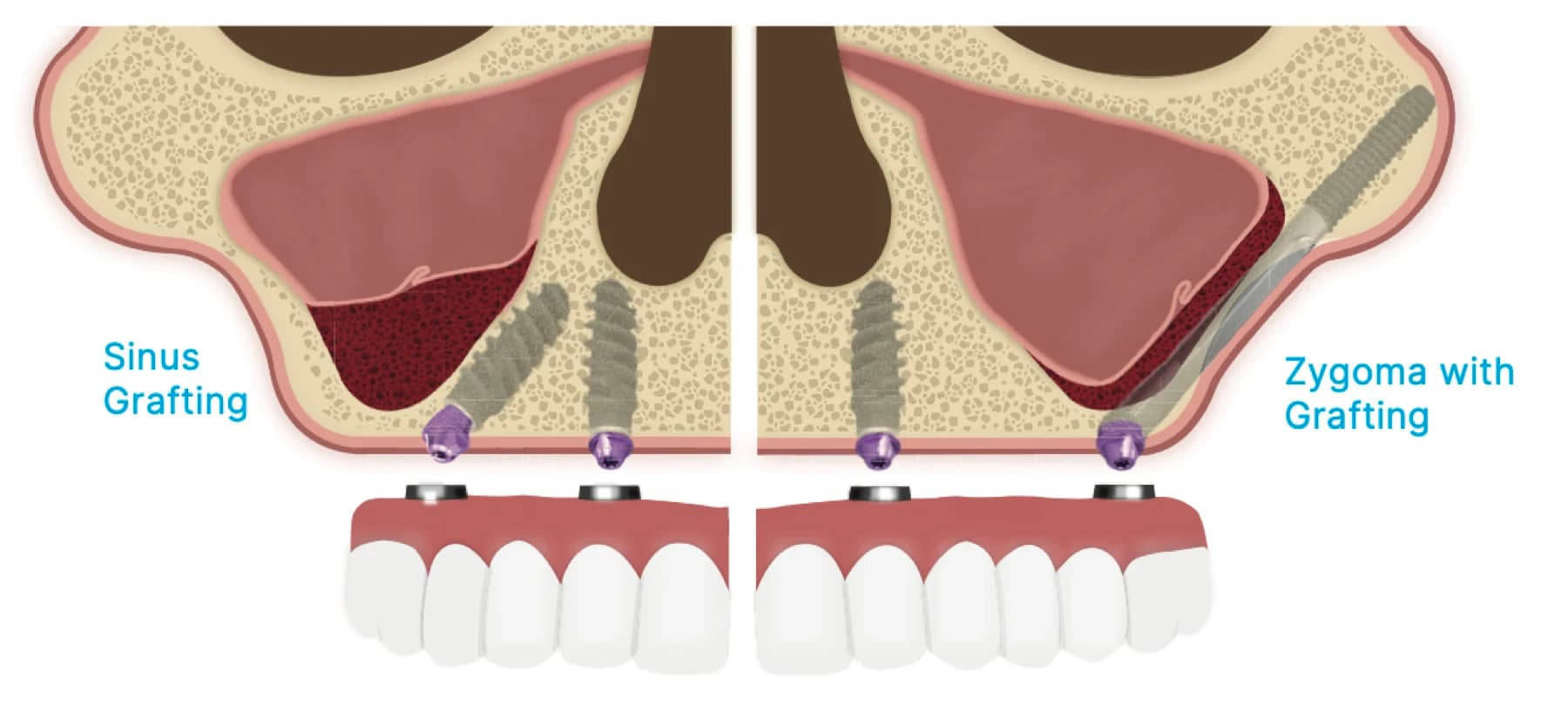
Bone is where a lot of people count themselves out too early. When a tooth is gone, the bone that held it slowly shrinks, and after years in a denture the ridge can get quite thin — which is exactly why so many people are told they "don't have enough bone." That's rarely the end of the road. Bone grafting rebuilds the ridge, a sinus lift creates height in the upper back jaw, and for arches with almost no usable bone left, zygomatic implants anchor into the dense cheekbone and skip grafting altogether. Between those tools, very few jaws are truly out of options — the plan just changes to match the anatomy.
Commitment matters too, in a plain way: implants need daily cleaning at the gumline and regular checkups, the same as natural teeth. If you'll brush, clean between your teeth, and keep your maintenance visits, you have the habit that protects your investment for decades. A 3D scan and an exam confirm the rest, and at our center that consultation and CBCT scan are free — a $499 value — so finding out where you stand costs you nothing.
The Honest Caveats — What Gives a Surgeon Pause
A few conditions genuinely raise the stakes, and a good surgeon will be straight with you about them. Uncontrolled diabetes is the clearest one — high blood sugar slows healing and works against the bone fusing to the implant, so it needs to be managed before surgery, not ignored. Heavy smoking is the other big one: nicotine narrows the blood vessels that feed healing bone and measurably raises the risk of implant failure. Neither is usually an absolute "no." Controlled diabetes and reduced or paused smoking change the picture substantially, and your doctor will tell you honestly where your situation lands.
Other factors get weighed case by case: a history of gum disease, certain bone-density medications, past radiation to the jaw, or a heavy grinding habit that overloads the bite. None of these are automatic disqualifiers — they're variables a surgeon plans around, sometimes with a nightguard, sometimes by adding more support, sometimes by treating the gums first. The reason this matters is that a lot of "you can't have implants" verdicts come from a flat X-ray and a quick look, not a full workup. We take the cases other offices turn away, including rescuing failed implants placed elsewhere, precisely because most of these hurdles have a solution once you can see the whole picture in 3D.

Matching the Approach to You
"Am I a candidate" and "which treatment" are really the same conversation. Missing a single tooth usually means one implant and a crown — the option that leaves your neighboring teeth untouched, unlike a bridge that grinds them down. A few gaps might mean several implants or an implant-supported bridge. A full arch of failing or missing teeth points toward fixed full-arch solutions like All-on-4, or the All-on-8 Robust protocol Dr. Sam Jain developed for heavier bites and generous bone. If you're weighing fixed teeth against a removable plate, our implants vs. dentures comparison lays out the real trade-offs.
Two things set the experience here apart from the average implant ad. One, Dr. Sam Jain (a DMD who also holds a master's in mechanical engineering) and Dr. Arpana Gupta — a married team, both ICOI Masters — personally plan, place, and restore every case. There are no fly-in surgeons who place an implant and disappear; the people who design your bite are the people who finish it. Two, everything sits under one roof: the free 3D CBCT, guided surgery, IV sedation, and an in-house zirconia mill that produces final custom teeth in roughly a day for single or multiple implants, or about 72 hours for a full arch — not six to eight months in temporary plastic. You can see that same-day workflow step by step.
Cost is part of candidacy too, because the best plan is the one you can actually move forward on. We're in-network with many PPO plans, and financing through Cherry, CareCredit, Proceed, and Happen Bank turns treatment into a manageable monthly payment for many patients — the cost page breaks down what moves your number. The cleanest way to get a real answer, though, is to sit down with the scan on the screen. Schedule a free consultation and you'll leave knowing exactly where you stand and what your path looks like.
Written and medically reviewed by Dr. Sam Jain, DMD, MS, and Dr. Arpana Gupta, DDS, MDS, who own this practice.
This article is patient education, reviewed by Dr. Sam Jain, DMD, MS, and Dr. Arpana Gupta, DDS, MDS, and is not a substitute for an exam. Treatment recommendations are made only after an in-person consultation and 3D imaging.