Dental Implants vs Dentures: Which Is Right for You?
One replaces the root and stays put; the other sits on your gums and comes out at night — here's how to tell which one actually fits your mouth, budget, and bite.


Written and medically reviewed by Dr. Sam Jain, DMD, MS, and Dr. Arpana Gupta, DDS, MDS
Published · Updated

The Short Answer, Before the Details
If you want teeth that stay in, chew like real teeth, and protect the bone in your jaw, implants are the better tool. If you need the lowest possible upfront cost, want something non-surgical, or have a medical reason to avoid a procedure right now, a well-made denture is a legitimate choice — and for some people, the right one. That's the honest fork in the road, and most comparison pages won't say it that plainly.
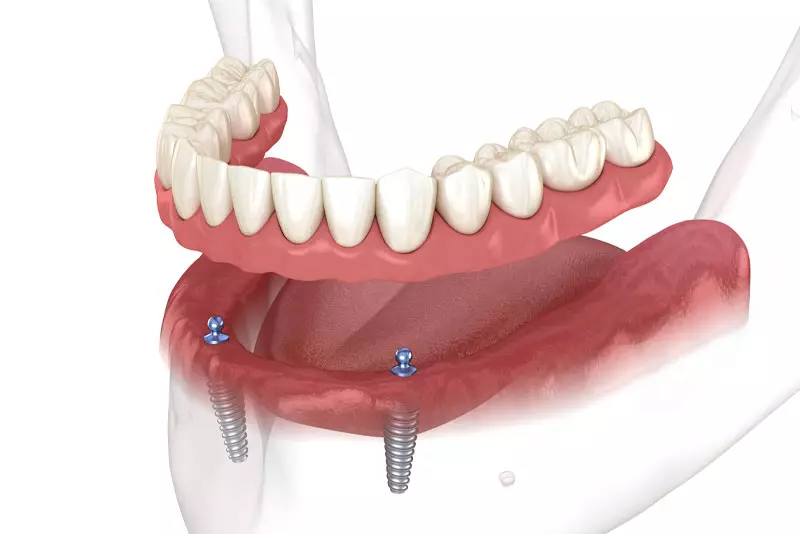
The difference underneath is simple. A dental implant is a small titanium post placed into your jaw that acts as a new tooth root; a crown, bridge, or full arch of teeth attaches to it, and nothing moves. A denture rests on your gums — held by suction, a bit of adhesive, or clasps on remaining teeth — and lifts out. That single distinction, replacing the root versus resting on the gum, drives almost every real-world difference in how the two feel, function, and hold up over a decade.
So the useful question isn't "which is better" in the abstract. It's: how much do you want to spend now versus over ten years, how important is a fully stable bite to you, and how do you feel about keeping the shape of your jaw? Answer those honestly and the choice usually makes itself. If your specific situation is switching away from a denture you already have, our implants vs. dentures deep-dive covers that ledger category by category.
Where Implants Clearly Win
Stability and chewing power are the biggest gap. Implants are anchored in bone, so bite force transfers the way it does with natural teeth — most people get back the great majority of their chewing strength and eat steak, apples, and corn without a second thought. A conventional upper denture covers the roof of your mouth and can slip when you laugh or bite into something firm; even a good lower denture floats on a narrow ridge. For many patients that means avoiding certain foods and living with the low-grade worry that something shifts at the wrong moment.
Then there's bone. When a tooth leaves, the jawbone that held it stops getting stimulated and starts shrinking — research consistently shows the fastest loss in the first year after extraction, with a meaningful share of ridge width gone within twelve months. A denture sits on top of that gum but does nothing to stop the process; in fact, as the ridge shrinks underneath, the denture loosens and needs relines or remakes. Implants are the one option that actually preserves bone, because the post stimulates it the way a root does. That's also why a denture worn for years can change the shape of the lower face over time, while implant-supported teeth hold it.
Longevity favors implants too. Long-term implant survival runs high — studies commonly cite around 95% over ten years — and for many patients a well-cared-for implant lasts decades. Dentures typically need relining or replacement every five to eight years as the mouth changes beneath them. That's the decade-long math the upfront price tag hides: a lower sticker on the denture, a lower running cost on the implant.
Where Dentures Still Make Sense
The clearest advantage is upfront cost and the absence of surgery. A full denture is the least expensive way to replace a full set of teeth on day one, it requires no incision or healing, and it can be delivered relatively quickly. If a real medical constraint makes surgery unwise right now, or if the budget for anything more simply isn't there this year, a properly fitted denture restores a smile and basic function — and that matters.
Dentures are also removable by design, which a few people genuinely prefer, and they're straightforward to adjust as circumstances change. It's worth being clear-eyed, though: the trade for that low entry price is the ongoing cost of relines and remakes, the adhesive routine, the food limits, and the bone loss that keeps quietly changing the fit. None of that makes a denture the wrong choice — it makes it a different set of trade-offs, and the right one for some people. What we'd push back on is choosing a denture only because someone told you that you "don't have enough bone" for implants. That's often not true anymore.
Modern implant dentistry has answers for thin or resorbed jaws that didn't exist a generation ago: bone grafting and sinus lifts to rebuild what time took, angled full-arch designs like All-on-4 that reach solid bone without grafting, and for severely resorbed upper jaws, zygomatic implants that anchor in the cheekbone and skip the graft-and-wait entirely. Our candidacy guide covers what actually rules people out — and it's far fewer things than most expect.
The Money, Honestly
A single denture arch costs less than implants up front — there's no way around that, and we won't pretend otherwise. Where the picture changes is over time. Because dentures need periodic relines and replacements while implants are built to last, the two costs converge over a decade, and for many people the implant comes out ahead once you count the remakes, adhesives, and the value of not restricting your diet. The honest way to compare isn't the sticker price; it's the ten-year total plus how you want to live in the meantime. Our implant cost page breaks down the five factors that actually set your number.
Roughly 92% of our full-arch patients finance their treatment through options like Cherry, CareCredit, Proceed, or Happen Bank, turning the total into a monthly payment. We're in-network with many PPO plans, including Delta, Aetna, Cigna, MetLife, Guardian, UnitedHealthcare, Anthem Blue Cross, and Blue Shield of California, though not Medicare, Medi-Cal, or HMO plans. The free consultation includes a 3D scan — a $499 value at no cost — so you get a real number for your mouth, not a phone quote.
One thing worth knowing if you lean toward implants: what you leave with varies by office. At many centers, a same-day arch is temporary acrylic you wear for six to eight months while the implants fuse. Because we plan, place, restore, and mill everything under one roof — including an in-house CAD/CAM zirconia mill — most patients get final, custom-milled teeth in about 72 hours for a full arch, or about a day for a single tooth. You can see that workflow on the same-day dental implants page.
So Which One Is Right for You?
Lean toward implants if you want a fixed, stable bite, you care about preserving bone and facial shape, and you can either budget or finance the higher upfront cost — which describes most people once they see the ten-year math. Lean toward a denture if lowest upfront cost is the deciding factor, you want to avoid surgery, or a medical reason makes waiting the right call for now. And know that these aren't strictly either/or: implant-retained overdentures snap onto a few implants for far more stability than a plain denture, and full-arch options like multiple implants or the All-on-8 Robust protocol sit at the top end of fixed, permanent teeth.
The part that shouldn't change, whichever way you go, is who does the work and how carefully your case is planned. At the Center for Implant Dentistry — family-owned in Fremont and San Francisco since 2008 — Dr. Sam Jain (a DMD who also holds an MS in mechanical engineering and developed the All-on-8 Robust protocol) and Dr. Arpana Gupta, both ICOI Masters, personally plan, place, and restore every case. No fly-in surgeons handing your bite off to someone else. They also take the hard cases and rescue failed implants placed at other offices — the kind of work not every practice will touch.
The cleanest way to settle the implants-versus-dentures question isn't reading one more article — it's seeing your own jaw on a screen. A free 3D CBCT scan measures your bone in three dimensions, so the recommendation comes from your anatomy and bite rather than a guess. Bring your questions, bring this article, and ask the people who'd actually do the work. Book the free consultation and get a real answer for your mouth.
Written and medically reviewed by Dr. Sam Jain, DMD, MS, and Dr. Arpana Gupta, DDS, MDS, who own this practice.
This article is patient education, reviewed by Dr. Sam Jain, DMD, MS, and Dr. Arpana Gupta, DDS, MDS, and is not a substitute for an exam. Treatment recommendations are made only after an in-person consultation and 3D imaging.