The Temporary Tooth While an Implant Heals: Every Option, What Each One Protects, and Why the Healing Site Comes First
For most people, the first question about a front tooth implant is not about the implant at all. It is whether they will have a gap. Usually they will not, but the kind of temporary matters more than people expect, because the tooth filling the space has to do its job without disturbing the implant healing underneath it.


Written and medically reviewed by Dr. Sam Jain, DMD, MS, and Dr. Arpana Gupta, DDS, MDS
Published
In this article
- 1A temporary tooth has two jobs, and one of them is invisible
- 2A temporary crown on the implant itself
- 3A tooth bonded to the neighboring teeth
- 4A clear retainer with a tooth inside
- 5A flipper: a small removable denture
- 6What the temporary does for the final tooth
- 7Back teeth and full arches
- 8Living with a temporary: the rules that protect the implant
A temporary tooth has two jobs, and one of them is invisible
The visible job is obvious: you need to smile, speak and go to work while the implant bonds to the bone. The invisible job is to protect that bond while it forms. During the first weeks, the implant's initial mechanical grip is gradually replaced by new bone, and an implant that is moved too much during that window can heal with scar tissue instead of bone. Our article on osseointegration explains that biology and the threshold of movement it tolerates.
So every temporary option is judged by the same two questions: does it look and work well enough for your daily life, and does it keep pressure and movement away from the implant, and from any graft placed with it? A temporary that looks good but presses on a fresh graft every time you bite is the wrong temporary, however convenient it is.
A temporary crown on the implant itself
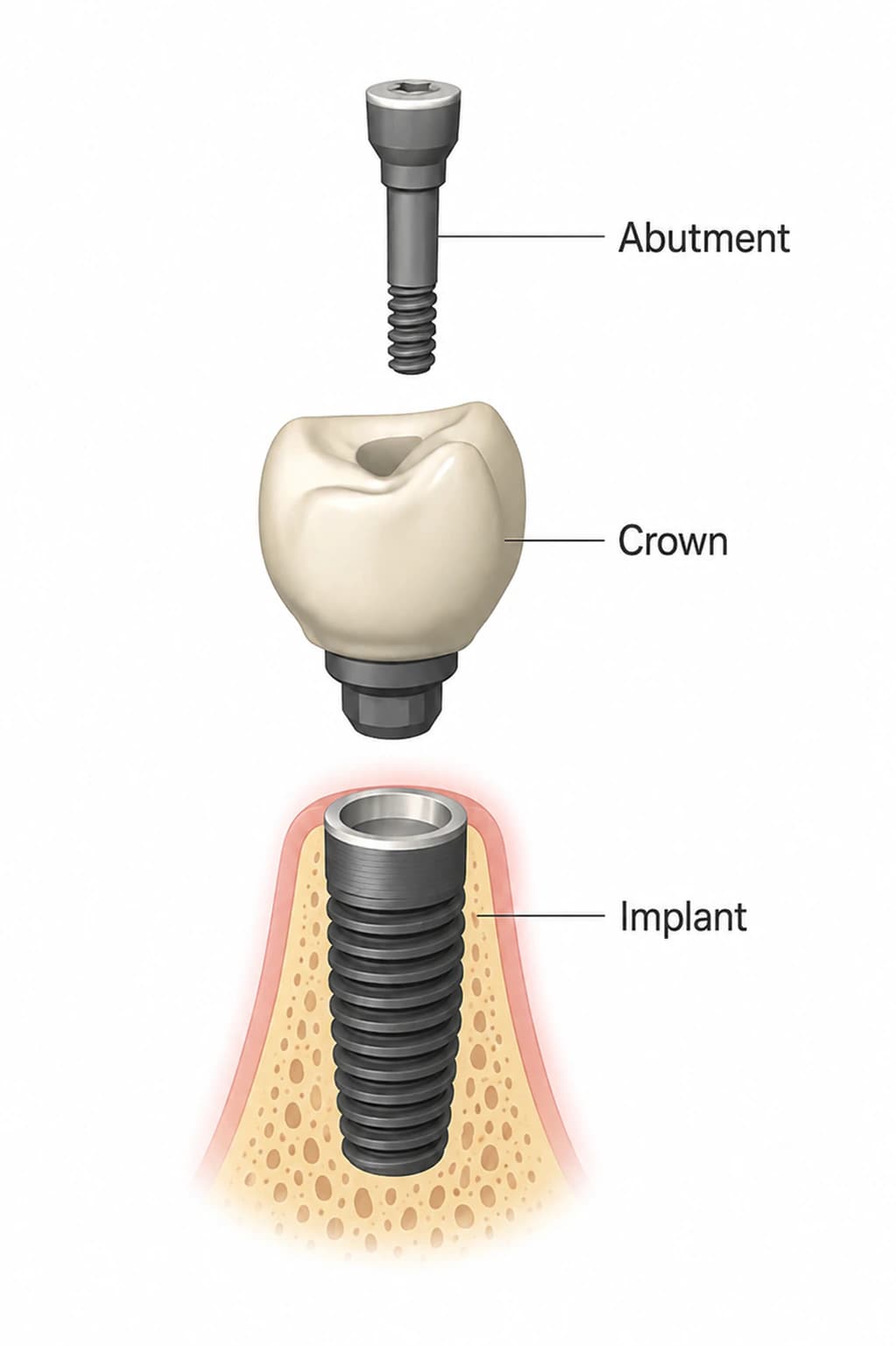
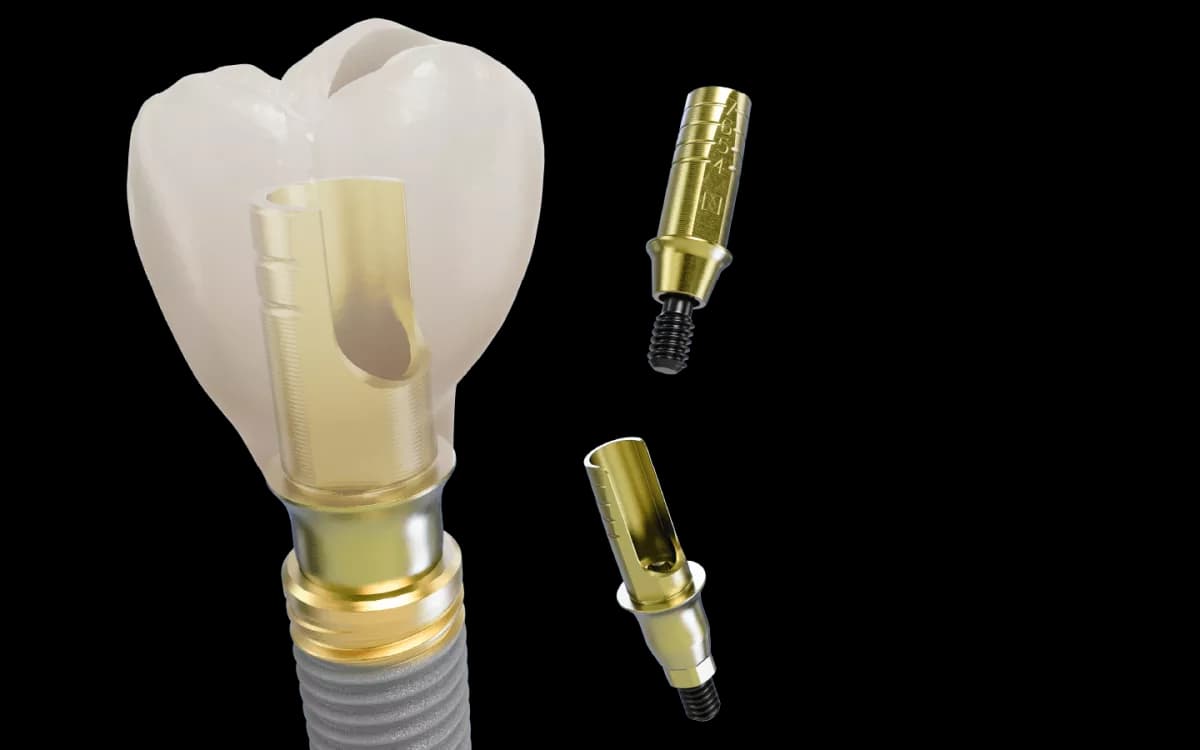
When the implant is firm enough at surgery, a temporary crown can be attached to it the same day. For a front tooth, the crown is shaped so that it does not touch the opposing teeth when you bite together or slide your jaw, which keeps chewing forces off the implant while it heals. It looks like a tooth, it is fixed, and there is nothing to take out.
The research supports this for the right implant. A 2014 systematic review of ten randomized trials comparing single implant crowns loaded immediately with those loaded after conventional healing found no difference in implant survival or bone loss over one to five years. The authors noted that this conclusion came mainly from implants placed with an insertion torque of at least 20 to 45 Ncm, or a stability reading of at least 60 to 65, and without a bone graft at the same time. At immediate implants, the temporary crown may also help the gum: a 2022 meta-analysis of seven randomized trials found 0.87 mm less recession of the gum at the front of the implant when a temporary crown was placed immediately, without any effect on survival, although the certainty of that evidence was rated low.
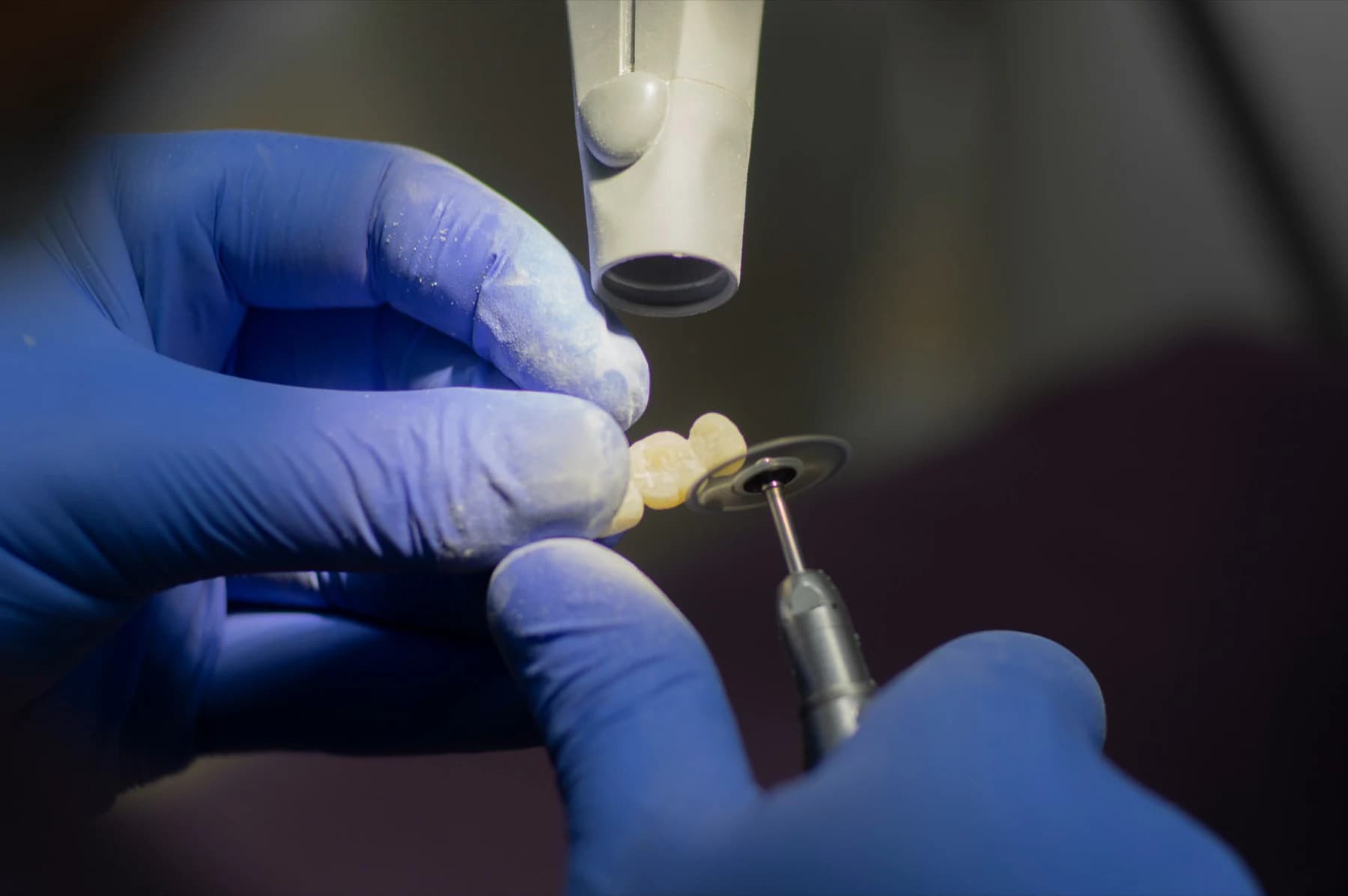
At our practice, the in-house lab makes it possible to shape a temporary or a custom zirconia tooth on the day of surgery for many qualifying front-tooth cases. The decision is made at the chair with the torque reading in hand: if the implant does not reach the stability needed, the plan changes on the spot to one of the options below, and the reason is explained before you leave.
A tooth bonded to the neighboring teeth
When the implant should not carry a crown yet, a replacement tooth can be bonded to the back surfaces of the neighboring teeth, with a small wing or a fiber splint and tooth-colored resin. It stays in place, it does not rest on the gum over the implant, and in most cases it needs no drilling of healthy teeth. It does need enough room behind the front teeth for the bond, and it can come loose, especially if you bite into something hard with it.
The same principle, made as a permanent all-ceramic restoration, is a recognized long-term alternative to an implant for a single missing incisor; our front tooth implant article explains when that alternative deserves serious thought.
A clear retainer with a tooth inside
A thin, clear plastic tray made from a scan of your teeth can carry a tooth-colored replacement in the gap. It is quick and inexpensive to make, and the inside can be relieved so it does not touch the healing site. The trade-offs are practical: it is removed to eat, it covers the other teeth so speech can feel slightly different at first, and people who clench or grind can wear through it. For a few weeks after surgery, or as a backup while another temporary is being made, it is often a sensible choice.
A flipper: a small removable denture
A flipper is a replacement tooth on a small acrylic plate that rests against the palate or gums. It is familiar, inexpensive and easy to take in and out; our article on the options for missing teeth covers it as a budget replacement. As a temporary over a new implant, its weakness is where it rests. A plate that presses on the gum over the implant or a graft transmits every bite to the healing site, so a flipper used in this role is trimmed and adjusted so it does not bear on that area, and it may need readjusting as swelling settles. Most people also find the plate bulky for speech at first.
What the temporary does for the final tooth
For a front tooth, a fixed temporary crown on the implant does more than fill the gap. By adjusting its shape over a few visits, the gum around the implant can be guided into the contour of a natural tooth before the final crown is made. A randomized trial tested exactly that: 20 patients with front implants either had a temporary crown stage used to shape the gum or went straight to their final crowns. At one year, the combined appearance score was 16.7 with the temporary stage and 10.5 without it; at three years the gum appearance score remained significantly better with the temporary stage, while the appearance of the crowns themselves did not differ.
Once the gum has the right shape, that shape is recorded so the final crown, designed and finished in our own lab, can support it rather than change it. That continuity is one of the reasons the temporary is planned together with the final tooth rather than treated as an afterthought.
Back teeth and full arches
For a single missing back tooth that does not show, many patients choose no temporary at all, and the implant heals under the gum or with a small healing cap. That avoids any risk of chewing on the site. If the space shows when you smile, the same options apply as for a front tooth.
For full arches, the temporary is a fixed set of teeth attached to the implants on the day of surgery for qualifying cases, as our same-day implants page describes. Because our lab mills the final arch in the building, the final teeth for a qualifying full-arch case typically replace those surgery-day teeth in about 72 hours rather than after months of wearing a temporary.
Living with a temporary: the rules that protect the implant
Do not bite into food with a front temporary: cut food into small pieces and chew with your back teeth, as the what-to-eat guide explains. Do not test the tooth with your tongue or fingers. Remove a clear retainer or flipper to eat and clean it every day. If you grind your teeth at night, say so before surgery, because it changes which temporary is safe.
If a temporary crown feels loose, cracks or comes off, or a bonded tooth debonds, call the office that day and do not glue it back at home. A loose temporary is usually easy to fix, and checking it promptly protects the implant under it. The same applies if a removable temporary starts to press or rub on the healing area.
Written and medically reviewed by Dr. Sam Jain, DMD, MS, and Dr. Arpana Gupta, DDS, MDS, who own this practice. Reviewed
This article is patient education, reviewed by Dr. Sam Jain, DMD, MS, and Dr. Arpana Gupta, DDS, MDS, and is not a substitute for an exam. Treatment recommendations are made only after an in-person consultation and 3D imaging.