Options for Replacing Missing Teeth (Including Budget Choices)
There are really only five ways to replace a missing tooth — here's what each one costs, how long it lasts, and the honest trade-off nobody explains at the front desk.


Written and medically reviewed by Dr. Sam Jain, DMD, MS, and Dr. Arpana Gupta, DDS, MDS
Published · Updated

The Short Answer: Your Five Real Options
There aren't a hundred ways to fix a missing tooth. There are five, and everything else is a variation on them: a flipper, a partial denture, a full denture, a bridge, or a dental implant. They line up almost perfectly from cheapest-and-most-temporary to priciest-and-most-permanent, and picking well is mostly about being honest with yourself about which of those two things you actually need right now.
Here's the quick map. A flipper is a single false tooth on a small plastic retainer — the fastest, cheapest thing you can put in a gap, often $300–$500. Partial and full dentures sit on the gums and clip or suction into place; they cost more, last longer, and come out at night. A bridge caps the two teeth beside the gap and spans a false tooth between them — fixed, natural-looking, but it grinds down two healthy neighbors. A dental implant replaces the root itself with a titanium post in the bone, then a crown on top — the only option that stops the jawbone from shrinking where the tooth used to be.
So the real question isn't "what's cheapest" or "what's best" in the abstract. It's: are you buying a placeholder to get through the next few months, or are you buying the tooth back for the next few decades? Both are legitimate answers. The mistake is paying implant money for a denture result, or paying denture money over and over because the cheap fix kept failing.
The Budget Options: Flippers, Partials, and Dentures
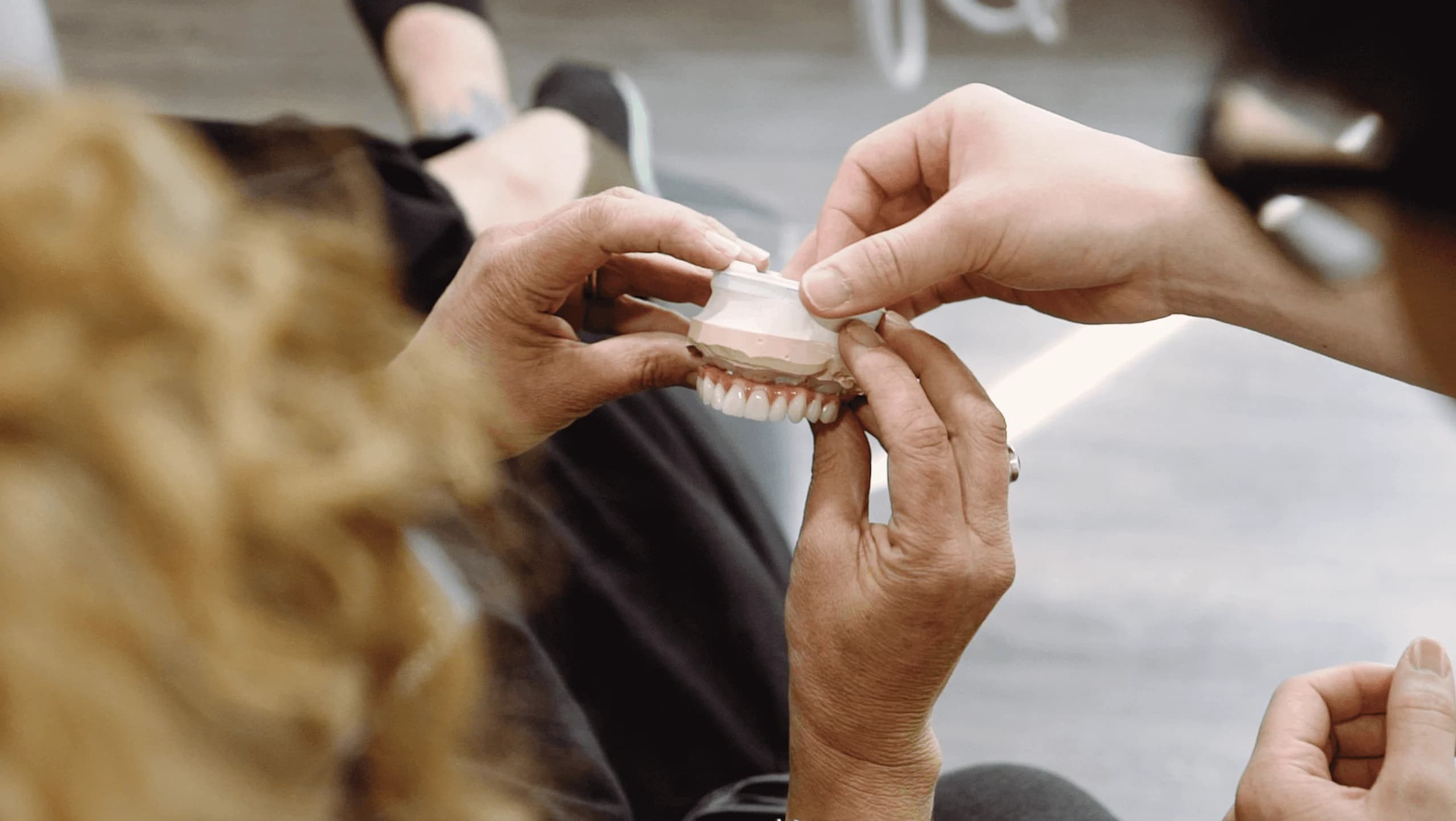
If cost is the deciding factor today, the cheapest way to fill a gap is a flipper — a removable acrylic tooth that flips into place. A single-tooth flipper typically runs $300–$500, needs no surgery, and can be ready in days. It's genuinely useful as a temporary: it holds the space and hides the gap while you heal from an extraction or save up for something permanent. What it isn't is durable. Flippers crack, they cover the roof of your mouth or hook onto teeth, and they do nothing for the bone underneath.
A partial denture is the sturdier cousin — a metal or acrylic framework carrying one or more teeth that clasps onto your remaining ones. It costs more than a flipper and lasts longer, and for someone missing several teeth in one area it's a reasonable, affordable choice. A full denture replaces an entire arch. All three of these share the same honest limitation: they rest on gum and bone rather than replacing the root, so the jaw keeps slowly resorbing beneath them. That's why dentures need relining and replacing every several years, and why long-time denture wearers get that sunken, collapsed look around the mouth — the bone that used to hold teeth has melted away. We lay out that trade-off in detail on our implants vs. dentures comparison.
None of this is a reason to shame the budget route. If a removable option is what fits your life and your wallet, it beats a gap. Just go in knowing what you're buying: a good, affordable prosthetic that sits on top of the problem, not one that solves it.
Bridges vs. Implants: The Fixed Options
If you want teeth that stay put — no clicking in and out, no bedside glass — you're choosing between a bridge and an implant. A traditional bridge is the older fixed option. To replace one missing tooth, the dentist files down the two healthy teeth on either side into pegs, then cements a three-tooth unit over all of them. It looks and chews well and it's usually cheaper up front than an implant. The cost is permanent damage to two good teeth, and a design where food and bacteria can work under the span — bridges commonly need replacing in roughly ten to fifteen years, and if a support tooth fails you can lose the whole thing.
A dental implant is the only option that replaces the root. A titanium post is placed in the jawbone, it fuses over a few months, and a custom crown goes on top. Because the post loads the bone the way a real root does, it stops the resorption that dooms dentures and bridges — and it leaves your neighboring teeth completely untouched. Long-term implant survival is high; studies commonly cite around 95% over ten years, and many implants simply last for life. For a single tooth, that whole workflow is covered on our single-tooth implant page; for several gaps, multiple implants can each be restored independently.
The catch everyone hears about is price — an implant is a bigger number up front. But run the math over a decade or two. A flipper you replace, a denture you reline and remake, a bridge you redo once or twice: those costs stack. The implant is the one option you often pay for once. Our honest cost breakdown walks through what actually moves your number, and financing through Cherry, CareCredit, and similar spreads the cost into monthly payments.

"But I Was Told I'm Not a Candidate" — and Full-Arch Options
A lot of people rule out implants before they ever get examined, usually because someone somewhere said they don't have enough bone, or they're too old, or their diabetes disqualifies them. In practice, very few things actually rule you out — our candidacy page covers what genuinely does and doesn't. When bone is thin, it can often be rebuilt with bone grafting or a sinus lift. And for upper jaws with almost no bone left — the cases most offices turn away — zygomatic implants anchor into the cheekbone and skip the graft-and-wait entirely.
If you're missing most or all of your teeth, you don't need an implant for every one. Four to six implants can carry a full fixed arch — that's All-on-4, and for heavier bites and generous bone, the All-on-8 Robust protocol that Dr. Sam Jain developed using his mechanical-engineering background for maximum load distribution. About 92% of full-arch patients finance the treatment. It's often the moment a lifelong denture wearer gets fixed teeth back for good.
Two things set the work here apart, and both matter more than any brochure. First, Dr. Sam Jain and Dr. Arpana Gupta — a married team of ICOI Masters — personally plan, place, and restore every case; there are no fly-in surgeons handing your bite off to a stranger. Second, everything sits under one roof, including an in-house zirconia mill, so for qualifying cases final custom teeth arrive in about a day for a single tooth or 72 hours for a full arch, and many implants go in the same day the tooth comes out — not six to eight months of temporary plastic. The best way to know which of the five options fits your mouth is to see your own 3D scan on the screen, which is exactly what the free consultation is for.
Written and medically reviewed by Dr. Sam Jain, DMD, MS, and Dr. Arpana Gupta, DDS, MDS, who own this practice.
This article is patient education, reviewed by Dr. Sam Jain, DMD, MS, and Dr. Arpana Gupta, DDS, MDS, and is not a substitute for an exam. Treatment recommendations are made only after an in-person consultation and 3D imaging.