Speech After All-on-4: Why the S Sound Changes, How Long Adjustment Takes, and What Can Be Adjusted
Most people's first worry about new full-arch teeth is eating. Speech is the change they notice first. A slight lisp or a whistle on S sounds in the early weeks is common and usually fades, but not always completely, and the reasons it happens explain both why most people adapt and what can be done when they do not.

Written and medically reviewed by Dr. Sam Jain, DMD, MS, and Dr. Arpana Gupta, DDS, MDS
Published
Why new teeth change the way you speak
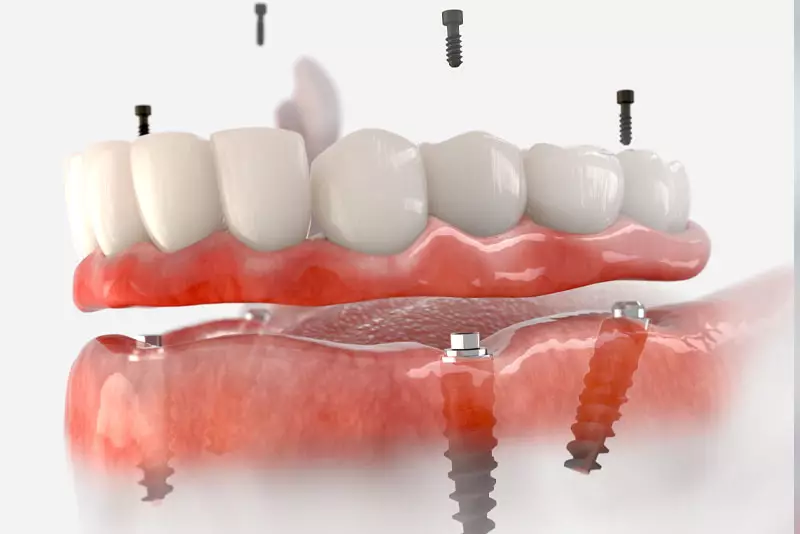
Speech depends on the tongue and lips touching or nearly touching exact places. An S is made by forcing air through a narrow channel between the tip of the tongue and the ridge behind the upper front teeth; F and V use the lower lip against the edges of the upper front teeth; T and D touch the tongue to the ridge behind them. Change the position, thickness or length of the teeth by a millimeter or two, or change the shape of the palate behind them, and the tongue has to relearn where to go.
Full-arch implant teeth change all of those at once. Compared with natural teeth, the bridge is usually thicker at the back of the front teeth, and there may be a small space between the underside of the bridge and the gum where air can escape. Compared with an upper denture, the palate is uncovered, which most people like but which also changes the surfaces the tongue has been using for years. The S sound is the most sensitive to all of this, which is why it is the one people notice.
What the studies found
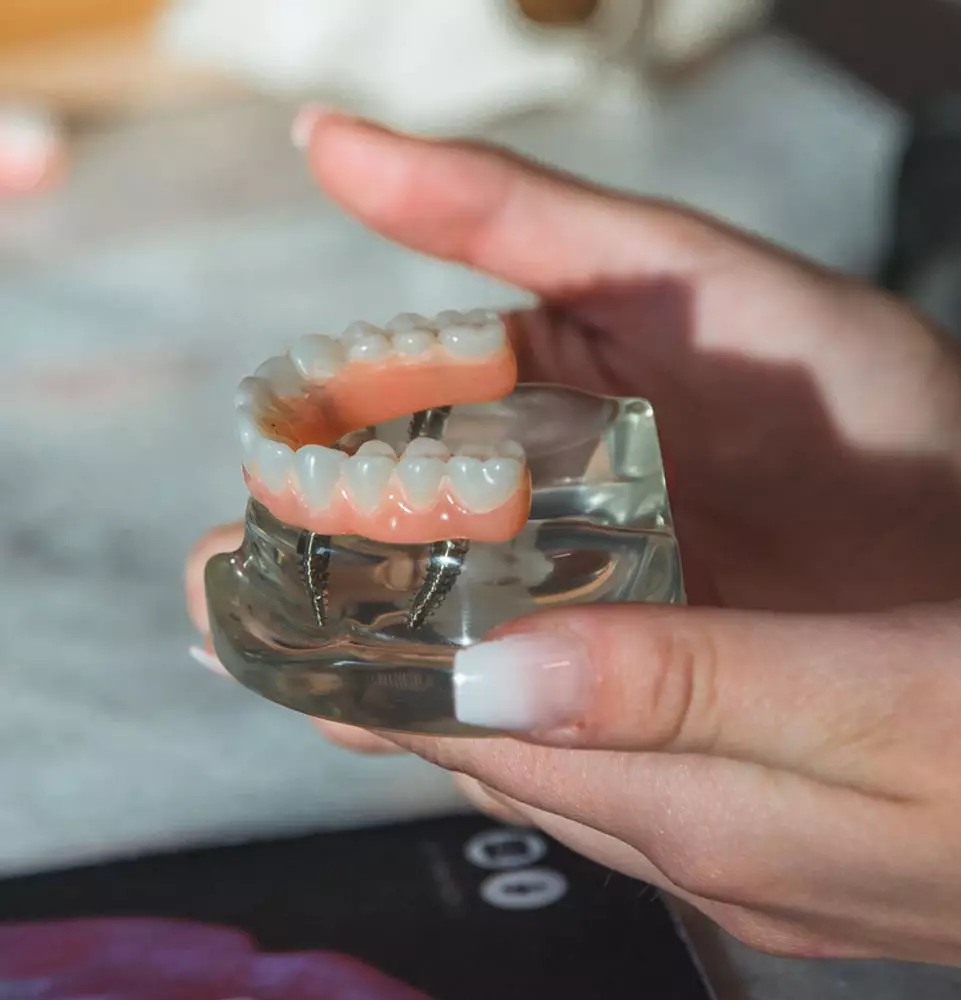
Speech changes after full-arch teeth are real and measurable. In a study of 15 patients assessed an average of 7.3 months after receiving All-on-4 teeth, 87% were satisfied with their prosthesis, but 53% said it had affected their speech, and assessment found at least one distorted consonant in 87% of them. The most common were distortions of S, in 40% and 33% of patients depending on the type, followed by Z, F and addental T and D, the tongue touching the teeth rather than the ridge behind them. The age-matched group with natural teeth had none.
A companion study comparing patients with single-tooth implants, fixed full-arch teeth and removable dentures found normal overall intelligibility in all three groups; satisfaction was 100%, 87% and 68% respectively, but the fixed full-arch group showed the widest range of distorted sounds, and the S sound was affected in more than half of the patients in every group.
The picture over time is more encouraging. In 21 patients given fixed upper bridges on implants, about 60% were judged to have indistinct speech after treatment. At three years, 94% considered themselves free of speech problems. Persistent difficulty with S was associated with weaker bite force, fewer contacts between the teeth, the width of the front of the bridge and tender chewing muscles, and two-thirds of the group had some hearing loss, which the authors suggested can make it harder to adjust speech by ear.
How long adjustment usually takes
The best estimate of the normal adaptation period is three to six months. In ten patients whose full-arch teeth were attached immediately after implant surgery, articulation was unchanged or improved three to six months later in all but one, and immediate loading did not lengthen that period. A 2024 study of 50 patients with fixed upper full-arch teeth found that how much the S and similar sounds improved depended mainly on speech before treatment, the amount of bone remaining at the front of the upper jaw, and time.
Practically, the first days after surgery are not a fair test: swelling, numbness and the thickness of temporary teeth all affect speech. Most people hear a steady improvement over the first weeks as the tongue relearns its positions. A sound that is still clearly distorted after several months deserves a look, because some causes can be adjusted.
Fixed or removable: does it matter for speech?
It can. In a crossover trial, 30 people without teeth wore an upper fixed bridge on implants and an upper removable overdenture on implants, each for two months. Lay listeners correctly identified more stops and fricatives, the sounds made by stopping or squeezing air, with the overdentures, and it made no difference whether the overdenture covered the palate. A removable denture can seal against the gum and carry a flange that supports the lip, which may explain part of the difference.
Removable is not a guarantee of clear speech either. In 21 patients with upper overdentures on four implants, 37.5% still had a distorted S at three years, even though satisfaction with their speech had improved. The honest conclusion is that some change in S is common with any full-arch replacement, and that design details matter more than the category.
What can be adjusted when a sound does not settle
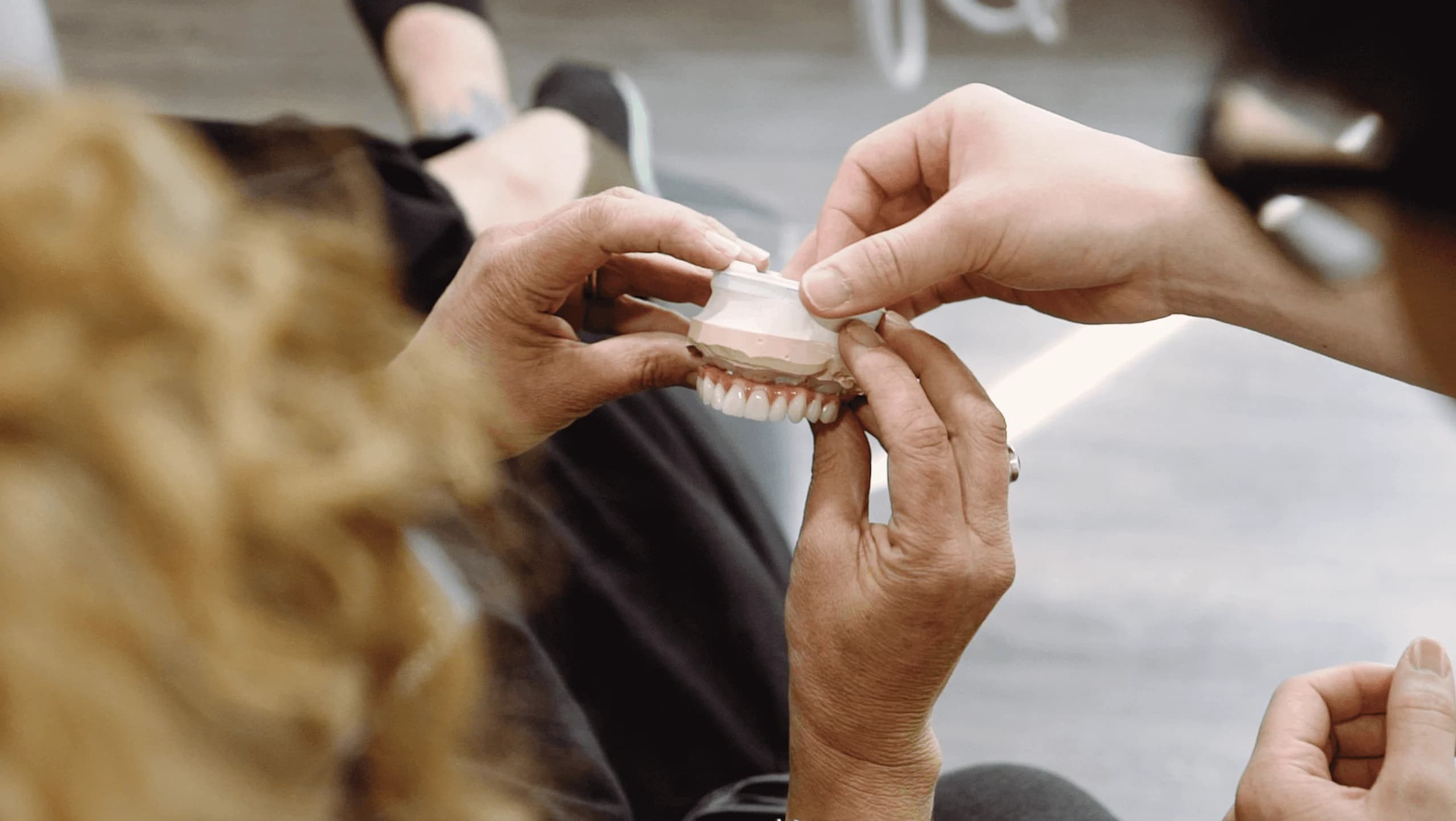
The first step is to identify which sound is affected, because each points to a different part of the design. A whistle or hissing S often means air is escaping through a space under the upper bridge or between the teeth, or that the tongue does not have room behind the front teeth. A soft F or V can mean the upper front teeth are too short, too long or too far back for the lower lip. A lisp in which the tongue touches the teeth can mean the front teeth are too thick behind or the bite has closed too far. Some of these can be improved by reshaping the back of the front teeth or the palate side of the bridge, closing a gap under it or adjusting the bite; others need a revised design.
There is a trade-off to respect. Closing every space under an upper bridge can help speech but makes it harder to clean, and cleaning access protects the implants. That balance is set case by case. Interestingly, a randomized study found no link between wide or narrow spaces between the teeth of upper bridges and whether speech was affected, so a space is not automatically the culprit.
For patients who still have teeth before treatment, our smile design process lets you wear the planned smile, built in tooth-colored composite on your own teeth, and eat and speak with it for days before surgery; the final arch is then milled in our own lab to reproduce the design you approved. After treatment, bite adjustments and follow-up visits are part of our care, so a sound that has not settled is examined rather than dismissed. Some patients also benefit from working with a speech-language pathologist, although whether targeted speech therapy shortens adaptation has not yet been well studied.
Helping your speech adapt in the first weeks
Speech adapts through use. Reading aloud for a few minutes each day, especially passages with many S, F and TH sounds, gives the tongue repeated practice, and counting slowly from sixty to seventy exercises the S sound in particular. Recording yourself early and again a few weeks later is often reassuring, because improvement is easier to hear than to feel.
If you have hearing loss, mention it before treatment; it can make adjustment harder, and knowing that in advance changes how progress is judged. And if a particular sound is still bothering you after the first couple of months, note which words are hardest and bring that list to your follow-up visit. Our article on life after dental implants describes the rest of the day-to-day adjustment.
Written and medically reviewed by Dr. Sam Jain, DMD, MS, and Dr. Arpana Gupta, DDS, MDS, who own this practice. Reviewed
This article is patient education, reviewed by Dr. Sam Jain, DMD, MS, and Dr. Arpana Gupta, DDS, MDS, and is not a substitute for an exam. Treatment recommendations are made only after an in-person consultation and 3D imaging.