Dental Implant Feels Loose? How to Tell a Loose Crown, a Loose Screw and a Failing Implant Apart, and How Each Is Fixed
When an implant tooth moves, most people assume the implant has failed. Far more often a crown or a small screw has loosened — a mechanical problem that is usually fixed in a visit. Here is how the two are told apart, why some crowns keep coming loose, and what happens when a screw breaks.


Written and medically reviewed by Dr. Sam Jain, DMD, MS, and Dr. Arpana Gupta, DDS, MDS
Published
In this article
- 1Three parts can move, and only one of them is the implant
- 2What to do today if an implant tooth moves
- 3How we find out which part is loose
- 4A loose screw: why it happens and how it is fixed
- 5When an implant crown keeps coming loose
- 6A broken screw: getting the fragment out
- 7When the implant itself is loose
- 8Keeping it from coming back
- 9Bringing a loose implant tooth to us
Three parts can move, and only one of them is the implant
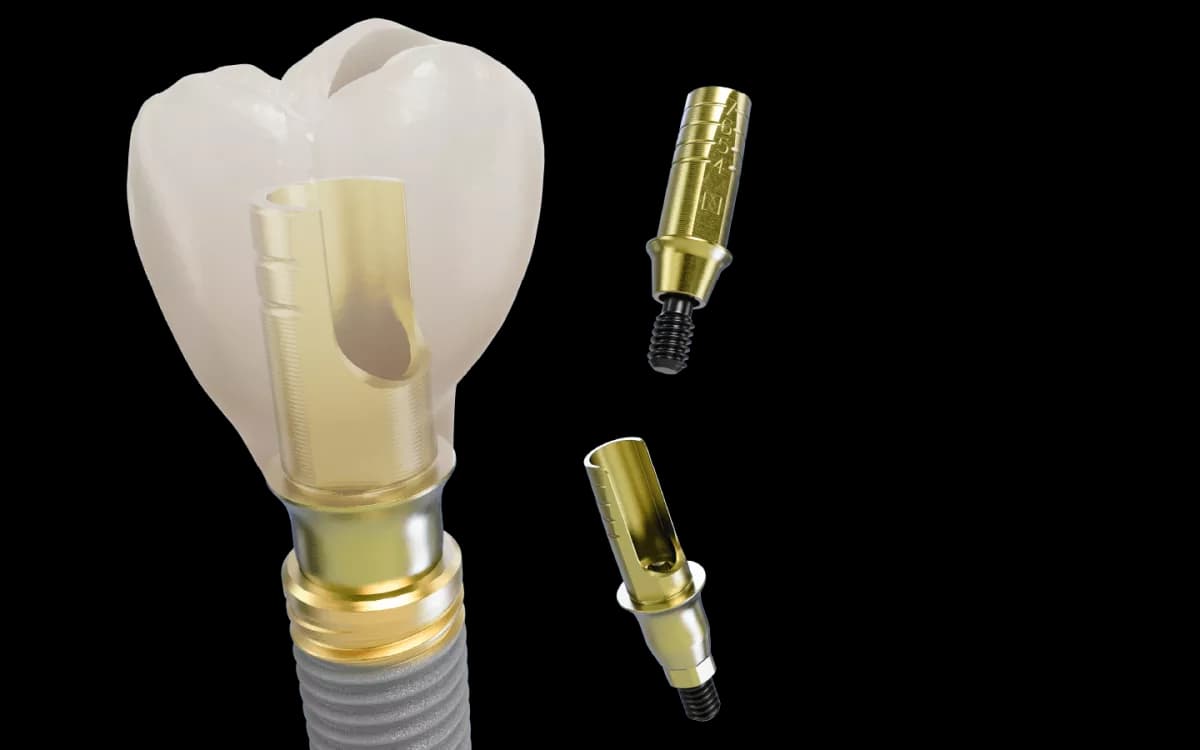
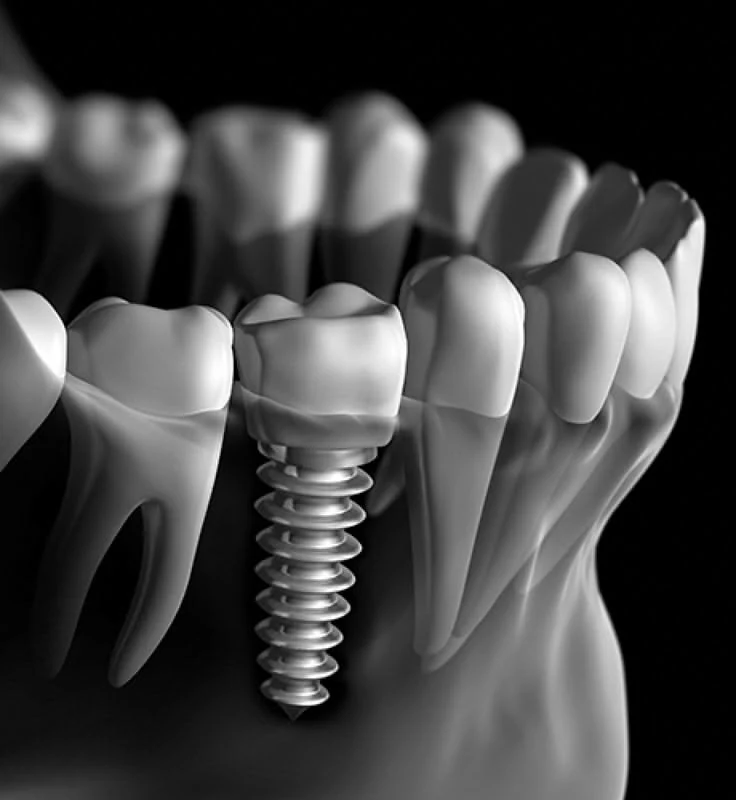
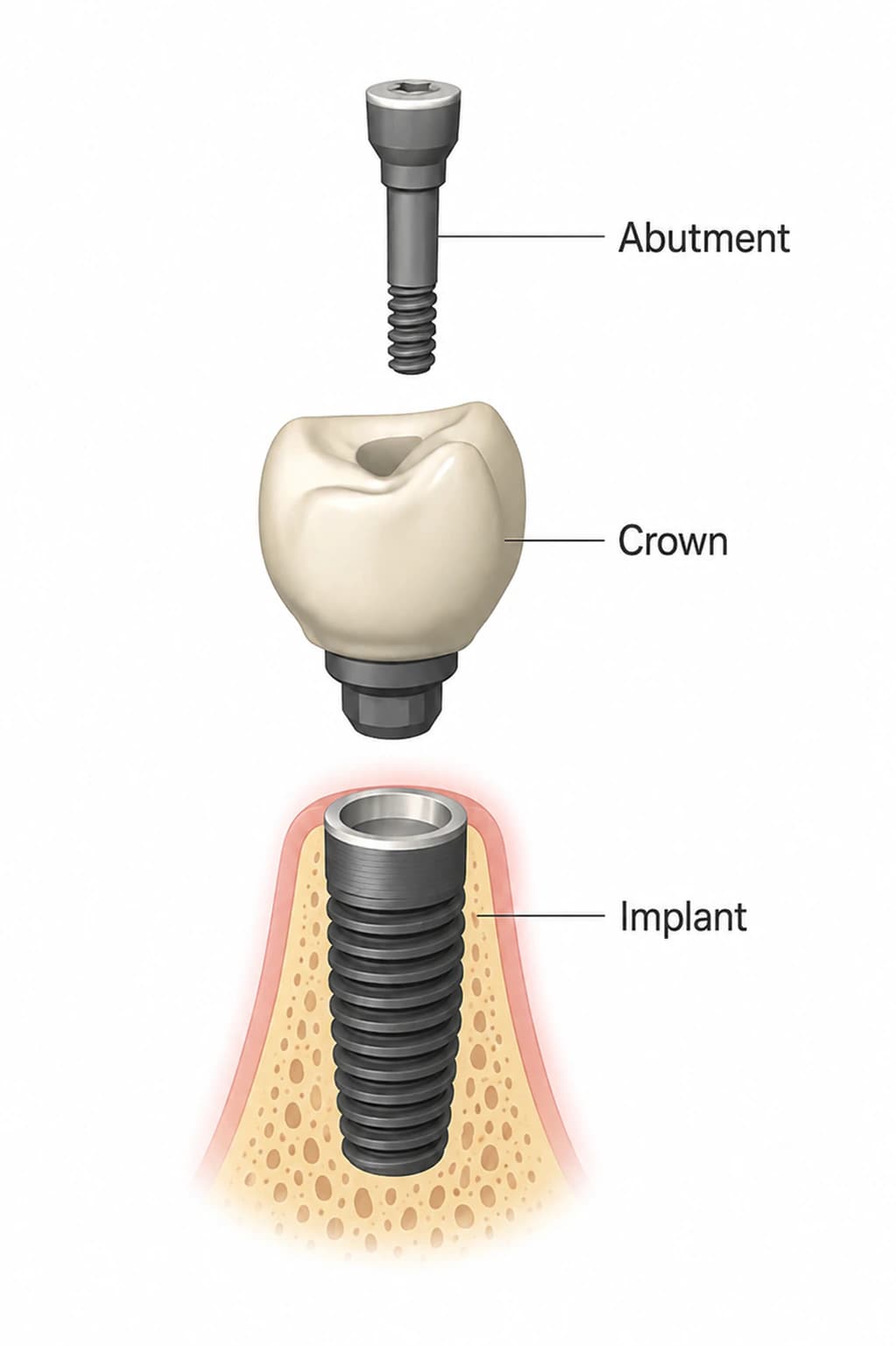
An implant tooth is a small assembly. The implant is the titanium or zirconia post in the bone. On top of it sits the abutment, the connector that rises through the gum, held to the implant by a screw about the size of a grain of rice. The crown sits on the abutment — either cemented onto it, or fastened with its own screw through a small access hole on the biting surface. When the tooth feels loose, any of those joints can be the one moving.
Mechanical loosening is common. A systematic review of implant-supported single crowns followed for at least five years found screw loosening in 8.8% of crowns and loss of retention of a cemented crown in 4.1% over that period. The implant itself breaking is rare: in a retrospective study of 10,099 implants, 44 fractured, or 0.44%. And an implant that has lost its bond with the bone is a different problem entirely, which we come to below.
The difficulty is that from the patient's side, a loose crown and a loose implant can feel exactly the same. Only an examination and an X-ray tell them apart. That is worth knowing before searching for the worst explanation.
What to do today if an implant tooth moves
Chew on the other side and avoid testing the tooth with your tongue or finger; every wiggle loads the joint that has already lost its tightness. If the crown comes off completely, keep it in a clean container and bring it with you. It can often be reused, and even when it cannot, it tells us a great deal about what failed.
Do not glue it back yourself. Over-the-counter cements and household glues can seat the crown in the wrong position, lock a loose screw underneath, and leave cement below the gum — and in an endoscopic study of implants with peri-implant disease, excess cement was present in 81% of the diseased cases. A crown glued back at home can turn a simple repair into a gum infection.
A loose implant tooth is rarely a middle-of-the-night emergency, but it is not something to leave for months either. A screw that has lost its tension keeps moving every time you bite, which fatigues it, and a screw that finally breaks is harder to deal with than one that is simply loose. Swelling, pus, a bad taste or pain along with the looseness point to infection and call for an earlier visit.
How we find out which part is loose
The examination starts with where the movement is. If the crown rocks but the gum and the abutment below it stay still, the crown's cement or its screw has failed. If the crown and abutment move together, the abutment screw has usually loosened. If the whole unit moves as one, including the part that disappears into the bone, the implant is suspect, and an X-ray or 3D CBCT scan shows the bone around it.
We also look for why it happened: wear facets and fractures that point to grinding, a bite that lands too hard on the implant tooth, a crown that extends like a cantilever beyond the implant, a gap on the X-ray between the abutment and implant that suggests a part is not seated, and the identity of the implant system. That last step matters for implants placed at other offices. Parts are specific to each system and connection, and a component that nearly fits is one of the recurring causes of screws that will not stay tight.
A loose screw: why it happens and how it is fixed
Screws stay tight because they are stretched slightly when they are tightened to a specified torque, and that tension — called preload — clamps the parts together. Anything that erodes the preload lets the screw back out: tightening below the manufacturer's value, parts that do not fit precisely, a bite that rocks the crown sideways, heavy grinding, or a long crown on a short implant. A systematic review of abutment connections found screw loosening to be the most frequent technical complication, more common with external connections, and noted that proper preload may reduce it.
Fixing it means reaching the screw. On a screw-retained crown, the filling over the access hole is removed and the screw is right there. On a cemented crown there is no access hole, so the crown may have to be drilled through and repaired, or cut off and replaced. This is the practical advantage of screw retention. A systematic review found screw-retained single crowns had more technical complications over five years — 24.4% compared with 11.9% for cemented crowns — but concluded that screw-retained restorations seem preferable overall, because they are more easily retrieved and the complications are easier to treat.
Once the screw is out, we inspect it and the threads inside the implant, usually replace it with a new screw rather than re-tighten a stretched one, and tighten it to the value specified for that system with a calibrated driver. Then we correct whatever loosened it: adjusting the bite, reshaping the crown, or recommending a night guard for a patient who grinds.
When an implant crown keeps coming loose
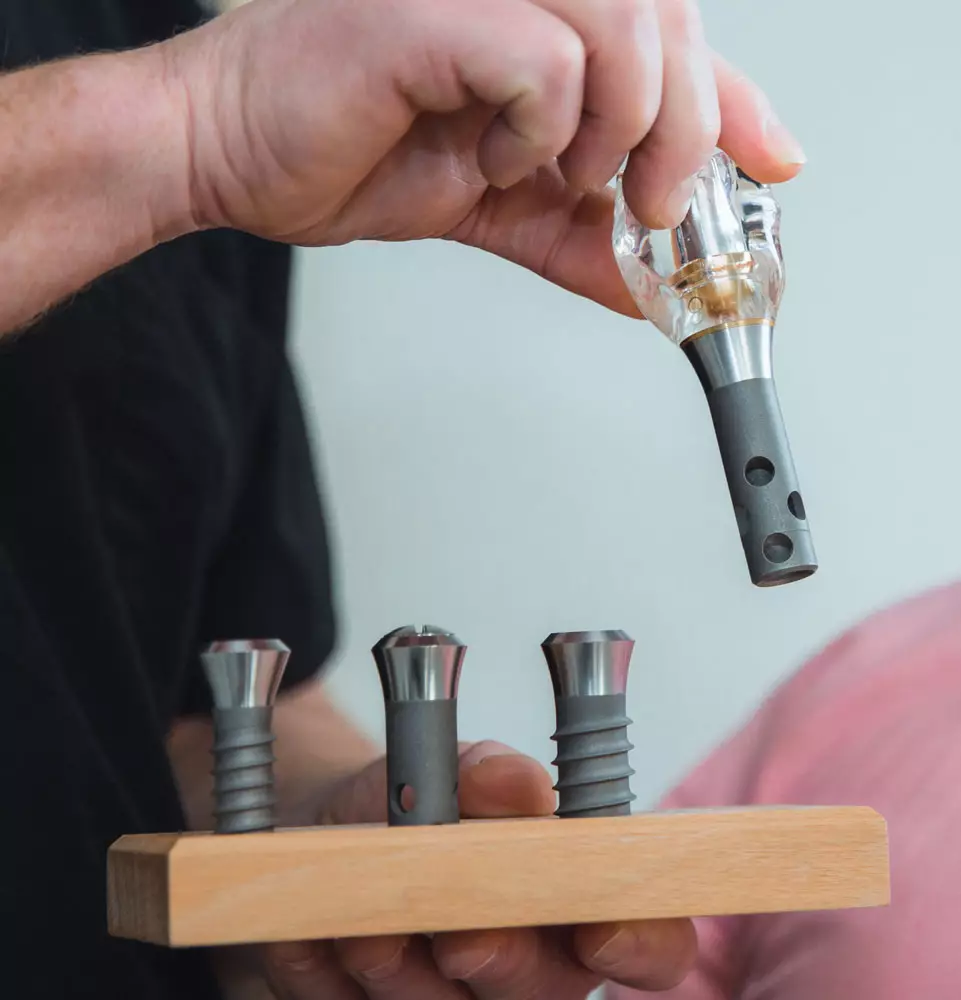
One loose screw can be bad luck. A crown that comes loose again and again is telling you the cause has not been fixed. The usual suspects are a bite that overloads the implant, especially with grinding or clenching; non-original or mismatched components; an abutment that does not seat fully; a crown that is too wide, too tall or cantilevered; and, less often, an implant placed at an angle that directs chewing force sideways. Grinding matters more than most people realize: a 2025 meta-analysis found bruxism associated with higher odds of every mechanical complication it examined, including about 3.4 times the odds of screw loosening and 7 times the odds of screw fracture, and a 2024 meta-analysis linked it to about twice the odds of implant failure.
The repair therefore depends on the diagnosis. Sometimes it is a new original screw and abutment for that implant system. Sometimes it is a redesigned crown with a narrower biting surface and no cantilever, or a cemented crown converted to a screw-retained one so it can be serviced. Sometimes it is a bite adjustment and a night guard. Because our lab is in the building, a new abutment or crown can be designed around the actual problem and tried in without shipping the case away.
Recurring looseness is also a reason to check the implant itself. An X-ray confirms that the bone level is stable and that there is no crack in the implant, before anyone keeps tightening screws on a foundation that is failing.
A broken screw: getting the fragment out
When an abutment screw breaks, the head comes away with the crown and the threaded part stays inside the implant. The good news is that a fragment from a screw that had already loosened is often not tight: it can frequently be turned out counterclockwise with a fine instrument or an ultrasonic tip, under magnification, without touching the implant. A fragment that is jammed needs dedicated retrieval instruments and more time, and the goal throughout is to protect the implant's internal threads.
Occasionally the internal threads are damaged, or the fragment cannot be retrieved safely. Then the options narrow to working around the implant or, in some cases, removing it and placing a new one. That is uncommon, and it is one of the reasons we take broken screws seriously as a sign: screws fracture under repeated overload, so the plan has to address the load as well as the fragment. In full-arch bridges, screw fractures were reported in about one in ten prostheses over five years in a systematic review of fixed full-arch implant teeth.
When the implant itself is loose
An implant that moves in the bone cannot be tightened. The International Congress of Oral Implantologists' health scale, agreed at a consensus conference in 2007, places a mobile implant in its failure category. In the first months after placement, that usually means the implant never fully integrated. Years later, it usually means the supporting bone has been lost to peri-implantitis or overload, or, rarely, that the implant has fractured — in the series of 10,099 implants, fractures appeared on average about eight years after placement, half of them between the second and eighth years, and bruxism and implants next to a cantilever were associated with a much higher risk.
A mobile implant is removed, the site is cleaned and often grafted, and a new implant is planned once the bone is ready — or sometimes in the same visit when there is enough solid bone. Our articles on implant removal and replacement and on peri-implantitis treatment explain those paths and their odds.
Keeping it from coming back
Most loosening is preventable with the same few habits. Original components for the implant system, tightened to the correct value. Screw-retained crowns where the anatomy allows, so parts can be checked and serviced. A bite that shares load with the natural teeth rather than landing on the implant first. A night guard for anyone who grinds, which our teeth-grinding article covers in detail. And regular maintenance visits where the bite and the screws are checked before a problem announces itself.
For implants we place, what a re-tightened screw or a bite adjustment costs depends on the warranty terms written into your treatment plan, which follow the implant system and materials you chose; our warranty page explains how those terms are set.
Bringing a loose implant tooth to us
If your implant tooth moves, whoever placed it, bring it and any crown that has come off. We are open six days a week, and at a free consultation we examine the joint, take the imaging needed to see the bone, identify the implant system and give you a plain-language diagnosis with the options and costs in writing. Mechanical problems such as a loose screw or a failed cement seal are often corrected in a single visit; a crown that has to be redesigned or remade is designed and milled in our own lab. You can book a free consultation here, or read more on our implant complications page.
Written and medically reviewed by Dr. Sam Jain, DMD, MS, and Dr. Arpana Gupta, DDS, MDS, who own this practice. Reviewed
This article is patient education, reviewed by Dr. Sam Jain, DMD, MS, and Dr. Arpana Gupta, DDS, MDS, and is not a substitute for an exam. Treatment recommendations are made only after an in-person consultation and 3D imaging.