Implant Troubleshooting by Dr. Sam Jain: Calcium Sulfate for a Summers Lift
A common grafting question from the operatory, answered plainly: why calcium sulfate alone rarely holds a crestal sinus lift, and what to reach for instead.

Written and medically reviewed by Dr. Sam Jain, DMD, MS, and Dr. Arpana Gupta, DDS, MDS
Published · Updated
The one-paragraph answer
The question comes up on clinical forums and in our own study club all the time: can you pack calcium sulfate into a Summers osteotome sinus lift instead of a standard bone graft? Short answer, from what Dr. Sam Jain sees and what the literature backs up: on its own, usually no. Calcium sulfate resorbs too quickly to hold the sinus floor up while new bone forms. It tends to disappear in roughly a month, which is well before the graft site has organized into anything that will support an implant apex long-term.
A Summers lift depends on the graft acting as a hydraulic plug. You tap the osteotome, the mass of native bone plus graft material pushes the sinus membrane up gently, and that material has to stay put long enough to 'tent' the membrane and give new bone a scaffold to grow into. Calcium sulfate is a fine, resorbable material, but it lacks the body and the timeline to do that job by itself. When it dissolves early, the tented space can collapse and the height you gained goes with it.
That does not make calcium sulfate useless. It has a real role as a graft binder, a barrier, and a source of calcium ions that new bone can precipitate onto. The nuance is how you use it, in what mix, and in which case. That is the part worth spending a few paragraphs on.
Why calcium sulfate resorbs before it can hold height
Bone graft materials are chosen largely by how fast they turn over. Autogenous bone is the biological gold standard because it is osteogenic, osteoconductive, and osteoinductive, but it comes with donor-site morbidity and can resorb unpredictably. Allografts and xenografts sit slower on the timeline; a bovine xenograft in particular is prized in sinus work precisely because it barely resorbs and maintains volume for years. Beta-tricalcium phosphate holds the gained volume noticeably longer than calcium sulfate does. Calcium sulfate is at the fast end of that spectrum.
In a crestal Summers approach, resorption speed is the whole game. You are working through a small osteotomy with limited access and asking the graft to keep a membrane tented over a healing period measured in months, not weeks. A material that is substantially gone in six weeks simply cannot span that gap alone. It is also honestly a technique-sensitive material: if you get bleeding under the membrane, unconsolidated calcium sulfate particles may not set the way you want, and the result is unpredictable. For many operators, that variability is reason enough to pick something denser.
There is one more limitation worth being plain about. Calcium sulfate is osteoconductive but not osteoinductive, meaning it gives bone a surface to grow along but does not signal new bone formation on its own. Combine that with rapid resorption and you have a material that helps the process but is not the load-bearing scaffold a sinus augmentation usually needs.
What Dr. Jain reaches for instead, and where calcium sulfate still earns its place
For a predictable crestal or lateral sinus lift, the workhorses are a slower-resorbing xenograft or allograft, often extended with beta-TCP, and increasingly a layer of the patient's own L-PRF or concentrated growth factors to speed vascular ingrowth. Those materials hold the space long enough for real bone to organize. Where calcium sulfate shines is as a component, not the whole graft: mixed with beta-TCP or an allograft it can act as a binder that keeps particles together, add a mild bacteriostatic effect, and give calcium ions a matrix to re-precipitate onto, which can nudge differentiation along. Used that way, it extends and improves a graft rather than trying to be the graft.
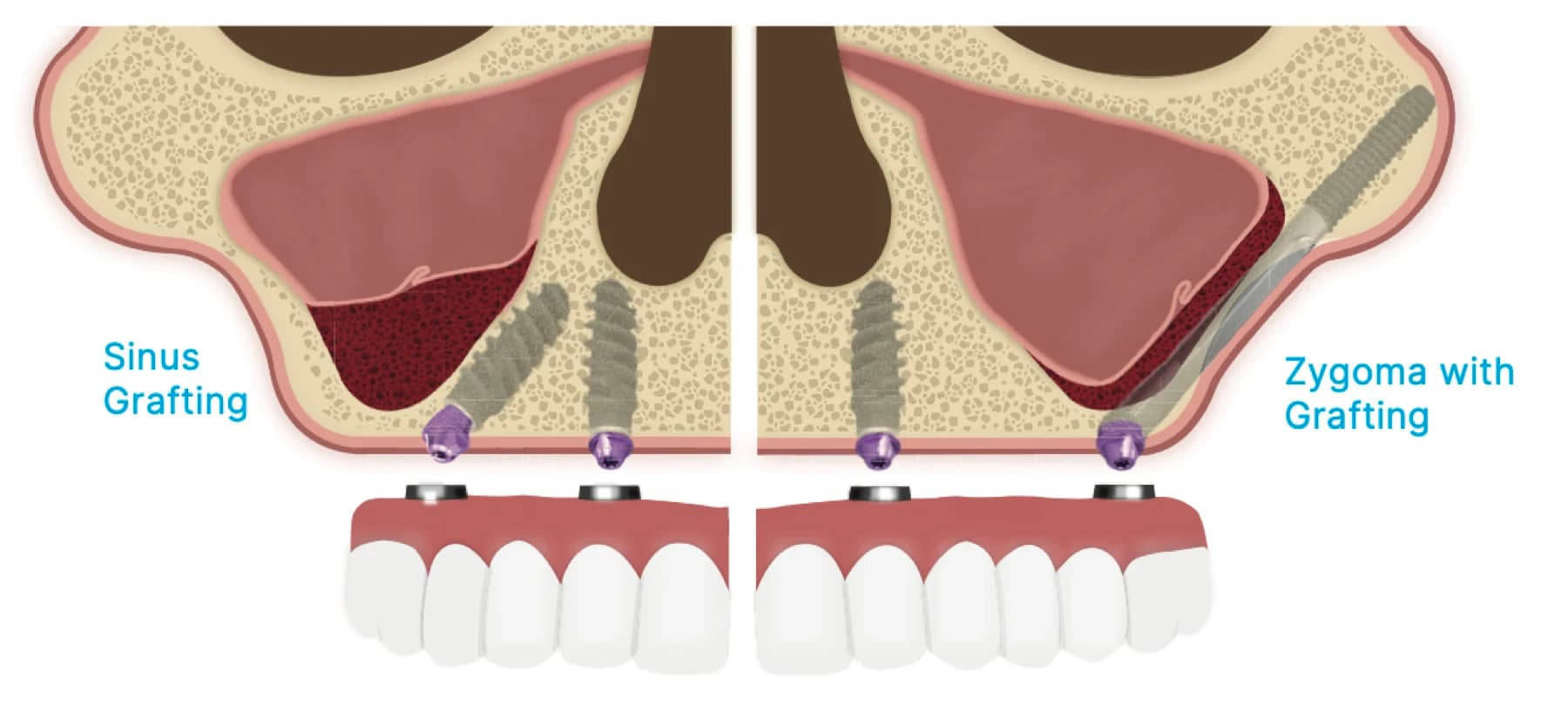
Case selection matters just as much as material selection. The osteotome technique generally wants a reasonable amount of residual ridge under the sinus, often cited around 5 mm or more, to get primary stability on the implant. When there is less bone than that, or the sinus floor anatomy is unfavorable, forcing a crestal lift with any material is the wrong call. That is when a formal lateral-window sinus lift with immediate implant placement or a staged bone grafting plan gives a far more predictable result. And in the truly atrophic posterior maxilla where grafting the sinus repeatedly has failed, zygomatic implants can anchor teeth without touching the sinus floor at all.
One quiet advantage of how our practice is built: because Dr. Sam Jain and Dr. Arpana Gupta plan, place, and restore every case themselves, the grafting decision is made by the same person who reads the free 3D CBCT and mills the final tooth. We are not handing a graft off to a fly-in surgeon and hoping the sinus holds. That continuity is a big part of how the Center for Implant Dentistry manages the harder posterior cases, including rescuing implants and grafts that failed somewhere else.
How this plays out for a patient
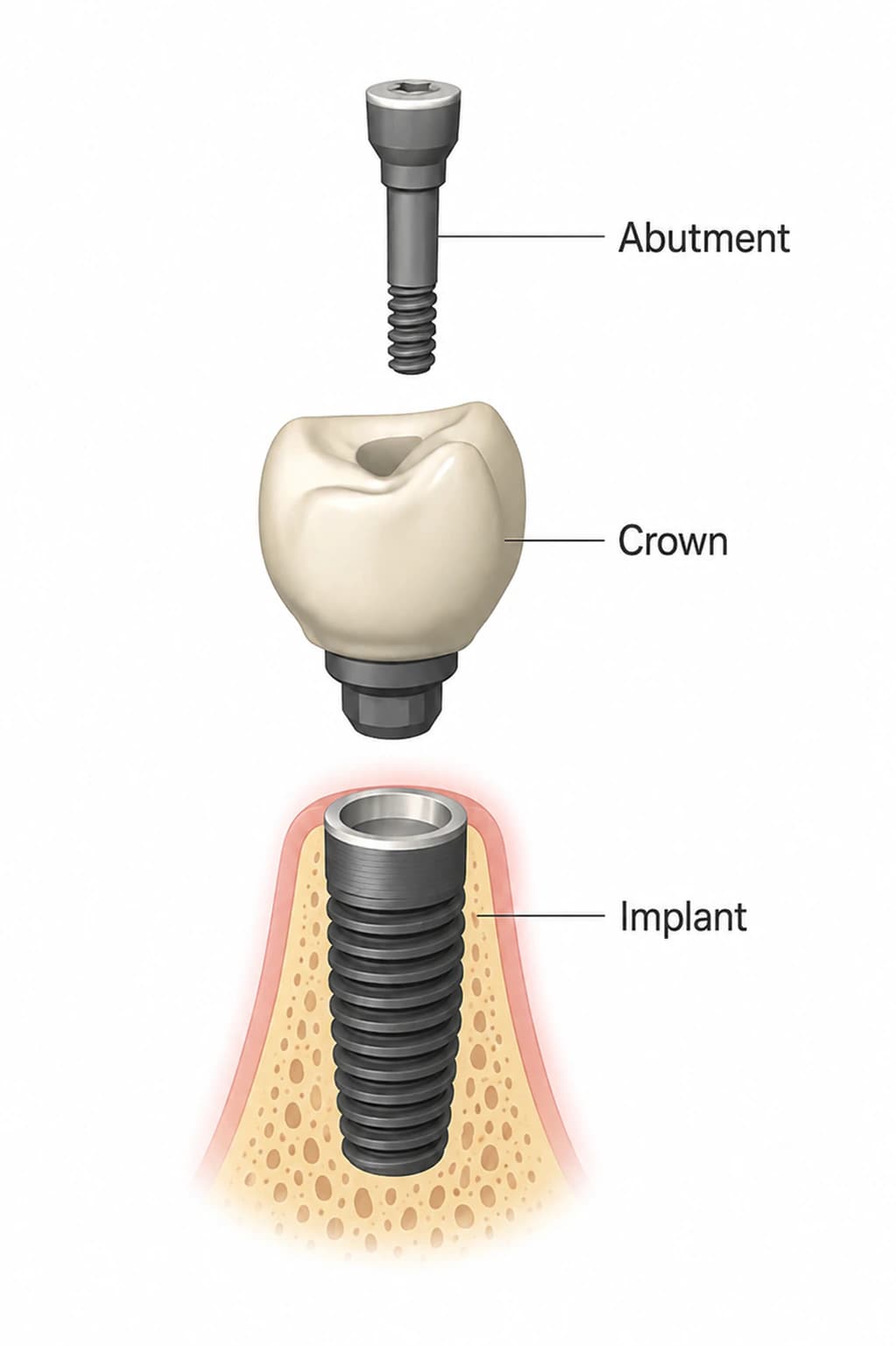
If you are a patient reading this because a dentist mentioned a sinus lift, here is the plain version. Your upper back teeth sit just below the maxillary sinus, and after tooth loss that bone often thins. To place an implant there safely, we sometimes lift the sinus membrane and add graft material underneath so there is enough height. The material we choose is picked to stay in place long enough for your own bone to grow in, which is exactly why a fast-resorbing material like calcium sulfate is rarely used by itself.
The good news is that a well-planned sinus lift is routine and, in many cases, done at the same appointment as the implant. With our in-house 3D imaging and guided surgery technology and IV sedation, most patients are comfortable through it and back to normal life quickly, with clear post-op instructions to follow. Dental implants placed into a healthy grafted site carry long-term survival rates commonly reported around 95 percent, though your doctor will confirm what is realistic for your specific bone and health.
If a previous graft or implant did not hold, that is not the end of the road. A large share of what we do is second-opinion and rescue work. A free consultation and 3D scan is the fastest way to find out whether a crestal lift, a lateral-window graft, or a graft-free option is right for your anatomy.
Written and medically reviewed by Dr. Sam Jain, DMD, MS, and Dr. Arpana Gupta, DDS, MDS, who own this practice.
This article is patient education, reviewed by Dr. Sam Jain, DMD, MS, and Dr. Arpana Gupta, DDS, MDS, and is not a substitute for an exam. Treatment recommendations are made only after an in-person consultation and 3D imaging.