Osteoporosis Drugs and Dental Implants: Two Very Different Answers
Two people can be on “the same” bone medication and get opposite answers. The dose, the reason and the route decide it — and most patients are in the reassuring group.


Written and medically reviewed by Dr. Sam Jain, DMD, MS, and Dr. Arpana Gupta, DDS, MDS
Published
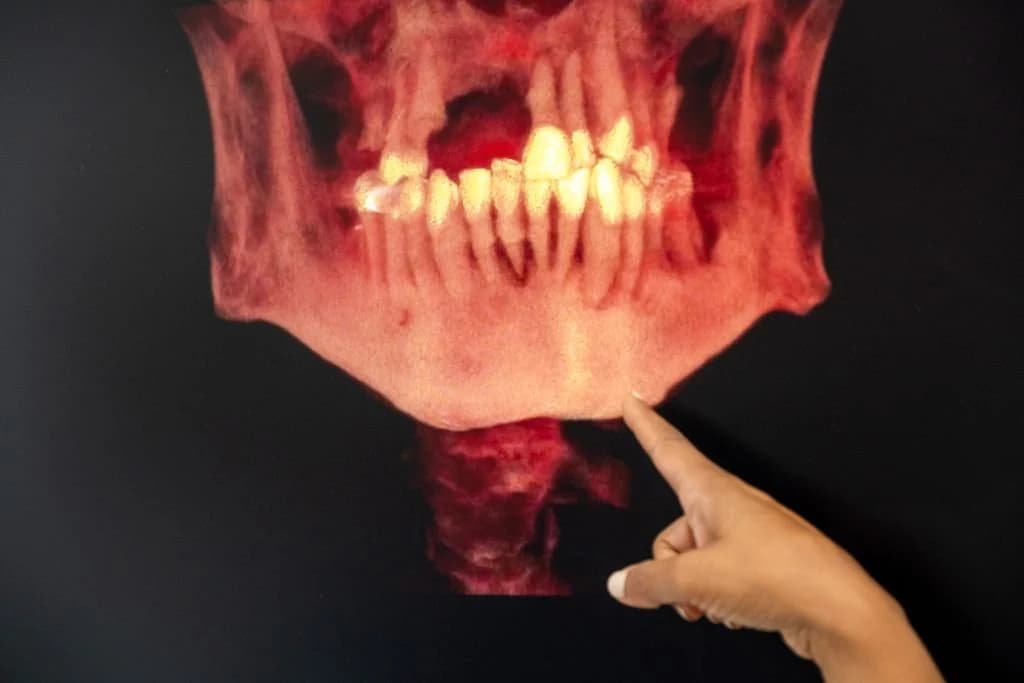
One drug name, two completely different situations
The medications in question are called antiresorptives: the bisphosphonates — alendronate, risedronate, ibandronate, zoledronic acid — and denosumab. The same molecules are prescribed in two very different ways. One is a low dose, usually a weekly or monthly tablet or an annual infusion, to keep an aging skeleton from fracturing. The other is a much higher, much more frequent intravenous dose used to control cancer that has spread to bone. Almost every frightening article you can find about bone drugs and dental surgery was written about the second one.
The complication people are reading about is MRONJ — medication-related osteonecrosis of the jaw, an area of jawbone that fails to heal after a dental procedure. It is real, and nobody serious minimizes it. It is also, at osteoporosis doses, uncommon enough that the American Dental Association puts the incidence between 0.001% and 0.01% for people taking oral bisphosphonates for osteoporosis, and describes the highest reliable prevalence estimate across osteoporosis-dose regimens as approximately 0.10%. At the doses used for metastatic bone disease, the same organization reports a range of 1% to 10%. Same complication, different world.
So the first thing that happens at your consultation is not a measurement of your bone. It is establishing which of those two prescriptions you are on: the drug name, the dose, whether it is a tablet, an injection or an infusion, how long you have been on it, and whether you are still taking it. That conversation takes two minutes and changes everything that follows it.
If your bone medication is for osteoporosis
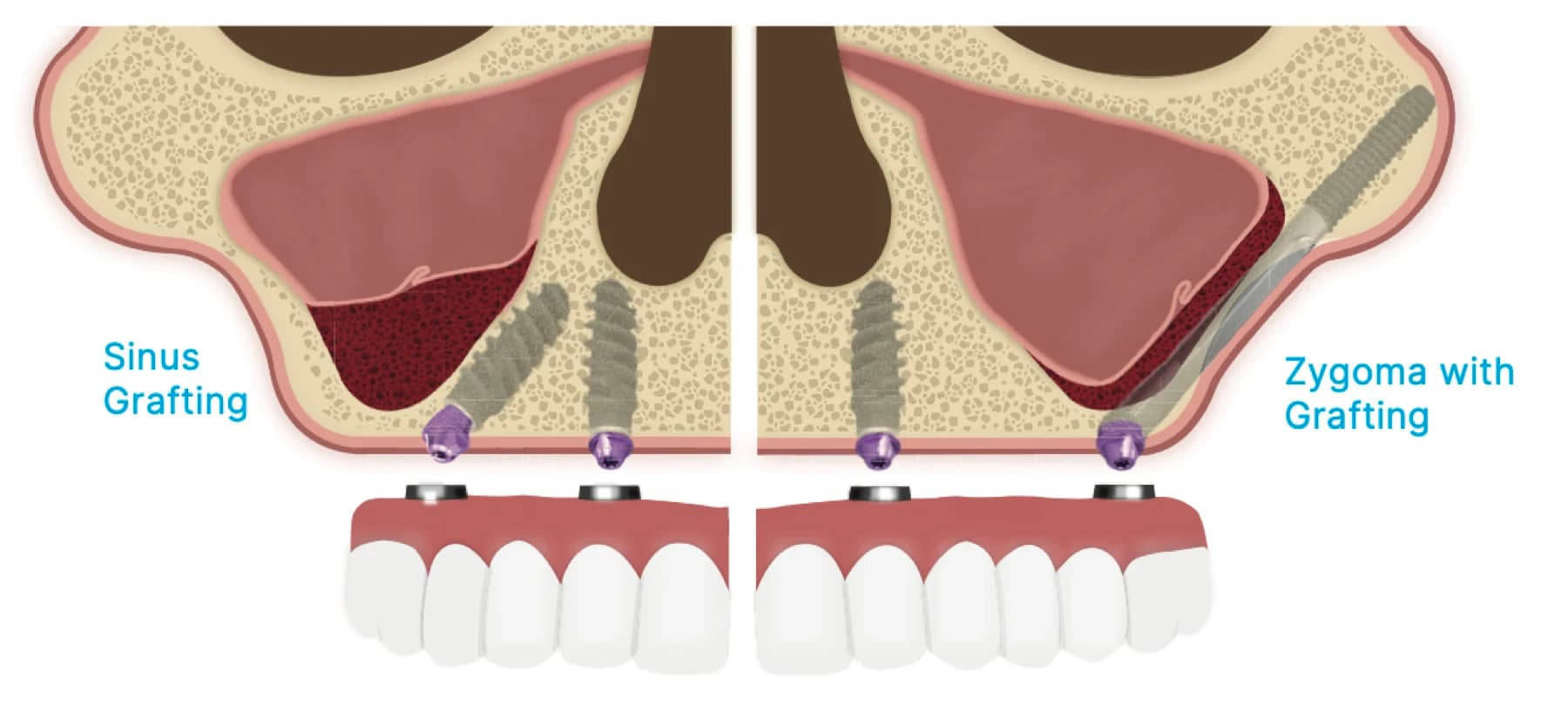
On the specific question of implants, current ADA guidance is direct: antiresorptive therapy does not appear to be a contraindication for dental implant placement, with the honest caveat that larger and longer-term studies are still wanted. In plain terms — your osteoporosis medication is not, by itself, a reason anyone should turn you away. If you have been told otherwise and left it there, that is worth a second look with a 3D CBCT scan and an examination behind it.
The next question is almost always whether to stop the drug for a few months first — the “drug holiday” patients read about. Current ADA guidance is that there is insufficient evidence to recommend a holiday from antiresorptive therapy for osteoporosis, or a waiting period before dental treatment, as a way of preventing MRONJ. The International Osteonecrosis of the Jaw Taskforce reached the same conclusion in 2025 and stated it as a recommendation: in patients with osteoporosis on antiresorptive therapy, the therapy does not need to be stopped before proceeding with a dental implant. Its companion meta-analysis pooled 21 cohorts and put MRONJ after implant placement in that population at about 0.5%, with long-term bisphosphonate use adding roughly three cases per thousand patients. Stopping is not free either: the fracture the medication was prescribed to prevent does not pause while you wait. Please do not stop your medication on your own initiative on our account. If a change is ever worth discussing, it is a conversation between you and the physician who prescribed it, and it happens before anything is scheduled here.
What your medication history does change is technique and follow-up. Where bone surgery is necessary, ADA guidance points toward a conservative surgical approach with primary tissue closure where feasible — gentle handling of the tissue, closure without tension, and a closer eye on healing afterwards than a routine case gets. It also changes our bias about waiting: we would far rather treat a failing tooth definitively now than leave an infection sitting in bone while you continue therapy for years.
If your bone medication is for cancer
Here the answer changes, and we would rather you read it on this page than discover it after surgery. The ADA's position is that dental implants are contraindicated in patients on oncology antiresorptive agents — the high-dose intravenous bisphosphonates and denosumab given for multiple myeloma or bone metastases — and that dentoalveolar surgery, including implant placement, is a risk factor for developing MRONJ. Antiangiogenic cancer drugs belong in the same conversation: the class includes bevacizumab, the tyrosine kinase inhibitors sunitinib and sorafenib, the mTOR inhibitor everolimus, and immunomodulators such as thalidomide and lenalidomide.
That is a genuine no to implants during oncology-dose therapy, and it deserves to be stated as one rather than hedged. It is not a no to your teeth. Removable and tooth-supported options remain available, existing restorations can be maintained, and infection can be controlled with conservative treatment — the goal shifts from replacing what is missing to protecting what you have. Whether the picture changes later depends on which drug, at what dose, how long ago, and what your oncology team says now; that is a discussion between us and them, not a decision we would make alone. The broader picture after cancer treatment is its own subject.
If you are about to start one of these medications, the most valuable thing you can do is have a full dental examination with radiographs first. The professional task-force position the ADA cites is that a thorough dental examination should ideally be completed before antiresorptive therapy begins, and that necessary invasive procedures should ideally be finished before it starts. Weeks matter here in a way they rarely do in dentistry — if a course of treatment is being planned for you, tell your dentist this week rather than next month.
What to bring — and why the internet frightened you
The search results skew for a structural reason worth knowing. Case reports get written about complications, not about the hundreds of thousands of uneventful extractions in patients on osteoporosis-dose medication, and the clinical literature on MRONJ is dominated by the oncology population because that is where the cases concentrate. So a patient on a weekly tablet reads material describing a risk profile that is not theirs, and arrives convinced the answer is no. It usually is not.
Bring the specifics rather than the category. The exact drug name; the dose; whether it is a tablet, an injection or an infusion; when you started; whether and when you stopped; why it was prescribed; and who prescribes it. If you had a single yearly infusion three years ago and never went back, say so — that is a different situation from a current prescription. If you receive denosumab every six months, tell us when the last injection was, because where you sit in that cycle is a real planning input rather than a formality.
Everything else about your case is then decided the way it always is: an examination, a 3D CBCT scan showing your actual bone rather than a generalization about it, and an itemized written plan you can take away and think about. If you are weighing whether you are a candidate at all, that question has its own page, and the full medical-history picture sits alongside it.
Written and medically reviewed by Dr. Sam Jain, DMD, MS, and Dr. Arpana Gupta, DDS, MDS, who own this practice. Reviewed
This article is patient education, reviewed by Dr. Sam Jain, DMD, MS, and Dr. Arpana Gupta, DDS, MDS, and is not a substitute for an exam. Treatment recommendations are made only after an in-person consultation and 3D imaging.