Dental Implants After Cancer Treatment: What the Numbers Show

A patient seated in a consultation room before an examination

After cancer treatment, the plan starts with records from your oncology team

Schedule Consultation

Dental Implants After Cancer Treatment: What the Numbers Show

Cancer treatment does not close the door on fixed teeth. It moves the odds by a measurable amount and it changes the calendar — and you deserve the actual figures for both.

A patient seated in a consultation room before an examination
After cancer treatment, the plan starts with records from your oncology team

What radiation does to the odds — the actual numbers

Two recent meta-analyses are worth quoting rather than paraphrasing. The first, published in Clinical Oral Investigations in 2021, pooled 2,602 implants placed in 660 head and neck cancer patients, 1,637 of those implants in irradiated jaws. Survival came out at 91.9% in irradiated patients after an average of about 40 months, against 97% in non-irradiated patients after about 38 months.

The second, published in Clinical Oral Implants Research in 2025 and covering the literature from 2021 to 2024, found 85.6% survival in irradiated patients against 90.0% in non-irradiated ones. Note what happens when you put the two side by side: they disagree about the absolute figures and agree about the direction and rough size of the gap — somewhere around five points. That is what honest evidence looks like in a field where patients, doses and follow-up periods differ, and it is more useful to you than a single confident number would be.

Two things follow. A survival figure in the high eighties or low nineties is not a coin flip, and it is the kind of number where planning moves the outcome more than luck does. And these figures describe radiation to the head and neck. Radiation delivered to a breast, a prostate or a lung does not irradiate your jaw, and this page is not about your case if that is your history — your medical history still matters, but for other reasons.
A smiling implant patient in a hooded sweatshirt
A real patient at Center for Implant Dentistry

Osteoradionecrosis, which deserves its own paragraph

Osteoradionecrosis is the complication behind the caution: irradiated bone has a diminished blood supply and heals poorly, and surgery in it can leave an area of bone that does not recover. In the 2021 pooled analysis, osteoradionecrosis occurred in 11 cases across the population studied — an incidence of 3%. That is neither negligible nor the majority outcome, and both halves of that sentence matter when you are deciding.

The number that changes your personal risk most is not in any published average: it is the radiation dose that actually reached the part of your jaw where an implant would go. Your radiation oncologist holds the treatment plan that shows it, and that document tells us more than any general statement about head and neck radiation ever will. Requesting it is one of the first things we do, with your permission.

Patients often ask about hyperbaric oxygen, which has been used before and after implant placement in irradiated jaws for decades. The honest answer from the pooled data is that its impact on implant survival was not statistically significant in the 2021 analysis. We mention it because you will read about it, and because a treatment that has not demonstrated a benefit in pooled data should not be sold to you as insurance.

Timing is the variable you can still control

The same 2021 analysis found that waiting more than twelve months between the end of radiotherapy and implant placement appeared beneficial, and that implants placed inside the first year carried a higher failure risk. The wider literature commonly recommends at least six months, on the reasoning that the acute radiation effects on bone and soft tissue need that long to settle. Twelve months is the figure with pooled evidence behind it.

It is worth reframing that wait as part of the treatment rather than a delay before it. The interval is when tissue quality is assessed properly, when any remaining dental disease is dealt with, when nutrition and oral hygiene are rebuilt after a brutal year, and when the scan that will drive the surgical plan is taken in tissue that has stopped changing week to week. A plan drawn on a jaw that is still settling is a plan that gets redrawn.

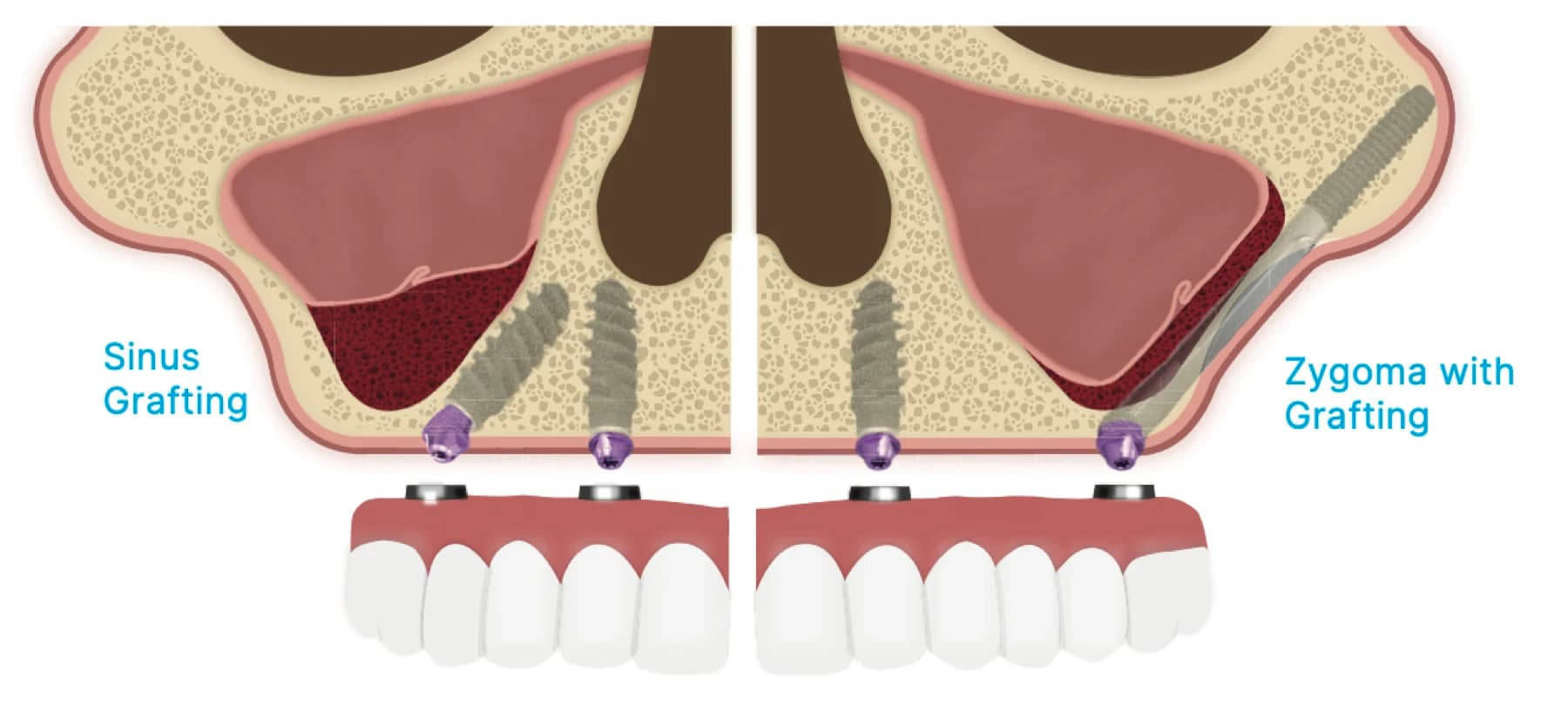
The 2025 analysis adds a design consideration: implant failure risk was higher in grafted bone than in native bone. In an irradiated jaw, that argues for approaches that anchor into the bone you still have rather than building new bone first — tilted implants in a full-arch design, or, where the upper jaw has lost too much, zygomatic anchorage into the cheekbone. Which of those fits, if any, is a scan-and-examination question rather than a website question.
A patient going through paperwork with a team member at the front desk
Your medication list is the first thing we review, and the last thing to leave at home

Chemotherapy — and the drugs that matter more than chemotherapy

Chemotherapy on its own is less studied than radiation, and less alarming in the data that exists. What the 2025 analysis did find is that among irradiated patients, those who also received chemotherapy carried a greater risk of implant failure than non-irradiated patients — radiochemotherapy is harder on the result than radiation alone. During active chemotherapy, elective oral surgery generally waits for blood counts to recover, and that is your oncology team's call to make rather than ours.

For a great many cancer patients, though, the deciding factor is not the chemotherapy at all. It is the bone-protective infusions given alongside it. The ADA's position is that dental implants are contraindicated in patients on oncology antiresorptive agents — the high-dose intravenous bisphosphonates and denosumab used for bone metastases and myeloma — and the same conversation covers antiangiogenic drugs such as bevacizumab, sunitinib, sorafenib and everolimus. That subject has its own page, because it catches people who were never told it applied to them.

If you are about to begin treatment rather than finishing it, the priority inverts. A full dental examination with radiographs before therapy starts, and any necessary invasive work completed before the first dose, is the single most useful thing you can do for your future options. Once high-dose antiresorptive therapy has begun, the door narrows considerably.

How a case gets planned — and what an honest no looks like

The plan starts outside this office. With your permission we ask your oncologist and radiation oncologist for the treatment summary, the radiation dose map, the current medication list, and their view on timing. That correspondence is not a formality: the difference between a jaw that received a modest scattered dose and one that sat in the primary field is the difference between a routine case and one we would approach very differently, and neither is visible from the outside.

Then the ordinary work happens: an examination, a 3D CBCT scan, and an itemized written plan. For a post-radiation case that plan is more explicit than most about what is being accepted — the survival figures above, the healing risk, the longer follow-up interval, and what happens if an implant does fail, which is a question every patient in this position is entitled to have answered before rather than after.

And sometimes the plan is that implants are not the right answer, now or at all. When that is our view you will get it plainly, with the reason, along with what we would do instead — because a well-made removable prosthesis in a jaw that cannot safely take implants is a better outcome than an implant that fails in irradiated bone. If you would like a second opinion on advice you have already received, that is a consultation we are glad to give, including the possibility that the advice was right.

This article is patient education, reviewed by Dr. Sam Jain, DMD, MS, and is not a substitute for an exam. Treatment recommendations are made only after an in-person consultation and 3D imaging — the first visit is free.

Still Wondering? Here's What People Ask Next.

How long after radiation can I get dental implants?

The pooled evidence favors waiting more than twelve months after radiotherapy ends; implants placed within the first year showed a higher failure risk, and the wider literature commonly recommends at least six months for acute radiation effects on bone and soft tissue to settle. The interval is used rather than wasted — tissue assessment, dental disease, and the planning scan all happen in it.

What are the real odds an implant fails after radiation?

Two recent meta-analyses give slightly different figures and the same story. One reports 91.9% implant survival in irradiated patients against 97% in non-irradiated ones over roughly three years; a more recent one reports 85.6% against 90.0%. The gap is around five points. Your own risk depends most on the radiation dose that reached the specific site, which your radiation oncologist's plan can tell us.

What is osteoradionecrosis, and how likely is it?

It is bone in an irradiated area that fails to heal, because radiation reduces the blood supply that healing depends on. In the pooled analysis of irradiated implant patients it occurred in 3% of cases. That is a real risk that changes how a case is planned and followed, and it is not the expected outcome.

Does chemotherapy on its own rule out dental implants?

No. Chemotherapy alone is less studied and less consequential for implants than radiation to the jaw; what the recent evidence shows is that radiation plus chemotherapy is harder on implant survival than radiation alone. Elective surgery generally waits until blood counts recover during active treatment, which is your oncology team's decision. The bone-protective infusions given alongside chemotherapy matter more, and are a separate question.

I had radiation for breast cancer. Does any of this apply to me?

Not the radiation figures on this page — they describe radiation delivered to the head and neck, which is what affects jawbone healing. Radiation to the breast, prostate or lung does not irradiate your jaw. Your treatment history still belongs on your health form, particularly any bone-protective medication, but the survival numbers here are not your numbers.

Readers Who Became Patients

Beyond The Article, What Patients Actually Say

Our patients wrote these, and we cannot edit a word. The rating beside them counts every review on our Google profile — not only the five-star ones shown here.

4.9from 470 reviews on our Google profile
  • Vincent Betar

    The entire staff here are really amazing from the receptionist to the doctors who perform an amazing transformation of my teeth and my facial expressions. I feel very grateful for the work done and very satisfied. I highly recommend center for Implant dentistry sincerely. Vince Betar.

  • T A

    Left a 5-star rating for Center for Implant Dentistry.

  • YIN OO

    I am very happy this place amazing somebody wants Inplant highly recommend at least go for Consultation de Jain and dr Gupta explain very well I did my immediate implant treatment result came out very good

  • Song Zhou

    Good service I like I did my couple implants very good place

  • Enedina Santaana lopez

    (Translated by Google) The doctors and their assistants are truly professional. They made me feel comfortable during my visit. For my first time seeing a dentist, coming to this clinic was the best decision I made. They were very efficient and quick with the process of placing my dental implants. I would definitely choose to come here again; I'm extremely satisfied with the results. (Original) Realmente los doctores son muy profesionales y sus ayudantes por igual, me hicieron sentir cómoda durante mi estancia , para ser mi primera vez viendo a dentistas ha sido la mejor elección venir a esta clínica, fueron muy eficientes y rápidos con el proceso para ponerme mis implantes dentales. Volvería a elegir venir aqui de nuevo, super satisfecha con los resultados.

  • Sayed Hasanzada

    It’s alway nice to come here get your teeth cleaned and make your smile right great staff clean and excellent experience Thank you everyone

  • Antonio Servantes

    Amazing Place I did my dental implant this place I am very happy they finish my treatment with natural tooth in 1 day I am very I feel confident before I loose my confident my smile is not good . Now I have pleasing and beautiful smile Amzing place they have manufacturing onsite they make my crown here . I wish give 10 star one discuss with dr Jain if anybody need implant I saw rating then I choose amzing very happy

  • Eric Tang

    I am writing this review truly from the bottom of my heart. My experience with the Center for Implant Dentistry in Fremont has been nothing short of life-changing. I cannot fully express how happy and grateful I feel after receiving my implants. From the very beginning, everyone at this facility has been incredibly friendly, caring, patient, and accommodating. Most importantly, they made me feel comfortable and confident throughout the entire process. I always felt that I was in good hands. This has been an amazing experience that I will remember for the rest of my life. Having my smile restored has given me back something that is difficult to put into words. I can now smile confidently without feeling self-conscious, enjoy the foods I want to eat, and simply enjoy the moment without constantly worrying about my teeth. It is more than just getting new teeth—it has truly changed my quality of life, my confidence, and the way I feel about myself every day. To everyone at the Center for Implant Dentistry in Fremont, thank you from the bottom of my heart for everything you have done for me. You didn’t just give me a beautiful new smile—you gave me a new chapter in my life, and that is something I will always be grateful for. For anyone who is struggling with their teeth and considering dental implants, I wholeheartedly recommend the Center for Implant Dentistry. If you are afraid or uncertain, I understand that feeling—but for me, taking this step was one of the best decisions I have ever made. This experience has truly changed my life in the best way possible. I can smile again, I can eat again, and most importantly, I can enjoy those moments with confidence. Thank you to the entire team for giving me something I will cherish for the rest of my life.

  • P. Chavez

    I couldn't have asked for a better experience or result! From Dr. Jain and Dr. Gupta and the entire staff, you are in absolutely great hands! I would wholeheartedly recommend them 100%, time and time again. They're absolutely amazing! Thank you so much C.f.I.D! 💯🙏❤️

  • Compa Ricky

    This is a great place to get dental implants 100% recommended , they treat me like a king and the personal are really professional and humble , they change my life 1000%

  • Elvia Cervantes

    I am very happy for this place Thank You Dr Jain and Dr Gupta i did my upper jaw Allo 8 treatment i visited so many dentist everybody recommended allon4 but when i came here dr Jain explain me A08 treatment he explained very well new technology . I have beautiful smile . I recommended everybody atleast meet dr jain if you want dental implant treatment. Amzing place i wish i give 100 stars. Thank You Dr Jain, Dr Gupta and entire team

  • Deb Koolpe

    I really thought about getting new implant teeth and now I’m wondering what took me so long. The Doctors and staff here are extremely knowledgeable and super friendly. I would highly recommend Center for implants.

Reviews are individual patient experiences, shown as posted. Results vary from person to person.

Have A Question About Your Own Mouth?

Book free consultation