Smoking, Vaping, and Dental Implants: The Honest Risk Conversation
Some offices refuse smokers; others take the money and skip the conversation. We do neither. Here's what smoking actually does to implant odds, and how an honest plan handles it.
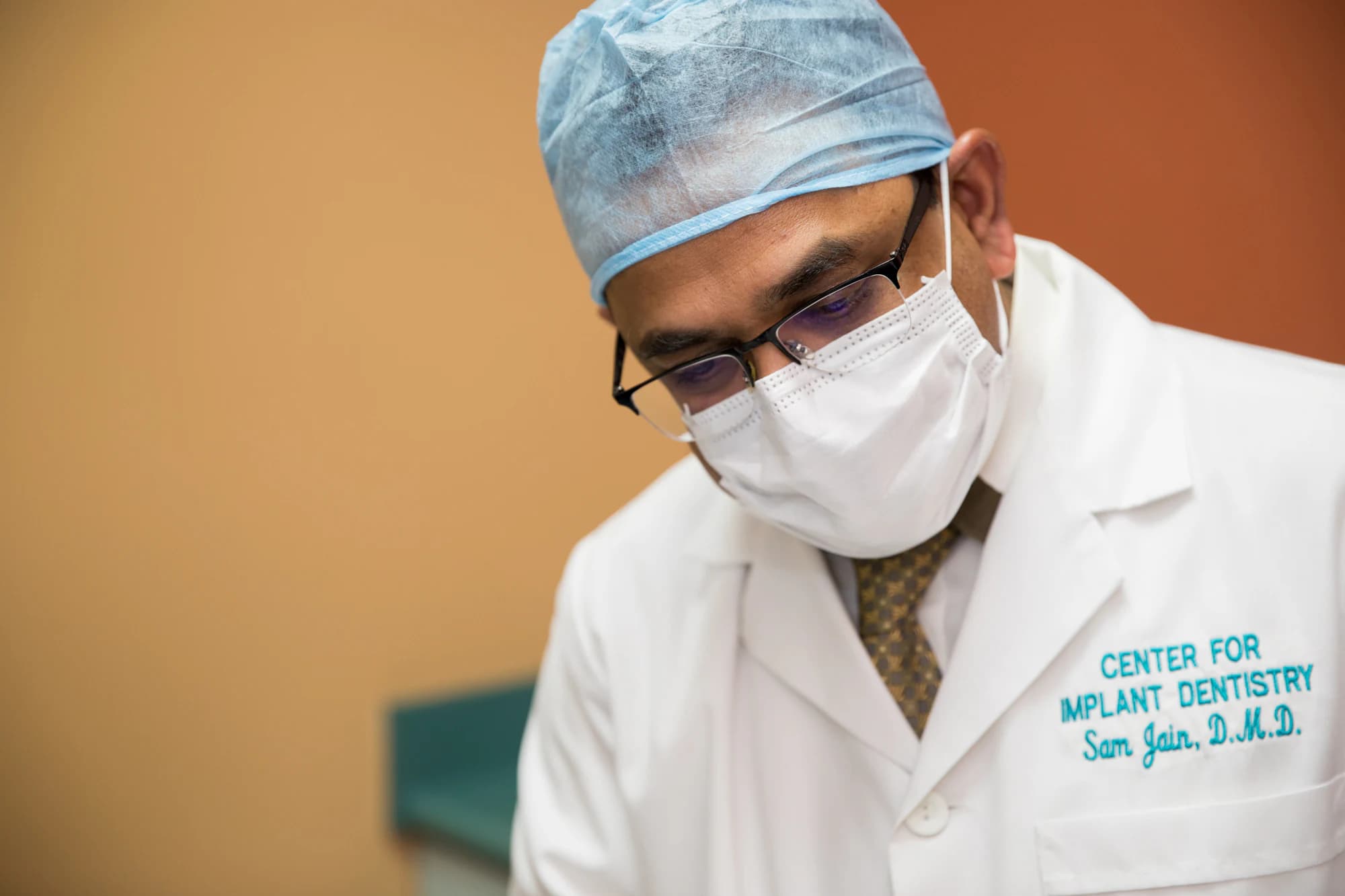

Written and medically reviewed by Dr. Sam Jain, DMD, MS, and Dr. Arpana Gupta, DDS, MDS
Published
What smoking actually does to an implant's odds
Implant success depends on healing: bone fusing to titanium in the weeks after surgery, and gums staying healthy around the implant for decades after. Smoking works against both — nicotine constricts the small blood vessels that healing depends on — and the literature is specific about the size of it. A 2024 meta-analysis pooling 32 studies, 59,246 implants and 14,115 patients put the odds of EARLY implant failure at roughly 2.6 times higher in smokers than in non-smokers, and found the upper jaw hit far harder than the lower: about a sixfold difference above, against under fourfold below.
The honest framing: smoking shifts the odds, it doesn't decide the outcome. Plenty of smokers heal well; the risk is elevated, not guaranteed. The long game shows the same shape — a 2025 review applying the 2017 World Workshop criteria found peri-implantitis on 18% of implants overall, but on 5.2% of implants in non-smokers. What separates a responsible practice from a mill is whether anyone tells you these numbers before surgery — and plans around them — rather than after something fails.
Vaping isn't the loophole it looks like
Patients increasingly ask whether switching to vaping solves the problem. The research on vaping and implants is younger than the smoking literature, so honesty requires hedging — but nicotine is nicotine, and its blood-vessel constriction doesn't care about the delivery device. Early evidence and clinical reasoning both point the same way: vaping is not a safe harbor for implant healing.
The same conversation applies to marijuana smoke and to smokeless tobacco — different products, overlapping concerns for healing tissue. Whatever you use, the useful move is telling us the truth at the consultation. We're not the tobacco police; we're the people engineering your case around reality.
The quit window that actually helps
You don't have to quit forever for it to matter (though your whole body would vote for that). The healing window around surgery — the weeks when bone and implant are fusing — is where smoking does its most direct damage, which is why pausing around surgery is so widely advised. Even a temporary cessation window is one of the biggest favors a smoker can do their investment, and your doctor will talk through realistic timing at the consultation rather than handing you a lecture.
We also plan smokers' cases with extra conservatism where the anatomy allows: healing time is respected rather than rushed, and we're straightforward about when a staged approach beats same-day heroics. The surgery-day timeline flexes to the healing your case actually needs.

Smokers get told 'no' elsewhere — here's our version
Some practices simply decline smokers; it keeps their statistics clean. Our position is different: smokers lose teeth too, often faster, and refusing to treat the people who most need fixed teeth isn't a standard we recognize. We treat smokers — with the risk stated plainly, the plan built for it, and the maintenance schedule watched more closely afterward.
What we won't do is pretend the risk away to close a sale. If your case's odds are genuinely poor, you'll hear that at the free consultation, along with what would change them. That's the same honesty that runs through who we say no to — and it's exactly why a smoker should want their implant surgeon to bring it up.
Written and medically reviewed by Dr. Sam Jain, DMD, MS, and Dr. Arpana Gupta, DDS, MDS, who own this practice.
This article is patient education, reviewed by Dr. Sam Jain, DMD, MS, and Dr. Arpana Gupta, DDS, MDS, and is not a substitute for an exam. Treatment recommendations are made only after an in-person consultation and 3D imaging.