When Medical Insurance Helps Pay for Dental Implants (and When It Won't)
Most people only ask their dental plan. For a specific set of situations — accidents, disease-related tooth loss, congenital conditions — the medical side is worth asking too. Here's the honest map.


Written and medically reviewed by Dr. Sam Jain, DMD, MS, and Dr. Arpana Gupta, DDS, MDS
Published

Why dental plans alone rarely carry an implant case
Start with the honest baseline: most PPO dental plans treat implants as a major procedure and cap annual benefits at roughly $1,000–$2,000. Against a single tooth that's real help; against a full arch it's a small dent. That cap — not whether implants are 'covered' — is the number that actually decides how much your plan contributes. We work with all PPO plans, verify your exact benefits in writing, and file the claims for you; what we won't do is let a vague 'insurance will help' stand in for an actual number.
The less-known half of the story is that dental insurance isn't always the only door. In a specific set of circumstances, medical insurance can contribute to parts of implant treatment — not routinely, not automatically, and never guaranteed, but often enough that the question deserves an honest page. The full picture of what we accept and how claims work lives on our insurance page; this article covers the medical-side edge cases most offices never mention.

When the medical side may genuinely apply
Medical insurance concerns itself with medical events — so the cases where it may contribute to implant-related treatment are the ones that start as medical problems. Tooth loss from an accident or facial trauma is the clearest example: if teeth are lost in a fall, collision, or injury, portions of the reconstruction may qualify for medical consideration. The same logic can apply to tooth and bone loss caused by pathology — a cyst, a tumor, or the reconstruction that follows its removal — and to congenital conditions where teeth never developed and jaw reconstruction is part of treating the underlying condition.
Two honest caveats belong next to that list. First, 'may qualify' is doing real work in those sentences — outcomes depend on your specific policy, its exclusions, and documentation, and no office can promise a medical payout. Second, everyday tooth loss from decay or gum disease almost never qualifies on the medical side, no matter how much it affects your health. If someone guarantees you medical coverage for routine implant treatment, that's a red flag, not a hack.
The paperwork that decides these cases
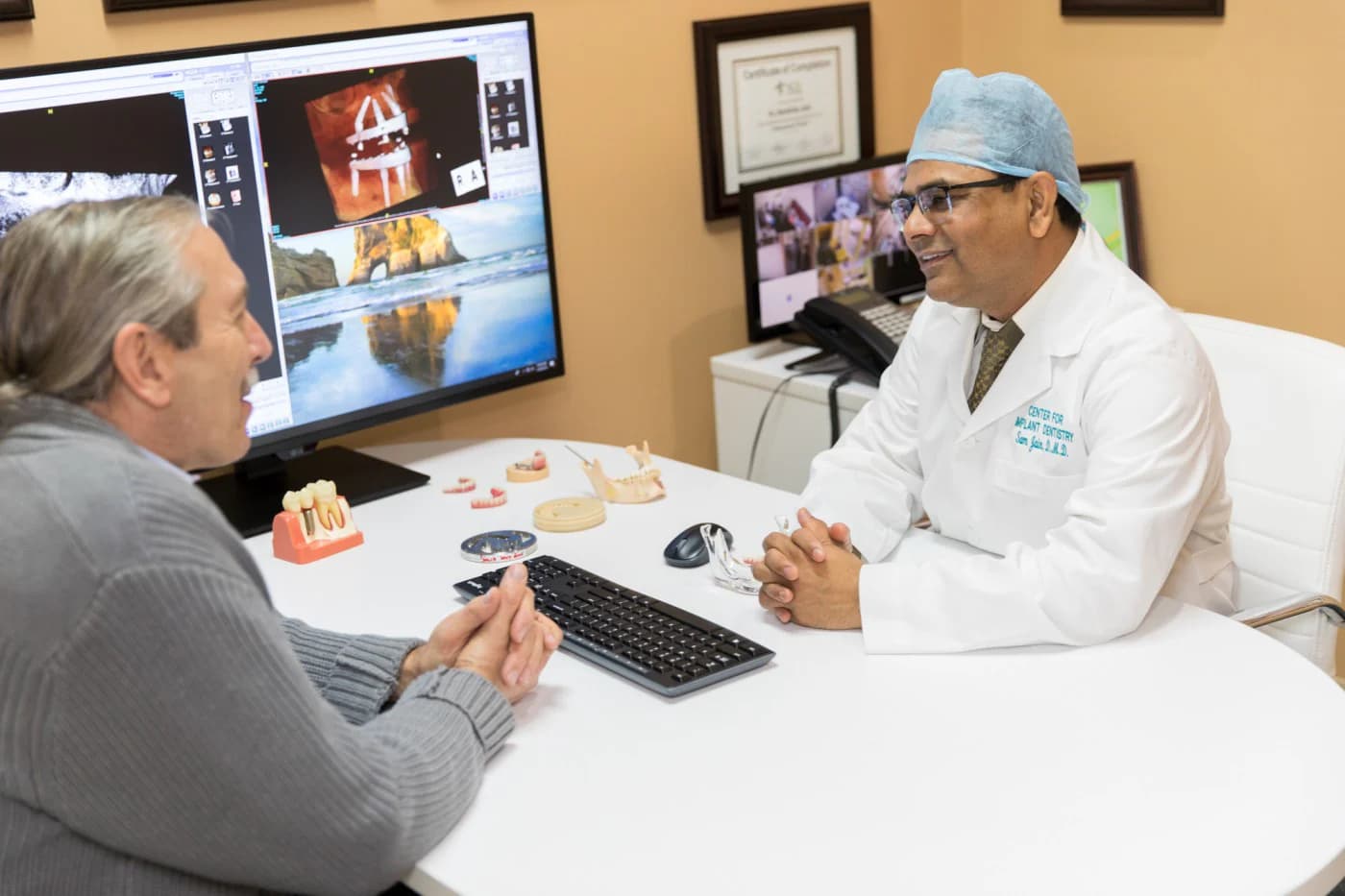
Medical claims live and die on documentation. What moves a case is a clear record connecting the medical event to the treatment: the accident report or medical records establishing the injury, imaging that shows the damage, and a written treatment plan that frames the reconstruction in medical terms. This is one place where being treated at an office with its own 3D CBCT imaging genuinely matters — the scan that plans your surgery is the same evidence a claim needs.
Timing matters too. Medical claims for trauma-related work are strongest when the paper trail starts promptly — an exam and scan soon after the injury, even if treatment happens months later. If you've had an accident and think implants are in your future, getting the record started early costs nothing at our office: the consultation and CBCT scan are free, and the imaging becomes part of your file either way.
HSA, FSA, and the two-benefit-year move
Whether or not any insurance applies, two tax-adjacent tools usually do. HSA and FSA funds can generally be used for implant treatment — implants restore function, which is what qualifies them — and paying with pre-tax dollars is an effective discount at your marginal tax rate. We accept HSA/FSA cards directly; the mechanics are on our cost page.
The other legitimate move is timing. Dental benefits reset each calendar year — so a treatment plan that naturally spans two phases (say, extractions and grafting late in one year, implant placement early in the next) can draw on two annual maximums instead of one. It doesn't suit every case — biology sets the schedule before benefits do, and we won't distort a treatment plan to chase a cap — but when the clinical timeline already spans a year boundary, sequencing the claims well is free money. We map this out with you when we verify benefits.
How we handle all of this for you
You shouldn't need to become an insurance expert to fix your teeth. Our process: at the free consultation we verify your dental benefits in writing, flag honestly whether anything about your case (trauma, pathology, congenital) is worth pursuing on the medical side, and hand you an itemized plan where every number is visible. We file dental claims for you, and where a medical angle genuinely exists we'll tell you what documentation it needs — and just as plainly when it doesn't exist, so you're not chasing a refund that will never come.
For everything insurance doesn't reach, the financing options are laid out with the same honesty — four lenders compared, typical monthly ranges stated, prequalification without a credit-score impact. Between a verified benefit number, the right claim on the right side, pre-tax dollars, and financing, most patients find the real out-of-pocket looks different from the sticker — in the right direction.
Written and medically reviewed by Dr. Sam Jain, DMD, MS, and Dr. Arpana Gupta, DDS, MDS, who own this practice.
This article is patient education, reviewed by Dr. Sam Jain, DMD, MS, and Dr. Arpana Gupta, DDS, MDS, and is not a substitute for an exam. Treatment recommendations are made only after an in-person consultation and 3D imaging.