What To Expect At Your FREE Consultation

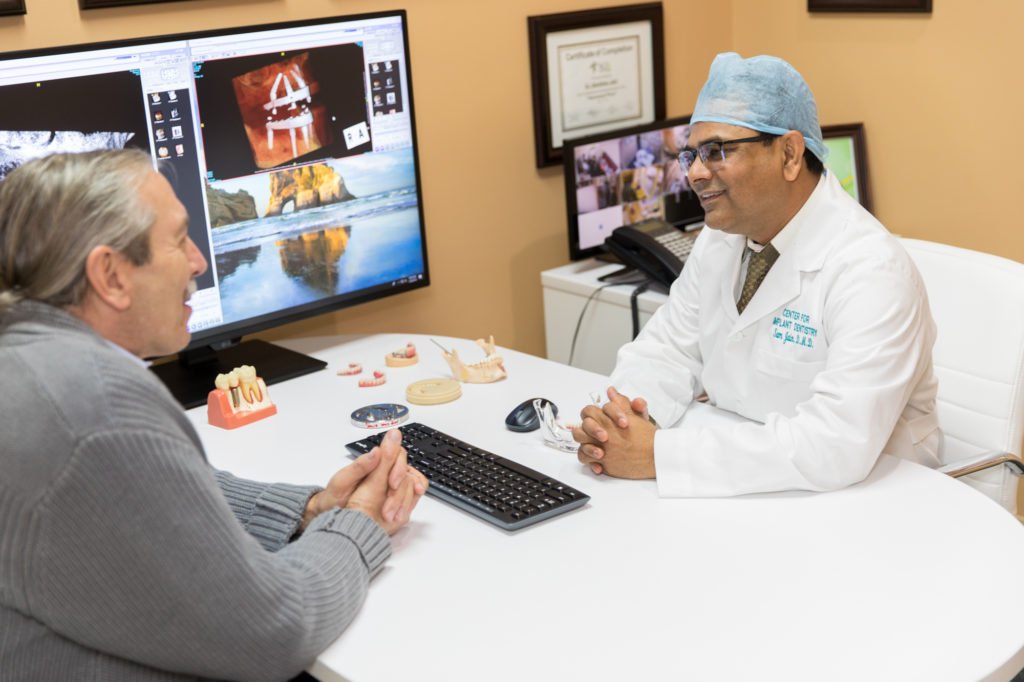
At your FREE consultation, you will be given an office tour of our exam rooms, CT scan rooms, and our CAD/CAM lab with the technology we use to design your smile all in one location. One of our doctors, Dr. Jain or Dr. Gupta, will then discuss with you your true motivations for wanting dental implants and your health history. They will determine what treatment option would best suit your needs, which all depends on your teeth condition, gum health, jaw bone health, smoking habits, and good health in general. If they believe you may be the right candidate for dental implants, they will proceed with a high quality 3D CT scan of your face.

What if you are not an ideal dental implant candidate, at first? In these cases, we may recommend certain procedures to increase your candidacy for dental implants. Each of our doctors are highly skilled in all phases of implant dentistry, including preparing your jaw for implant placement through bone grafting and sinus lift procedures. These specialized services rebuild lost bone in the jaw, creating the ideal environment for successful implantation and a lasting, healthy, beautiful smile.
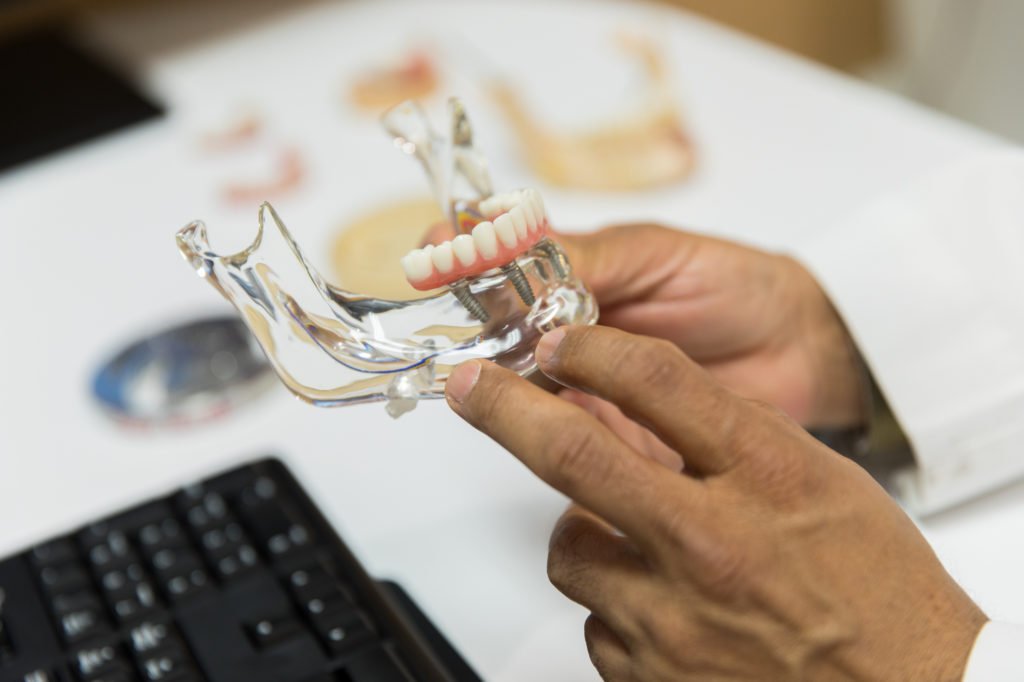
Treatment options may vary anywhere from single or multiple implants to all on 4 or all on 6 implants. Once you’ve had the chance to discuss your treatment options with our doctors, a treatment coordinator will prepare your treatment quote and discuss payment options.

We accept various forms of payment, including cash, cashier checks, and credit cards including Visa, Discover, and MasterCard. We also help apply for financing services in our office through CareCredit, Lending Club, and Proceed Finance to allow patients to break up their out-of-pocket costs with little to no interest financing. We want to deliver the finest care to our patients at the most reasonable cost, and this means that payment is due at the time of service unless our patients have made other arrangements with our office in advance.


For patients who are utilizing their insurance coverage, please remember that you are fully responsible for the charges at this office regardless of what insurance will cover. However, most insurance companies respond to our claim submissions within four to six weeks, and any remaining balance after coverage is the responsibility of the patient.

If you have any further questions about what to expect at your consultation of if you’re ready to schedule a FREE consultation, please call Center for Implant Dentistry at 510-574-0496. We will be more than happy to help!

Are dental implants the right choice for me?

Answer the following questions:

  • Do you have one or more missing teeth, or teeth in need of extraction?
  • Do you need to replace a bridge?
  • Do your dentures affect your quality of life by slipping, clicking or keeping you from eating what you want?
  • Do you have bite problems or pain because of a missing tooth?
  • Do you want a long-term solution for missing teeth?

If you can answer yes to any of the above questions, you may benefit from dental implants. It would be well worth your time to schedule a FREE consultation at our Fremont or San Francisco implant dentistry office. Implant dentist San Francisco CA are the ultimate long-term solution to your teeth problems; however implants require a healthy oral environment to be successful including adequate bone to support dental implants and healthy gums. Dental implants also work best for non-smokers or those willing to quit smoking permanently.

In certain cases when your gum and bone health isn’t ideal for implants, our dentists are highly skilled in all areas of implant dentistry. To help increase your candidacy for SF dental implants, we may recommend certain procedures such as bone grafting and sinus lifts. These specialized services rebuild lost bone in the jaw, creating the ideal environment for successful dental implantation and a long lasting, healthy, beautiful smile.

Oakland area dentist offers replacements of failed dental implants

At the Oakland area practice of the Center for Implant Dentistry, patients can have a variety of treatments done right in one office. Drs. Sambhav Jain, Arpana Gupta, and Shivani Gupta are dedicated to helping men and women in addressing imperfections of their smiles, including the loss of teeth. When this happens, many of our patients want to find out more about solutions such as dental implants.

Dental implants are the best option for tooth replacements. They are permanent restorations that can last a lifetime with proper care. However, there are times when they may become problematic. Sometimes they will fail and become loose, requiring further treatment. This may include treatment with the Fotona LightWalker laser, which is used in our practice to address peri-implantitis. It can reduce the amount of bacteria present in the area and allow patients to maintain their dental implants. However, if the implants continue to fail, patients may need to consider replacements.

Replacements of failed dental implants often include dentures or dental bridges. Dental bridges are used to replace one or more teeth in a row and use the surrounding teeth for support. They are permanent and do not need to be removed for cleaning and care. Dentures are removable. They may be full dentures (used to replace all the teeth in the dental arch) or partial dentures (used to replace one or more teeth within the arch). Both are available at the Center for Implant Dentistry. After a consultation appointment and evaluation following the removal of dental implants, our team will then decide what may work best for a patient to repair his or her smile.

If you want to find out more about effective replacements for failed dental implants in the Oakland area, now is a great time to contact Drs. Sambhav Jain, Arpana Gupta, and Shivani Gupta and learn more about bridges and dentures. We work closely with our patients to help them determine the best possible way to achieve a more beautiful, fully functional smile.

Pleasanton area dentist provides a solution for patients with dental anxiety

At the Center for Implant Dentistry, we understand that many patients young and old may have dental anxiety. Some patients have anxiety because of a past negative experience, while others are unsure of the reason for their fears. We believe patients should always have a positive experience when they visit our practice, which is why we offer sedation, including oral conscious sedation and IV sedation.

Oral conscious sedation can help put patients at ease for their appointment. It is taken approximately one hour before their visit and can greatly improve their experience. Patients arrange transportation to and from the dental office. They arrive coherent and can answer questions and follow directions. Once their treatment is done, they are taken home to rest. Most patients wake up without any recollection of the treatment but are excited to see their smile improved!

Another option for our patients to consider is IV sedation. This is a stronger sedation that is administered through a needle. Patients often fall asleep with this type of sedation. It is best for patients with severe anxieties. We have a professional monitor patients during the process to ensure safety.

Oral conscious sedation and IV sedation are wonderful additions to our practice. We are able to complete many treatments with the assistance of these sedatives and allow our patients to continue to have a positive experience during every dental visit. Some of our patients become so comfortable in our practice that they no longer need sedation to get them into the dental chair. We strive to provide this kind of comforting atmosphere to all of our patients.

If you reside in the Pleasanton area and are ready to visit Drs. Sambhav Jain, Arpana Gupta, and Shivani Gupta for treatment with sedation dentistry, book an appointment at the Center for Implant Dentistry. We can discuss the possibilities for sedation to make treatments easier for patients of all ages.

Extraction and crestal approach sinus lift vs extraction and delayed implant placement?

Planning a case for implant placement. #14 and #13 [maxillary left first molar and second premolar; 26, 25] are unrestorable. Resorbed ridge height is about 8mm at #14 area. My plan is to extract 13 and 14, place 11.5mm length implant for #13 (more apically for stability) and 6.0 diameter x 10mm length implant for #14. I plan to perform crestal approach lift, and lift approximately 3-4mm. My comfort zone would be to place a longer implant in 14 area but concerned about possible tear trying to lift too much, therefore planning to make diameter wider. My other concern is obtaining primary closure and risk of failure if I cant close suture once done, and risks of extracting, lift and implant placement all at the same time instead of extraction and grafting, waiting 4 months then implant placement with sinus lift. Ive attached CBCT, slices of 13 and 14 as well as intra oral of area. Your input is appreciated.


A few tips on deciding on a dentist for your implant treatment

Dear Friends and Patients,

A few tips on deciding on a dentist for your implant treatment. Ask the following questions:

  1. Does the dentist have a 3D Cat Scan machine? Performing implant dentistry based on 2D (traditional x-rays) is considered below standard of care, as it results in surgical complications.
  2. Is implant dentistry the only focus of the dentist?
  3. Does the dentist perform all aspects of implant dentistry? Or just one part of it?
  4. Does the dentist have an onsite dental implant lab?
  5. Is the dentist CAD/CAM savvy?

Dr. Sam Jain, D.M.D
www.bayareaimplantdentistry.com

Single implant with GBR maxillary lateral incisor

60 year old lady, referred for implant placement in the maxillary right lateral incisor region. Favourable IHB, horizontal bone & soft tissue defect Seibert’s Class 1. Ridge width at the crest 2.5mm, with a concave profile apically, thereby precluding ridge expansion and splitting. Implant placed against the palatal plate after tapping to prevent the push of the plate, and the resultant dehiscence was about 7-8 mm. Grafted using Autogenous chips as the first layer on the implant, followed by an Alloplast putty, and a pericardium membrane before achieving tension free primary closure. The last pictures are of 1 year follow up ( which was almost a year ago)


Can this site be made suitable for an implant?

A 26 year old white female patient in excellent health presents with a missing #30 [mandibular right first molar; 46] and a large radiopaque area.  The mandible does not show any expansion and the area is asymptomatic.  The mandibular canal appears to traverse through the apical extent of the radiopacity.  What do you think this is? I have received opinions of condensing osteitis and odontoma. I thought odontoma, but I am not an oral surgeon.  Should this lesion be removed or should I just proceed with the implant installation?  Should I expect that the bone in this area will have an increased density like Type I bone?
iCat Vision

Implant Troubleshooting Advice by Dr. Sam Jain

Sam Jain DMD says:
Many times we make osteotomies with trephine…in this case use a new sharp trephine with a steady hand and you get normal and abnormal bone in one cyclinder and you would be able to see and touch and look under 20x if you have Global microscope, the kind of stuff we keep wondering about just like we are doing right now. You are gonna send it to the pathology lab. If you feel it feels like hard bone, put the implant but if feels like enamel (very unlikely), do not place implant and send to the dental school omf dept and write a paper, we would all like to read. A very good learning opportunity.
If u are in bay area, bring the px to my office and we write paper together. Give me a call.
Good learning opportunity. Enjoy
Sam Jain, DMD (UCONN 2000)

Implant Troubleshooting Advice by Dr. Sam Jain-Failed Immediate Implant: Feedback on this case?

The case you see below is a failed immediate implant tooth # 21. I placed the implant after atraumatic extraction in the palatal wall and left sufficient space between the implant and the labial wall and there was no pre-existing infection, rather a split tooth situation.
Everything looked radiographically and clinically fine until the patient returned after having the screw retained temporary in place for 6 weeks (9 months of osseointegration). At this point the lesion you see on the labial appeared. I then had another CT scan done and it appears as though there is little to no labial plate. My plan is to flap and graft the labial area. I think retrieval of the implant would be difficult as it is well integrated elsewhere.
I am not sure with such a graft if I can leave the temporary in place or if I should place a cover screw and let the site close over for optimal graft results? Any feedback on this case would be greatly appreciated.
(click images below for enlarged photos)
Healing Collar 7 Months
Temporary crown 9 month’s
Healing Collar 7 months
healing-collar-7-months
Implant Troubleshooting Advice by Dr. Sam Jain
Sam Jain says:
Remove the temp and look with 6x loupes, may be some debri or open margin, over hang , crack in provisional etc. clean with pgd… I scrub with cotton pallet soaked in clinda and replace the temp and then wait.
Sam