PAINLESS DENTAL IMPLANT PROCEDURE

Dental implants - CID

Despite advances in dental treatment, most people lose their teeth due to various reasons like tooth decay, periodontal disease, or trauma. Bridges and dentures were the only treatment choices for persons lacking teeth for many years. Dental implants, on the other hand, are now available.

What Are Dental Implants?

Dental implants are artificial dental roots that are used to replace missing teeth. Fixed or removable replacements are custom fabricated and attached to the implants.

Advantages of Dental Implants?

There are many advantages of implants, including:

  • Improved appearance: Dental implants have the appearance and feel of natural teeth. They are also permanent since they are engineered to merge with bone.
  • Improved Speech: Ill-fitting dentures may slip around in the mouth. That can result to mumble or slur your words. Whereas dental implants allow you to speak without fear of your teeth falling out of place.
  • Improved Comfort: Implants are much comfortable than removable dentures since they become a part of you.
  • Easier eating: Chewing can be challenging with removable dentures. Dental implants work in the exact same way as natural teeth do, allowing you to consume your favorite foods with confidence and pain-free.
  • Improved Self-Esteem: Dental implants can help you regain your smile and improve your self-esteem.
  • Improved Oral Health: Unlike a tooth-supported bridge, dental implants do not necessitate reducing neighboring teeth. As the adjacent teeth are not altered to support the implant, the natural teeth are preserved improving long-term oral health. Individual implants also improve dental hygiene by allowing more straightforward access between teeth.
  • Durability: Implants are incredibly long-lasting and will last for many years. Many implants can last a lifetime with proper care.
  • Convenience: Removable dentures are precisely that: they may be taken out. Dental implants can help you to avoid the embarrassment of removing dentures and the necessity for sticky adhesives to keep them in place.

Is it possible for Anyone to Get Dental Implants?

Anyone healthy enough to have a standard dental extraction or oral surgery can be considered for a dental implant in most circumstances for all on 4 dental implants. One must have healthy gums and sufficient bone to support the implant. They must also be committed to maintaining good oral hygiene and visiting the dentist regularly. Heavy smokers, those with uncontrolled chronic diseases like diabetes or heart disease, and patients who have had head/neck radiation therapy should all be reviewed individually. If you’re thinking about getting implants, consult your dentist to discover if they’re a good fit for you.

What Is Involved in Getting a Dental Implant?

The construction of a unique treatment plan is the initial stage in All on 4 dental implants is tailored to your individual needs. It is created by a team of specialists with extensive experience in oral surgery periodontics and prosthodontics. This multidisciplinary approach ensures that you receive coordinated care depending on the right implant option for you. The dental implant which is a small titanium post is then inserted into the jaw bone in the space of missing teeth. The jawbone grows around the implanted metal post as it heals, securing it in the jaw. It might take anything from six to twelve weeks for the body to recuperate.

After the implant has adhered to the jawbone, a small connector post called an abutment is added to the post to hold the new tooth securely in place. Your dentist makes impressions of your teeth and a model of your bite to custom fabricate the new artificial teeth which are fixed to the implant abutment.

Some patients may have attachments installed on the implant to keep and support a removable denture instead of one or more separate crowns.

What Is the Pain Level of Dental Implants?

Most persons who have had dental implants report that the surgery is relatively painless. Local anesthetic can be administered during the operation, and most patients feel that implants are less painful than a tooth extraction.

How Should I Look After My Dental Implants?

Brushing, flossing, rinsing with an antimicrobial mouthwash, and frequent dental check-ups are all required for dental implants, just as they are for natural teeth.

Make your smile shine through dental implants!

Full Mouth Dental implants - CID

WHAT ARE DENTAL IMPLANTS

Before getting the answer to the question all around this web page, “what is the best dental implant center near me” we need to understand exactly what full denture implants are and how you can instantly relieve yourself from the pain of extra sensitive teeth by consulting the best full set dental implant center near you.

Dental implants are helping mechanisms that potentially act as a certain kind of replacement for natural teeth that may have to be removed due to degradation. These implants have the capability of developing tooth roots that are artificial yet are fitted with bridges, dentures, and crowns.

Broadly, the two types of dental implants are endosteal as well as subperiosteal, and some of the frequently used and preferred methods are the single tooth implants, loading implants (that are immediate), multiple implants, or full implants. The process of dental implants consists of several stages, and namely, these are, consultation, surgery, regrowth of the bones (phase called Osseointegration), abutment placement, crown placement, and finally, maintenance.

If you are facing problems that hinder processes like speaking and chewing, getting a full- mouth dental implant is ideal. Not only are they a significant source of improvement for such potential pre-existing conditions, but also very beneficial for your oral health. One of the most recommended treatment methods for missing natural teeth, such implants are crafted to be able to replace teeth that have been lost to natural causes or decay.

Such implants entail getting a teeth replacement that is as natural in appearance and feel as possible. Dental implants relatively have a significantly higher success rate and usually last a lifetime.

DENTAL IMPLANTS NEAR ME

(FULL DENTURE IMPLANTS IN FREMONT/ BAY AREA)

If you are thinking about getting full denture implants in the bay area around Fremont, there’s no better choice than the Bay Area Centre for Implant Dentistry. An establishment historically renowned for its precision and success rates in full mouth implants, full set of dental implants, as well as full arch dental implants. Their comprehensive and interactive website features detailed blogs to give you a better idea of the different options available and also real-life experiences narrated by patients who have undergone the procedure.

What Is The Cost of Full Mouth Dental Implants in The Bay Area?

If one has an active insurance plan, it becomes significantly easier for them to bring down the overall cost of full mouth denture implants. The Bay Area Centre for Implant Dentistry does accept insurance coverage from a variety of dental insurance providers. If the dental plan that you are currently working with comes with the coverage of a full mouth denture implant, it can easily be made sure to cover the cost of the dental implants. However, we take pride in saying that if one does not have insurance, we have other options and modes available at their disposal.


WHAT IS THE RECOVERY TIME FOR THE ALL-ON-FOUR DENTAL IMPLANT PROCEDURE?

All on 4 Dental Implants

Introduction

You may have difficulty speaking and chewing if you lack teeth. Furthermore, you may feel self-conscious whenever you grin. Dentures can help with these problems, but you may be hesitant to have them because of the inconvenience and discomfort they can cause. Traditional dental implants, which require bone grafting and months of healing, are commonly used to support dentures. It uses fewer implants and can save you a lot of time as compared to regular implant surgery. All-on-Four can give you a complete set of teeth without the need for several surgeries or general anesthesia.

Let’s count the benefits of All-on-4 dental implants;

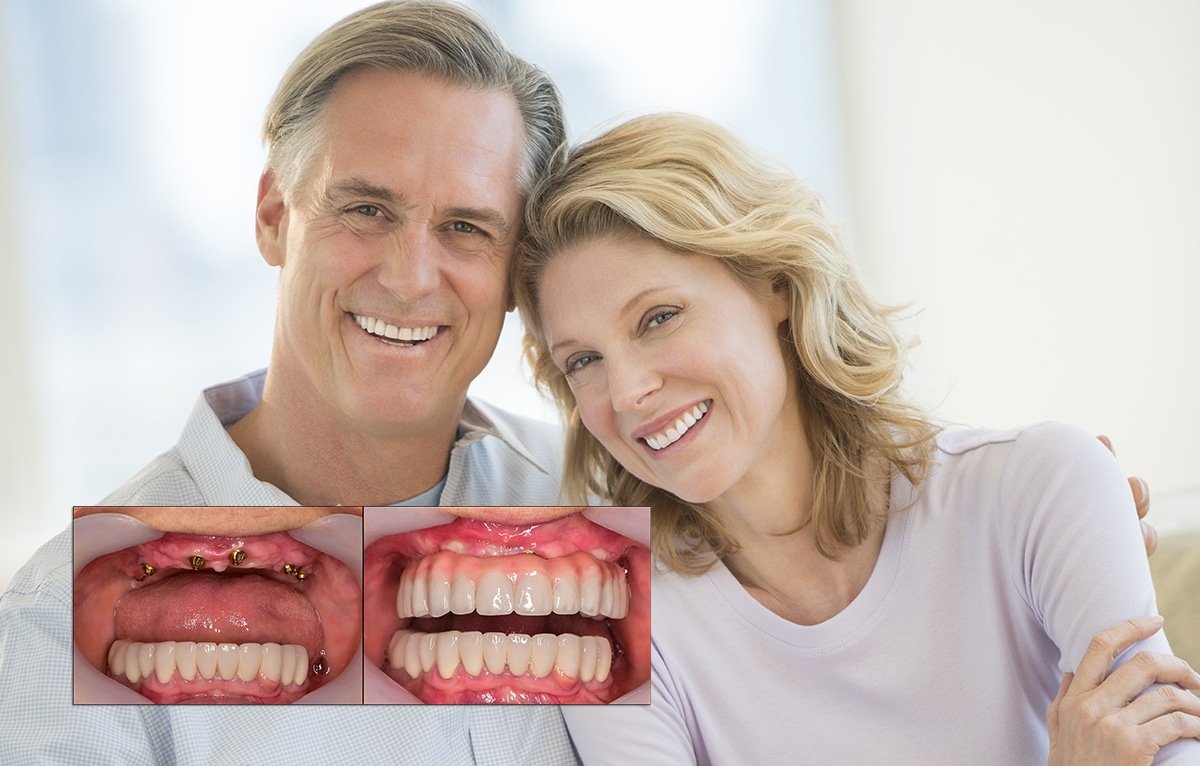
All-on-4 is a cutting-edge dental implant method that replaces a complete row of teeth with just four implants. The term ‘All-on-4’ describes the procedure well: four implants are placed in the jaw, and subsequently, a full row of teeth is linked to them.

Is all All-on-4 recovery excruciating?

It’s a frequent myth that All-on-4 implant recovery is excruciatingly painful. This is not the case: the swelling causes a dull ache for a few days, but the discomfort is minimal compared to other dental implants.

If necessary, medications prescribed by your dentist can successfully relieve the pain and discomfort caused by the surgery.

How long does it take for All-on-4 dental implants to heal?

In recent years, dental implants have come a long way. They’ve never looked better, and they’ve never been more reasonable. More people than ever before are foregoing disposable dentures favoring fixed, permanent dental implants that mimic natural teeth in appearance and function.

On the other hand, some prospective patients are concerned that the dental implant operation will result in a protracted and unpleasant recovery. These worries may prevent individuals from pursuing life-changing surgeries such as All-on-4 dental implants, which can:

  • Enhance your health and happiness.
  • Make eating more natural.
  • Improve your oral health.
  • They resemble natural teeth.

Are those concerns well-founded? How long does it take for All-on-4 dental implants to heal, and how painful is the healing process? We’ve compiled the following information on All-on-4 recovery to help you make an informed decision.

All-on-4 implants can be implanted with minimal discomfort and a short recovery time when performed by qualified professionals.

BENEFITS OF ALL-ON-FOUR DENTAL IMPLANTS

All-on-Four dental implants have a variety of advantages in addition to a quick recovery time. You may eat and normally drink with them in your mouth since they look and act like natural teeth. You can also restore your confidence while reducing the health risks that occur with declining teeth.

Precautions to be taken

If you can avoid work for the rest of the week, that is ideal—even if many people return to work in two days. It depends entirely on the type of employment you undertake. An office job that does not need any heavy lifting or physical exertion should not be a problem. Just be careful not to bend over, lift larger objects, stand up too abruptly from a seated position, or talk too much.

To avoid irritating the surgery site, make sure to obtain as much rest as possible and eat softer foods over the next 3-4 days.

ARE ALL – ON – 4 COMFORTABLE TO WEAR

If you previously had dentures, you will quickly realize that All-on-4 dental implants are significantly improved in more ways than one. They are sturdy and secure, for starters. For another, you will function normally again in a short length of time after the surgery. Most patients can function normally with a few adjustments to their typical routine, even at this early stage in the process. Last but not least, All-on-4 dental implants do not necessitate extensive care and maintenance; ordinary dental hygiene is all that is required. All-on-4 dental implants are designed to be more comfortable than regular dentures since they do not press down on your gums. You’ll soon be able to bite with greater force and enjoy hot or cold dishes with all of their tastes once more.

WHAT TO EXPECT AFTER ALL-ON-FOUR SURGERY?

Patients can now regain like-natural functions and the physical look of their jaw and teeth, thanks to recent breakthroughs in dental implant technology. Leading dental specialists go to great lengths to ensure that patients are as comfortable as possible during and after the operation:

  • There are a variety of anesthetic techniques available to lessen or eliminate patient discomfort during surgery
  • Measures to reduce the risk of bleeding, infection, irritation, and pain after surgery
  • During regular follow-up appointments, the healing process is monitored.

Dental Implants with Insurances

Dental Implant1

Before discussing dental implants with insurances, let us understand about dental implants. Dental implants are those aids that act as a replacement for the missing teeth and form artificial tooth roots,which are fitted with crowns, bridges or dentures

If we talk about the types of dental implants, they are two types. endosteal and subperiosteal . The common types of dental implant methods include single tooth implants , immediate loading implants, multiple implants, all on 4 implants, single stage or a two stage implants . If we talk about the processes involved in dental implantation are consultation, surgery, bone regrowth(osseointegration phase) , abutment placement, crown placement, and maintenance.

Before discussing dental implants with insurances, let us understand about dental implants. Dental implants are those aids that act as a replacement for the missing teeth and form artificial tooth roots,which are fitted with crowns, bridges or dentures

If we talk of benefits, it gives you a natural look, feels, and fit. In addition to this, it also has a high success rate as compared to other dental procedures. It has also improved the ability to bite and chew and have shown improvement in facial tissue and bone support. Dental Implants are also easy to clean.

Now, the central question arises, who needs dental implants? People who have lost their teeth or are suffering tooth loss due to various reasons should undergo dental implant surgery.

Does Insurance Help in covering expenses of Dental Implants?

Are you wondering about how to get dental implants covered by insurance? To answer this question, let us understand the costs of dental implants and understand their worth. A single dental implant costs are $3,000-$4,500 if you do not have any insurance. These costs may even spike up more in the case of multiple implants.

The expensive cost of dental implants will be worthy for you if they are of good quality and last for a lifetime. This is because they give you the look of natural teeth and allows you to have a beautiful and open smile without any hesitation. It also allows you to eat and speak confidently without any fear of embarrassment.

If we talk about bridges, implants are costlier than bridges because of the surgery process, and also the cost of dental implants Is also expensive. In addition to this, placement of dental implants also requires special training and equipment for dental implantation surgery.

If you want to replace your missing tooth or teeth through dental implants, but you are unable to afford it or find it difficult to pay all at once, don’t worry. Dental Insurance and other payment plans will help you to make it affordable.

The medical and dental insurances will help you cover the costs of the dental implantation under the following circumstances:

  • If you have ever lost any of your teeth due to an accident or injury.
  • Medical problems related to loss of tooth or teeth or also loss of teeth or tooth caused by genetic reasons.
  • Also, inquire about the plans mentioned in the dental insurance because every dental insurance from different companies differs.

The cost of covering the expenses from dental insurances and the help provided by them and their services may vary and differ from region to region or to company-to-company depending on the standards and policies they offer.

If you do not have dental insurance till now, don’t worry; dentists have other payment plans and options. You can try them out too.

In general, if we talk about tooth implant cost without any insurance, it would be high, especially if you are visiting a clinic that has high standards in terms of infrastructure, treatment and the equipment they use, and the services they provide to their patients and clients.

There are top 5 companies that are best for dental insurance for dental implants. They are:

  • Delta Dental Insurance
  • Denali Dental
  • Spirit Dental and Vision
  • Ameritas Dental
  • Cigna Dental

While selecting dental insurance companies for yourself, please be careful and do it with a proper checkup of background and verification. These days, fraudsters and low-quality dental insurances are becoming more common. Read all documents carefully before proceeding further. This will help you to stay safe and secure from your side.

All about wisdom tooth extraction and recovery after the surgery

Dental Implant

Wisdom teeth, also known as third molar teeth, are teeth that are located at the back of the upper and lower jaws and are the final teeth to erupt into the oral cavity. They usually appear in the mouth between the ages of 17 and 25. They are called wisdom teeth because they erupt in the mouth in the phase of life called the “age of wisdom.” Some individuals may get their wisdom teeth as late as their 40s or 50s. Wisdom teeth removal surgery is a procedure to remove these sets of molars. Most individuals have at least one impacted wisdom tooth because, in most cases, it does not have enough space to grow naturally.

What is a wisdom tooth extraction procedure?

Wisdom tooth extraction surgery is the surgical procedure to remove one or more wisdom teeth. If the wisdom tooth does not have room to grow, it may cause pain, infection, and other dental problems. If these symptoms are present in your case, you might want to get it pulled. Wisdom tooth extraction surgery can be done by a dentist or an oral surgeon. It is recommended to get this surgery done to prevent any future problems an impacted tooth may cause.

Why is the procedure done?

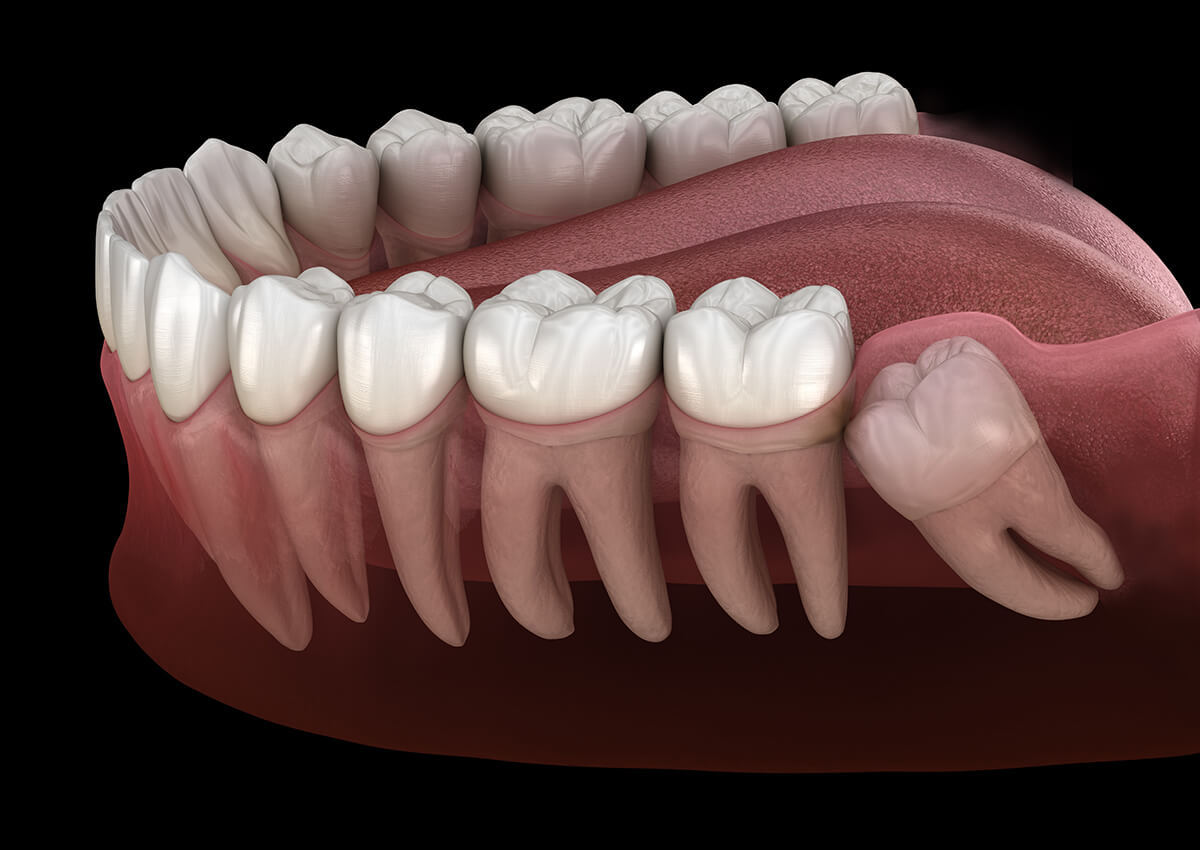
An impacted wisdom tooth may:
  • Grow at an angle that may be right next to other teeth.
  • Grow at an angle at the back of the mouth.
  • Grow at a right angle to other teeth, as if it is directly lying in the jawbone of the patient.
  • They may straight up and down but remain trapped within the jawbone of the patient.
Problems that come with an impacted wisdom tooth are as follows:
  • Pain in the teeth or the surrounding gums.
  • Food and other debris may get trapped behind the wisdom tooth.
  • There is the risk of getting infections and gum diseases. Some may get periodontal disease.
  • The patient may get tooth decay in the partially erupted wisdom tooth.
  • There could be damage to the nearby tooth and surrounding bones of the jawbone.
  • It may develop a fluid-filled sac around the wisdom tooth.
  • It may cause complications when the patient is getting orthodontic treatment.

What can one expect in the procedure?

The dentist or the oral surgeon can use three types of anesthesia during the procedure; the type of anesthesia depends on the complexity of the surgical procedure and the comfort level of the patient. There are mainly three types of anesthesia that are used for this procedure, and they are Local anesthesia, sedation anesthesia, and general anesthesia.

  • Local anesthesia- Your dentist or oral surgeon can inject this with one or two injections near the site of the extraction. Before the injection, the practitioner will have to apply a substance to your gums to numb them. This anesthesia allows the patient to be awake during the procedure, but it does not make them experience any pain.
  • General Anesthesia- In some cases, the patient can be given general anesthesia. This is inhaled through the nose or an IV line to the arm of the patient. The surgical team will monitor your condition throughout the procedure; general anesthesia will make the patient feel no pain and leave them with no memory of the procedure.
  • General Anesthesia- In some cases, the patient can be given general anesthesia. This is inhaled through the nose or an IV line to the arm of the patient. The surgical team will monitor your condition throughout the procedure; general anesthesia will make the patient feel no pain and leave them with no memory of the procedure.

Let’s discuss what happens during the procedure:

  • The doctor or oral surgeon makes an incision in the gum tissue to expose the tooth and bone.
  • Removes the bone that is blocking access to the tooth root.
  • Divides the tooth into sections to make it easier to remove.
  • Removes the tooth.
  • Cleans the site from which the tooth was removed. Removes all the debris from the tooth and bones.
  • Stitches the wound close to let the site heal; this may or may not be necessary.
  • Places gauze over the extraction site to control the bleeding and to help a blood clot form in that area.
  • Now that we understand how the procedure works let’s understand how one can quickly recover from a wisdom tooth removal surgery.

Tips for recovering from wisdom tooth extraction

  • The patient will have to rest as directed by their dentist. This is a very simple instruction but a very important one. Not following this will result in slowing the process down and could cause complications down the line.
  • The patient will have to avoid sucking liquid from straws during the recovery as it could dislodge the blood clots from the surgical site.
  • Keep your head elevated for a few days after the procedure to avoid swelling and excessive bleeding.
  • You can apply ice packs to the side of the face at 15-minute intervals to reduce the swelling in the face.
  • Always stay hydrated during the recovery to promote faster healing.
  • Eat healthy food and drinks that will keep you nourished during the recovery.
  • Do not eat foods that are spicy, crunchy, or hard for at least a week from the surgery. These foods could slow down the recovery process.

Conclusion

Center for Implant Dentistry can take care of all your needs for the surgery. We can make a comprehensive plan as per your needs; we have a very experienced staff working with us that will help you with every step of the procedure. Consult our doctors today to get the best treatment for all your dental needs.

How many steps are there in a dental implant, and how long does a procedure take?

Dental Implant

A dental implant is a surgical component that is interfaced with the bone of the jaw or skull to support a dental prosthesis such as the crown, bridge, or denture. Anyone can get a dental implant, but it is recommended if the patient has decayed, broken, or chipped teeth. However, one must consult the dentist first. But one can get the implant only if they have strong gums to support it. The dental implant is one of the best treatments for patients that want to replace their missing teeth. So, let’s discuss some advantages of getting a dental implant.

Advantages of getting a dental implant:

  • It improves oral health- Dental implants do not require to reduce your other teeth as a tooth-supported bridge does. As the new teeth are directly infused with the bone of the jaw and gums, the other teeth can be cleaned easily. Hence, getting a dental implant will only improve your oral hygiene.
  • Durable- With the right care, implants can last for many years. Good implants are very durable.
  • They are convenient- Unlike removable dentures, dental implants are fixed in the same place permanently. You won’t have to remove them from time to time to clean them, as they are as natural as your original teeth.
  • They make you comfortable- If you did not feel comfortable with a broken and chipped tooth, dental implants could help you get your self-confidence back. These are just some advantages of getting a dental implant, but now that you understand what dental implants are for and the advantages of getting one. Let’s get into the step-by-step procedure of how to get one. There are three physical components of getting a dental implant. The first step is the implant itself, the second step is the abutment of teeth, and the last step is placing the prosthetic itself. But this does not explain the complete picture of the procedure, so we shall explain all three steps extensively.

Step 1

Placing the implant

The first step of this critical implant process is to bury the implant in the patient’s jaw bone through a surgical procedure. The dental implant replaces the tooth root of the patient, and it requires some time to heal. In this healing time, the dental implant integrates itself with the bone. And the bone cells attach themselves to the implant rod; they fill the spaces to secure a permanent space for the implant. The healing time usually takes around three to six months.

Step 2

Placement of the abutment

The abutment is a post that connects the implant to the prosthetic teeth. The abutment is a bridge that spans throughout the gum line so that the implant itself can stay buried. Just like the implant, the abutment requires a healing period of its own. The gums around the abutment must heal themselves and form a cuff or a collar around it, and this is very important as only after that can one place a crown over it.

Step 3

The prosthetic tooth

After both the implant site and abutment are successfully integrated, the prosthetic tooth can be fabricated and installed.

This three-step process is very complex and has to be handled very carefully by the dentist. Now that you understand what each step of the process consists of, you must be thinking of how much time it would take for you to get an implant.

The dental exams

Before getting started with the procedures, there are several dental exams that a patient has to go through. This also includes X-rays and possibly 3D scans of your whole mouth. And multiple check-ups of your mouth are done by your dentist as they have to determine the health of your gums and the strength of the jawbone to support the implant. Only after these tests can they come up with a treatment plan that suits you the best.

Implant surgery

The first step of the surgery, the implant process, usually takes up to 1 or 2 hours per implant. After this step is complete, the patient will have to wait for around three months for the placement to fully heal itself. Only after three months can the dentist finally restore the teeth. This healing period is very important, as it is when the implant integrates itself to the bone.

Post-Surgery recovery

After the surgery is done with the patients will feel swelling, bruising, and pain. This would vary from patient to patient, especially if the dentist had to remove a tooth to install the implant. The healing period after the surgery is around three months.

Abutment and crown fitting

The last step is the fitting of the crown and the abutment to the implant. This step involves exposing the gums so that the crown and abutment can imprison the implant. After the abutment is secured in its position, the crown can be fitted too. And your dental implant process is complete. A dental implant process can take several months to complete. But in the end, you will get your broken tooth replaced with a permanent tooth.

All-on-4 dental implants

If a patient has any broken or chipped teeth, then the most cost-effective way to replace all of them would be by doing an All-on-4 dental implant. As in this type of implant, you can replace all your teeth in one of your jaws with just four implants. The All-on-4 implant is also referred to as ‘implant-supported dentures.’ This procedure is only recommended if you have multiple chipped, decayed, or broken teeth in one of your jaws.

Conclusion

Hope that gives you a brief idea of what dental implant procedures are for and how long it takes to get one. We also explained all the steps involved in the procedure. If you ever feel like your oral hygiene is compromised, you should come to the Center for Implant Dentistry to meet one of our dentists. We have made it our mission to give you the best treatment possible for all your dental problems. And we are experts in the field of dental implants.

Affordable dental implants near you

Affordable Dental Implants

A dental implant is nothing but a small titanium screw that is surgically placed within a patient’s jawbone, right beneath their gum line. This screw then infuses itself with the jawbone, creating a stable foundation for tooth restoration. A dental implant screw acts as a replacement for the patient’s missing tooth root. Not only that, but it also strengthens and preserves the patient’s bone structure. After the implant is set in its place, the dentist will fit a restoration on top of it. It could be a single crown that replaces one tooth. But in some cases, dental implants are also used to support multiple missing teeth with a bridge and or secured dentures. With proper care, dental implants can last a lifetime. Dental implants have a success rate of 98%. Most dentists recommend dental implants as a go-to option to replace missing teeth. If you have broken, chipped, or missing teeth, you should probably get dental implants. There are different types of dental implants like:

Types of Dental Implants

Single tooth dental implant

This is one of the most used implants; patients who want to replace a single tooth opt to get a single tooth dental implant. It only requires one screw and one crown.

  • Implant-supported bridge

If the patient has multiple missing, decayed or broken teeth adjacent to each other, they are recommended to get an implant-supported bridge. A dental bridge consists of two crowns on either side of the patient’s missing tooth gap, with an artificial tooth that is held in between by those two crowns. Unlike a regular dental implant, an implant-supported bridge has crowns directly connected to the dental implants.

  • Implanted denture

These are used when the patient wants to replace all the teeth on the upper or the lower jaw. A denture is an artificial arch of the teeth that rests on the gum line of the patient. They have an appearance similar to a complete set of teeth. In this treatment, the denture is directly secured in the mouth of the patient with the help of four strategically placed dental implants. Now that we have discussed what dental implants are and what the different dental implants are let’s get into how much a patient has to pay to get them?

What is the average cost of a dental implant?

A patient can expect to pay up to $1000 to $3000 for a single dental implant—the price increases on the number of dental implants the patient needs. The client can expect to pay around $3000 to $30000, but we at Center of Implant Dentistry try to limit the amount we charge as much as possible, as we want more and more people to have access to a beautiful looking smile they like. One must know that they aren’t just paying for hardware that is used to attach the tooth. Still, the patient is also paying for the expertise of our team of dentists, diagnostics, precision that is required in the procedure, and labor associated with the surgical procedure. The cost of the system may seem a bit high at first glance, but we assure you that our reasonable payment plans make the cost as affordable as possible.

How long does a dental implant last?

Dental implants are considered cost-effective because they are a long-term solution to multiple dental problems the patient may be suffering from. The client can expect a dental implant to last for 10 or 15 years. If one takes excellent care of the implants and has annual cleanings, they may even last a lifetime. Dental implants are better than dentures because there is a chance that you could lose or damage them. There is a possibility that you end up spending more money by replacing it multiple times.

Could dental implants fail?

As we mentioned earlier, the success rate of dental implants is 98%. Hence, there is a possibility that the dental implant may fail, but it is not as common as it once was. In many cases, dental implant failure is avoidable. If the client does not take the implants by regularly brushing and flossing them, they could be putting themselves at risk of infection and other complications. The client must have annual cleanings of the implants. Certain health conditions like rheumatoid, diabetes, lupus, arthritis, multiple sclerosis could fail the implant. Some medications also make you more vulnerable to dental implant failure. So we ask you to openly speak to our dentists about all your medical conditions if any. So, they can thoroughly evaluate a treatment plan that caters to your needs.

Conclusion

Dental implants can give you back a smile you used to love. Dental implant costs vary from patient to patient, but we can assure you that you get the best treatment possible. We at the Center for Implant Dentistry personally take care of every step of the implant procedure. We have all the resources and expertise available at our practice; you would not have to go through multiple dental practices to get the smile you deserve. Not only that, but we assure you that we will take good care of your teeth.

Do you think All-on-4 is the best option? Consider these five factors when creating a dental treatment plan.

CID-Dental-Implant

The reason I love dental implants is, it has no rules. There are guidelines to it. Because every case is unique, the dentist must need to have good knowledge. He/She must know every case with details and hence should implement the treatment plan accordingly. The factors such as periodontal disease, occlusion, parafunction, and the budget of the patient can affect even the regular cases. A dentist should take all these factors into account and should listen to the patient’s wishes. These factors can also affect the patients who lack teeth. This article focuses on the patients who are not edentulous and ready to remove the teeth for implantation.

The recent most popular trend in implant dentistry is full-arched fixed implant bridges. These are also known as all on for implant. The dental implants, which are around four to six, support these bridges. They are made up of titanium, monolithic zirconia, and stacked porcelain to a chromium and cobalt frame. Some dentist practitioners promote all-on- 4 dental implants to their patients, who are on the verge of being toothless. It comes with package pricing to make an easy presentation of the case.

Six to ten years ago, patients were not so aware of all-on-four implants. But due to huge information available on the internet and promotions by the dentist industry, patients know the advantages of all-on-4 dental implants.

Nowadays, patients request this implant technique, but is it always beneficial? Can all-on-four implants be harmful? What are its consequences?

To answer this, it will take so long to write about all-on-four implants. But the following five factors can be considered to recommend these implants.

1.Parafunction

2.Difficulty of speech

3.Proprioception

4.Significant caries index

5.Bridge thickness

Now let’s see how these factors can affect all-on-four dental implants.

Parafuntion:

Some people have parafunctional habits. Habits such as clenching the teeth, bruxism, or chewing cycles that are not regular can affect the treatment. Teeth can detect these forces than the forces of the implant. To make the parafunction better, some natural teeth present in the mouth can help.

If parafunction is present, and there is a need to replace all the teeth, an overdenture that is bar supported can be helpful. This is still an all-on-four implant process but seems like a modification of fixed bridges through your patient’s vision. For the patients who have bruxism habit and do it often, bar overdentures are effective. Patients can remove the overdentures and use a night guard that fits on the bar for retention. This helps in the protection of prostheses. It also helps to reduce the strain on the bone and supporting implants. Even if the soft tissue volume and bone are healthy, we replace them. Some part of the bridge adjacent to the soft tissue gets bulkier than the previous soft tissue volume and bone.

The difficulty of speech:

Speech difficulty is a major issue for patients. For all-on-four implants, a minor speech issue can become a big concern. For strength, vertical and horizontal bulk is required for implant-supported bridges. Most bridges require 15 mm or more of height to fulfill the vertical needs of different restorative materials. To achieve these measurements, dentists have to replace more than the volume of a tooth that is missed. It also has an impact on speech sounds. To form the sounds, the tongue comes in contact with the hard palate lingual to the central incisors. Sounds such as ‘T,’ ‘N,’ ‘D,’ ‘G,’ ‘J,’ etc., are impacted by this. Similarly, the ‘S’ sound is affected by the horizontal bulk in the posterior area, which can result in slurring.

Patients with all-on-four dental implants should be aware of this situation. It is a compromise for them. Though they can get a habit of retraining their tongue by practicing, they can be anxious and tired by it. If the difficulty in speech is major, the dentist is recommended to offer alternative treatment options. He/She can make a plan to replace the missing teeth with individual implants or short-term bridges and save the healthy teeth. A bridge can be used to replace the missing tooth structure when the teeth are terminal. This process takes more effort. It often requires more implants and more bone grafting. It requires more prosthetics, and hence patients need to give more time and cost.

Proprioception

While recommending dual-arch treatments to a patient, the value of proprioception is often overlooked. The teeth become vulnerable to the lower forces by the periodontal mechanoreceptors, also known as (PMR). These are present in the periodontal ligament. A periodontal ligament is not present in a dental implant. That is why to make the same proprioception as a tooth takes 10x more force. The proprioception that is associated with dental implantation is almost similar to the tooth, which is affected by local anesthesia. It will be difficult to identify the excessive occlusal and premature contacts. Due to a lack of sensation and feedback, excessive biting forces may be generated. Patients having dual-arch all-on-four dental implants bite excessively than the patients with fewer teeth. This can cause a bone loss or fracture of the restoration. To improve chewing efficiency, Periodontal mechanoreceptors (PMRs) associate with motor movements when teeth are present. The poor efficiency of chewing and the stress on the restoration and implants can be caused due to fewer movements and dual-arch implants.

During the healing period, tooth popping, and broken temporaries, the patients with the dual-arch all-on-four dental implants experience more implant loss. If both the arches need treatment, try to save at least some teeth. Use some restorative options for that. In some cases, this may not be possible. Then try treating the upper arch with staging treatment opposing natural teeth for a while, and you may modify the teeth at the occlusal plane level. For patients to avoid the extra biting force, the proprioception of the lower teeth helps. It also helps them to recognize the occlusal discrepancies. The dentist can treat the lower arch after some months. This will be helpful for a patient and give time to form mechanoreceptors in orofacial tissues. Orofacial tissues such as joints, muscles, periosteum, etc., will form the mechanoreceptors. To increase the osseointegration in the maxillary implant, the extra healing time can be helpful.

Significant caries index

Dentists can get this scenario often. Suppose a patient has a full upper denture, it can be an all-on-four, and his/her lower teeth are missing. He/She wanted to have an all-on-four lower fixed bridge. The patients like to eat chewy foods such as steak and have a square-shaped jaw. He/She seems to have a bruxism habit. The patient has crowns and root canals with some fractured teeth. Some of his/her teeth are filled with tartar and have periodontal pockets, and some teeth have lost the bone. In this situation, should a dentist save the teeth or not? What will be the risk factors? What will be the benefits?

If the canines and bicuspids are intact and less mobile, it will be the best option to save the teeth. There is a risk of developing periodontal disease. They will be a failure from decay. But these conditions have less chance than the prosthesis fracture or the damage to the implant due to parafunction.

Now again, if we consider the same situation but some canines and bicuspids have interproximal, and Class V decay. The teeth have plaque, and the cavities are not a problem. But now, how sure are you as a dentist to do future prognosis? You can diagnose the whole situation and ask a patient to take care of the teeth at home, have less sugar, and more visits to the dentist. But as you know, habits are easy to get and hard to change. The tooth decaying can increase the risk of prosthesis fracture, and a patient can lose these teeth. So the best treatment in such scenarios is all-on-four bar overdenture. Through this treatment, a patient can get a simple oral hygiene rule and reduce the stress of implantation. A dentist needs to give more time to patients with these conditions.

Bridge thickness

The bridge bulk can provide a different feeling in the mouth, and the patient needs to deal with it psychologically. It does affect not only the speech but also causes other difficulties. The all-on-four dental implant patients can feel the original soft tissue and later the fake soft tissue, and this may bother them. Unfortunately, they can suffer from this problem after surgery. The ridge got reduced after the surgery, and no steps can be taken to go back to have the feeling of natural tissues.

These surprises will never be appreciated by any patient. So the dentist should give advanced notice to them and have a conversation with the patient before the final treatment plan. The dentist can explain the natural structure and the structure after all-on-four implants to the patient. The replacement of the tooth volume can be done if the bulk is causing difficulty. The vertical and horizontal reduction of the bulk of these restorations needs more implants to support the bridge, and it can reduce the risk of fracture. There will be a need for grafting if the implants are placed posteriorly and the distal cantilevers are shortened. Because of the low cost and less treatment time, patients tend to choose the traditional all-on-four implants. Patients can accept the compromises and be secure when they receive all the information about the implant. They know about the limitations and can choose from the various treatment options.

Dentistry has a boon of implants to replace the lost tooth. In the old days, patients used to be happy even if they became able to chew again, and they were satisfied by that. The success rate of full-arch implants is high, but nowadays, the patient’s expectations are high too. Due to the widely available heap of information, patients are well-known about the implant techniques, and despite its long procedure and awkward feel, they demand all-on-four dental implants. But they must also know the side effects of all-on-four implants.

A dentist should always provide the best treatment to his/her patients. He/She can offer several full-arch options but should study deeply about the patient’s case and apply the best suitable technique. A dentist should tell the advantages as well as disadvantages of the treatment to the patient to get the best results. This way, the patients will be satisfied, and this is something a dentist will desire!

Center for implant dentistry- the best destination for the dental implants

The center for San Francisco implant dentist, California, provides the best implants to their patients by giving all the consultations before the treatment. With the highest level of training and qualified dentists, you can get everything under one roof. At the center of implant dentistry, we care about the patient’s oral health and are committed to providing satisfactory treatments to our patients. We care for your teeth. In our clinic, technology meets the dentistry to give only the best treatments to our patients. We have many happy patients smiling wide due to our high-level and pain-free implant techniques at reasonable prices. If you ever feel you need SF dental implants, just book an appointment with us, and we will be happy to help you.

How to find the best dental implant dentist?

Dental-Implants

If you are too shy to smile in front of a camera because of missing teeth, tooth decay, or gum disease, dental implants could be the best option for you. A dental implant is dental prosthetics that are interfaced with the bone of the jaw or skull. There are many dental implants, such as crown, bridge, denture, and facial prosthetics. These implants would massively boost your confidence. Now that you understand what dental implants are, what should you do to get them? To get dental implants, the patient has to visit the dentist many times, both before and after the implants are placed. This could be quite a tedious process if the patient has to visit different centers for every other thing.

Look for a center that does it all. 

While you are looking for a dental implant dentist, you should find a dental practice that could act as a one-stop shop. You need to look for a course that can take care of all your needs. Most dental practices can’t do all the procedures in one place, and you would have to go to different clinics for every course. This may cause some problems for you. 

The Center of Implant Dentistry takes a better approach than most other practices out there. We are equipped and skilled to do everything necessary for your procedure. You can get your extractions done, implants placed, a restoration made and set, and you can get your after-care taken care of by one of our top doctors at one of our offices. Many components are involved in a dental implant procedure, such as oral surgeons, periodontists, and dentists. For you to keep track of all these appointments could be very frustrating. 

Dental implant options  

Dental implants are not the same for all patients. Every patient has their own needs and sizes regarding their implants. And for that, you may need to go to a dental practice that could help you out. We make sure that you get as many available options and the best restoration of your teeth. 

What type of implants do you need?

Depending on your needs, you may need one tooth removed and replaced, or it could be multiple teeth implants, or you may even need a complete arch implant. You will have to come to our practice to get a consultation from one of our top doctors. They can guide you in the best manner possible. 

The technology needed for an implant

You may not be concerned about the technology that a dentist uses, but you need to know about all the treatment factors. It does not mean that if a dentist does not have the latest technology, they won’t do your procedure correctly. But you need to know about the specifics of the process and the safety measures to be taken.

 Image technology and Digital radiography are used in implant procedures. Your dentist should be experienced enough to walk you through this process and explain all the points necessary for you to know. With the help of technology available at our practice, the dentists can get an in-depth understanding of the specific implants you need. 

Training of our staff

If there is a point that the patient should not be worried about, it would be this one. A specialist who has the proper training would gladly answer any questions you have. Dental implant surgeries aren’t something a dentist learns from day one of their jobs, and a dentist needs to have specific training in dental implant placement. It is also essential that whichever dentist you visit is up to date with their education courses on the field. 

How should one choose an implant dentist?

The points mentioned above are of the utmost importance when looking for a dental implant dentist for you. You should always look for an educated and professional dentist. You can also find client testimonials on our website. A well-respected practice like ours is not afraid to show off our reviews to the public. You can find many videos on our website that talk about patient’s experiences with us. Dental implants are permanent, and you must do your research on the topic as much as you can. You must choose a dentist that can handle your teeth with care and have good experience in dealing with various teeth. 

Environment

When going through a dental implant procedure, the last thing you need is an environment filled with rude people. Professionalism and the best customer service are one of our top priorities. It is essential that you feel comfortable and safe in our practice. It is also vital that you feel safe with the dentist that is handling your procedure. The fantastic staff at our training will make you feel right at home. 

Why should you choose the Center for implant dentistry?

If you need a practice that does it all, our practice is the best choice for you. Not only that, but we also offer you various options for your implants. We also have the latest technological solutions and have a very experienced staff. We make sure that your needs are taken care of. Our motto is to make you happy. Our fantastic team makes sure that you get the best treatment possible. We have the best solutions to all the problems you may have; our doctors can create a specialized plan. A treatment plan that makes sure that you get the care that you deserve. Replacing lost or severely damaged teeth is very important for your oral hygiene. There are many reasons you should contact your broken and missing teeth to be replaced with implants as soon as possible. Many health problems could affect you in the long run. We make sure that you get the best treatment possible and get the smile that you always wanted.

The Impact of COVID-19 Vaccines On Dental Health Care

Center-for-implant-dentistry-3-scaled

As vaccine dispersion continues across the world, several people are skeptical of how life will alter and what it insinuates for various health care services they expect.

The light is on the horizon for the world as COVID-19 vaccines have ultimately started to be distributed across the world. This is big news for everyone. Nonetheless, it’s still going to be various months until we are entirely out of the woods and things can return to a state of normality. In the meantime, it’s significant to understand how specific things will change and the circumstance evolves as more and more people are provided the vaccine while others patiently await their shift.

This is especially relevant when it comes to attaining health care services, comprising visits to your dental clinic. In this article, we’re going to examine how the distribution of COVID-19 vaccines will influence the health and safety approaches we’ve been following in our daily lives and what patients will need to understand about getting dental care once they get vaccinated.

When Is Someone Considered to Be ‘Fully Vaccinated’?

While vaccines are our biggest preservation against viruses like COVID-19, taking a vaccine isn’t actually like flipping a switch and turning on an invisible shield. It’s not an immediate effect. The science behind vaccines is quite extraordinary, and if you’d like to know more about how vaccines function to protect us, the World Health Organization has a helpful resource that provides an abundance of information on the topic. You can discover it here – Vaccines and Immunization: What is Vaccination?

Depending on the type of vaccine a person is given, the timeline to accomplish full vaccination status will vary slightly. Presently, there are two types of COVID-19 vaccines being distributed in Canada. Some vaccines, such as those created by Pfizer and Moderna, mandate two doses administered 21 days apart for Pfizer and 28 days apart for Moderna. The other type of COVID- 19 vaccine available in San Francisco is a single-dose vaccine produced by Johnson & Johnson.

A person is considered to be ‘fully vaccinated’ two weeks after the one-dose vaccine has been administered or two weeks after acquiring their second dose of the two-dose vaccine. Once someone has traveled this threshold and is considered fully vaccinated, there are amended guidelines that they are permitted to follow. Still, certain precautions are essential for the protection of others who have not yet been vaccinated.

How Do Health and Safety Guidelines Amend Once Someone Is Vaccinated?

Once vaccinated, some of the approved guidelines on personal protective measures are loosened in certain conditions. Particularly, the use of masks in several types of circumstances is not always expected. For instance, the CDC has implied that somebody who has been fully vaccinated does not need to wear masks when amassing indoors with other vaccinated individuals. Likewise, vaccinated persons do not need to wear a mask when indoors with a group of unvaccinated people who all reside in the same household; still, this does not pertain if any of those people are at increased risk of severe COVID infection.

Lastly, vaccinated individuals do not need to strictly avoid touch with others if they have been near someone who has COVID-19 unless they are indicating symptoms correlated with the virus. Regardless, for those people who are employed in or live in a group setting such as a retirement home, long-term care facility, corrections center, or another similar atmosphere, you should pursue a 14-day self-isolation and collect a test if you come into touch with someone infected with COVID-19, even if you are not exhibiting any signs or symptoms correlated with the virus.

What Has Not Altered Even When Someone Becomes Vaccinated?

Even when completely vaccinated, it is still in the best interests of your family and community to obey self-protection guidelines when in public domains, assembling with people from more than one household who have not been completely vaccinated or coming into the vicinity with high- risk individuals.

Travel should still be resisted unless necessary, and even when traveling, you will still be compelled to adhere to all health and safety recommendations without exception. Workplace domains are also spaces where you certainly must follow all crucial precautions for the safety of all those who come and go from those locales.

Ultimately, you must continue to remain observant and essentially monitor your health for any signs and symptoms related to COVID-19. If you undergo any of these symptoms, it is recommended you self-isolate and obtain guidance from your doctor, even if you have been fully vaccinated. It’s not worth the risks of potentially jeopardizing others who are not vaccinated yet.

What are we Doing to Ensure Patient Safety? The Center for Implant Dentistryremains determined to provide comfortable and protected surroundings for our patients and staff, and so we continue to obey all precautions and guidelines as set forth by health authorities for dental clinics during COVID-19. This comprises a comprehensive set of safety protocols and regulations for visiting patients, staff, and for our clinic spaces to minimize the risks of potential exposure and retain a clean, sanitary environment.

However, vaccination status, all patients arriving at the clinic spaces will be compelled to wear facemasks, the Center of Implant Dentistry team members will conduct a symptom screening when you arrive. Hand sanitizer is available throughout the clinic, social distancing criteria are still in place, and the number of people inside the building is kept to a minimum.

All staff is equipped with a set of personal protective equipment (PPE), comprising face masks, face shields, and respirators as required. In expansion, clear barriers and room dividers are in place to curb airborne particles from spreading from one space to another, and in-room HEPA air filtration systems are frequently carried out to sanitize the air inside the clinic.

At the edge of each day, a top-to-bottom sanitization of all clinic spaces and surfaces is performed using a refined ozone-saturation sterilization system. Once all clients and personnel have left the clinic for the day, the ozone sanitization system operates during the night, flooding the whole building with an airborne ozone mixture through the ventilation system of the building. This ozone mixture entirely sanitizes all surfaces it comes in contact with and then quickly dissipates to become inert and harmless. Each sunrise, when the clinic unlocks its doors again, the whole environment is disinfected and ready for the day.

For a detailed list of all safety precautions and protocols that are in place at the Center for Implant Dentistry, we recommend you check our Guide to COVID-19 Dental Clinic Protocols. We make sure the safety of our patients and staff is our absolute prime priority and are repeatedly working to provide the highest levels of safety for all individuals who arrive at our clinic spaces.

Is it Safe to Visit a Dental Clinic Now?

Even before the pandemic, dental clinics were expected to maintain relatively strict hygiene exercises. It has long been a basic protocol for the whole dental care team to wear shielding gear, comprising gloves, surgical masks, and goggles for eye protection to minimize the danger of transmitting germs from one patient to another.

Now, due to COVID-19, there are following safety precautions in place, numerous of them advised by the Ministry of Health & Family Welfare (MoH&FW) itself, and with the recently enhanced safety precautions, the dental clinics are, hence, safe to visit.

What Precautions Should I Take While Visiting a Dental Clinic?

Take part in pre and post-appointment screenings, be honest with your dentist, and don’t miss the details.

You should wear a mask whenever possible- while stepping through the facility, while talking with your consultation, and on the way out. Doing so may prevent you from unknowingly spewing contagious airborne particles and may even prevent you from inhaling them in.

Resist using the restroom. If you decide to use the restroom or touch a surface with your bare hands, you should wash or sanitize your hands instantly afterward. Also, washing your hands is necessary after you leave the clinic.

Adhere to the appointment time and prevent getting an attendant, with an oddity of dependents and children.

Stop wearing a wristwatch, jewelry, and any other additional accessories or bags.

Online fees through wallets or QR codes are enabled to avoid chances of transmission via cash or credit cards.

What Can I Do in the Meantime?

COVID-19 is going to be with us for numerous months. So it’s crucial to look after your oral health by maintaining a healthy diet and oral hygiene habits.

Brush twice daily: Give at least 2- 3 minutes on brushing.

Utilize Fluoride toothpaste: Fluoride is consumed into the enamel and enables to repair it by restoring the lost calcium and phosphorus, obliged to keep your teeth hard.

Avoid sticky foods: ‘Sticky foods’ are those that contribute long-lasting sources of sugar, such as hard candies, breath mints, and lollipops. These are also associated with tooth decay and should be resisted.

Drink lots of water: Water helps in maintaining your mouth clean and battling dry mouth. It rinses away leftover food and residue that cavity-causing bacteria are gazing for. Further, it also dilutes the acids developed by such bacteria.

Stay Safe, Stay Healthy, Stay the Course We have struck a turning point in the fight against COVID-19, with vaccine distribution now taking place nationwide, and so we look ahead to the day when the danger of this virus has become lessened to the point where life can return to normal. Until that day arrives, every person must remain dedicated to protecting themselves and all others protected to the best of their abilities.

Here at the Center for Implant Dentistry,we remain to concentrate on delivering exceptional dental health care to all our patients and their families in a protected and insulated environment. Contact us today to schedule your next appointment. We look forward to catching sight of you again soon!