The Dental Implant Procedure: Steps and How Long It Takes
A single implant is really three stages — plan, place, restore — and the surgery itself is the short part; here's what each step does and how long it takes.


Written and medically reviewed by Dr. Sam Jain, DMD, MS, and Dr. Arpana Gupta, DDS, MDS
Published · Updated

Three Stages, and the Surgery Is the Quick One
A standard dental implant is three stages, not one appointment: plan it, place it, and restore it. The planning visit and 3D scan take about an hour. The surgery to place a single implant is usually 30 to 60 minutes of actual chair time — genuinely one of the shorter procedures in dentistry. Then comes the longest and least dramatic part: your jawbone grips the implant over the following months. Once it has, a final tooth goes on top in a short visit. Most single-implant cases run start to finish somewhere in the three-to-six-month range, and the reason it's months rather than days is biology, not paperwork.
Here's the part that surprises people: the drilling and placing — the step everyone braces for — is over quickly and, done under sedation, isn't something most patients even remember. What stretches the calendar is osseointegration, the slow fusion of bone to titanium that turns a placed implant into an anchored one. That healing can't be rushed for a natural tooth root, and it's the same for an implant. What can change is how you spend those months. At many offices you wait in temporary teeth; in the right cases here, a same-day approach means you leave with working teeth the day of surgery. More on that below.
So the honest headline is: fewer steps than most people fear, a fast surgery, and a healing wait that's normal and expected. Below is what actually happens in each stage, and where the timeline flexes.

Step One: The Plan — One Visit, and It Decides Everything
Nothing gets drilled until the case is fully mapped. Your first visit is an exam plus a 3D CBCT scan — a cone-beam image that shows your jaw in three dimensions: bone height and width, where the nerve runs, where the sinus sits. A flat X-ray can't show any of that. This scan is where the surgeon decides whether there's enough bone to place an implant directly, or whether you'd benefit from a bone graft or sinus lift first, and it's where the exact position, angle, and depth of the implant get planned before you're ever in the chair. Here, that consultation and 3D scan are free — a $499 value — because a good plan is what separates a clean case from a compromised one.
Two things make this stage matter more than it sounds. First, the scan often overturns bad news: plenty of people arrive having been told they "don't have enough bone," and a proper 3D look finds a workable path anyway. If you're wondering whether you'd even qualify, the candidacy page covers what actually rules people in and out. Second, the plan drives the surgery's precision. Cases here are placed with guided-surgery systems — X-Guide and Navident EVO — so the implant lands exactly where the 3D plan put it, not freehand. That's part of the wider technology the practice runs under one roof.
For a full arch of teeth rather than a single tooth, this same planning stage is where the number of implants gets decided — four, six, or the All-on-8 Robust protocol Dr. Sam Jain developed for heavier bites. The stages are the same; the scale and the plan change.
Step Two: Placing the Implant — the 30-to-60-Minute Part
On surgery day, the implant — a small titanium post that acts as a new tooth root — is placed into the jawbone at the position the scan mapped. For a single implant, expect roughly 30 to 60 minutes of actual work; more implants or an extraction in the same visit add time. If a failing tooth needs to come out first, that's often done in the same appointment, and in many cases the implant goes straight into the fresh socket — an approach the extraction-and-immediate-implant page explains, since a socket starts collapsing the day a tooth leaves.
Comfort is a fair question. The surgery itself is well-tolerated. It's done under local anesthesia, and IV sedation is available for anyone who'd rather sleep through it — most sedated patients remember little of the appointment. Afterward there's some soreness and swelling for a few days, which the post-op instructions walk through in detail. This article is about the process itself, not recovery, but the short version is that placement is minor as oral surgery goes.
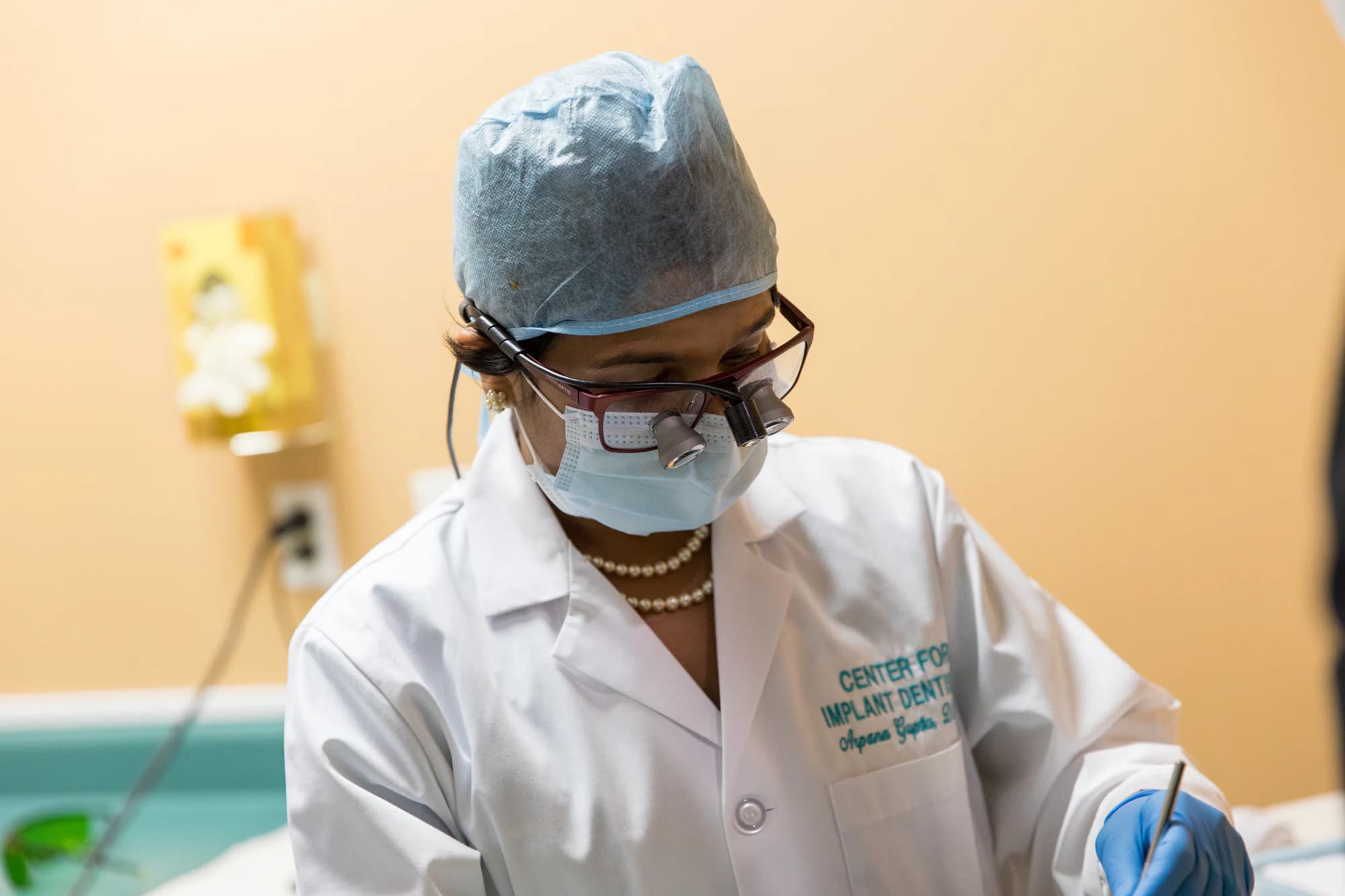
One thing worth knowing: the surgeon who planned your case is the one placing the implant. Dr. Sam Jain and Dr. Arpana Gupta — a married team of ICOI Masters — personally plan, place, and restore every case, with no fly-in surgeon handing your bite off to someone else. The same hands see it through all three stages.
Step Three: Healing and the Final Tooth — Where the Months Go
After placement, the implant needs to fuse to your bone — osseointegration. This is the long stretch, and it typically runs about three to six months, though your own timeline depends on your bone quality, your health, and habits like smoking; your doctor will give you a realistic window for your case. During this time the implant is quietly becoming a permanent part of your jaw. Rushing it is the surest way to lose it, which is why no honest surgeon compresses this step arbitrarily. Once the fusion is confirmed, the final stage is short: an abutment (a connector) and your custom-made crown are fitted, usually in one or two brief visits, and the tooth is done.
This is where the practice's setup changes the experience of those months rather than the biology of them. Most single and multiple cases don't spend six to eight months in temporary plastic waiting on an outside lab. Because there's an in-house CAD/CAM zirconia mill inside the same walls — run by engineer Andy Jain — a final custom-milled tooth can be produced in roughly 24 hours for single and multiple implants, and in about 72 hours for a full arch. In selected cases the whole visible result arrives on surgery day; the same-day dental implants page shows how that workflow fits around the healing that's still happening underneath.
Add the stages up and a typical single implant is: about an hour to plan, under an hour to place, three to six months to heal, and a short visit to finish — roughly three to six months in total, most of it spent simply living your life while bone does its work. Full-arch cases follow the same three stages on a compressed front end, since a fixed set of teeth is often attached the same day. If you're comparing this whole path against a removable option, the implants vs. dentures breakdown is a useful next read — and any real timeline for your mouth gets set at the free consultation.
Written and medically reviewed by Dr. Sam Jain, DMD, MS, and Dr. Arpana Gupta, DDS, MDS, who own this practice.
This article is patient education, reviewed by Dr. Sam Jain, DMD, MS, and Dr. Arpana Gupta, DDS, MDS, and is not a substitute for an exam. Treatment recommendations are made only after an in-person consultation and 3D imaging.