Types of Sedation for Dental Implants: Local, Nitrous, Oral and IV, Explained by the Doctors Who Give It
Sedation is not what stops implant surgery from hurting — local anesthesia does that. Sedation decides how much of the appointment you are present for. Here is how each level works, what California requires of the dentist giving it, and how we match it to the procedure.
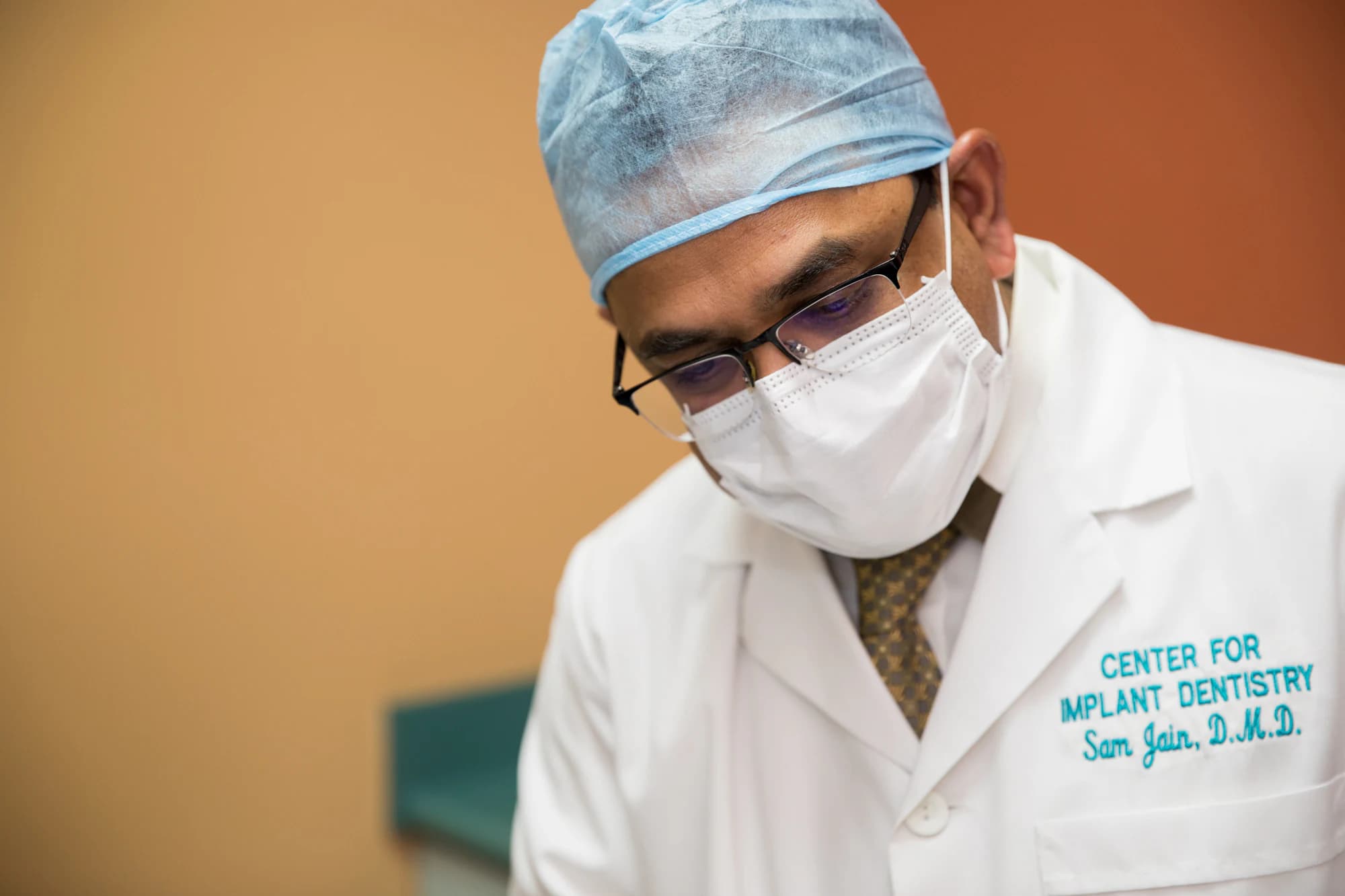

Written and medically reviewed by Dr. Sam Jain, DMD, MS, and Dr. Arpana Gupta, DDS, MDS
Published · Updated
In this article
- 1Pain and fear are handled by two different drugs
- 2Route and depth are not the same thing
- 3What California requires of the dentist sedating you
- 4Local anesthesia alone: more implant surgery than you would expect
- 5Nitrous oxide: light, fast, and gone within minutes
- 6Oral sedation: a tablet taken before you arrive
- 7IV sedation: why it is the standard for longer implant surgery
- 8Matching sedation to the implant procedure
- 9The day of surgery, and the first twenty-four hours
Pain and fear are handled by two different drugs
The most useful thing to understand before choosing sedation for implant surgery is that it is not the pain control. Every implant we place, sedated or not, is placed under local anesthetic — the same family of medicine used for a filling, delivered precisely around the site. Once it has taken, you feel pressure, vibration and movement, but not the sharp sensation people dread. Sedation sits on top of that. Its job is the part of you that is anxious, the part that notices time passing, and the reflex that gags when an instrument reaches the back of the mouth.
That distinction changes how you should choose. Asking “which sedation hurts least?” leads nowhere, because none of them is doing the numbing. The better questions are: how anxious am I about this, how long is the appointment, how involved is the surgery, and what does my medical history allow? A calm patient having one implant placed can be completely comfortable with local anesthesia alone. A patient who has avoided the dentist for fifteen years and is having a full arch rebuilt usually should not be asked to sit through it fully present.
Dental fear is common enough that it deserves to be treated as a clinical problem rather than a personality flaw. A 2021 meta-analysis of 72,577 adults put the global prevalence of dental fear and anxiety at 15.3%, with 3.3% severe. A 2013 analysis of national survey data found that among people with moderate to high dental fear, 38.5% fit the pattern of avoiding care, accumulating treatment need, and visiting only when something went wrong — against 0.9% of people without fear. That cycle is how a single missing tooth becomes a full-arch case. Breaking it is often the first thing sedation does for our patients.
Route and depth are not the same thing
Sedation is described two ways, and mixing them up causes most of the confusion online. The route is how the medicine reaches you: a gas you breathe, a pill you swallow, or medication through a vein. The depth is how sedated you actually are. The American Society of Anesthesiologists defines depth as a continuum — minimal sedation, moderate sedation, deep sedation and general anesthesia — measured by how you respond. Under moderate sedation you respond purposefully to a voice or a light touch, you keep your own airway without help, and your breathing is adequate on its own. Under general anesthesia you do not respond even to painful stimulation, and your breathing often needs support.
The route does not fix the depth. The same oral dose can leave one person pleasantly relaxed and another deeply drowsy; an IV can deliver very light sedation or very deep sedation depending on what is given and how fast. That is why the American Dental Association's sedation guidelines, and California law, regulate the depth a dentist is trained and permitted to provide rather than the device used to deliver it. The skill is in keeping you at the intended depth — and in recognizing and correcting it quickly if you drift deeper than intended.
What California requires of the dentist sedating you
California is more specific than many states, and it is worth knowing the categories because you can check them yourself. A dentist who gives oral sedation above the single maximum dose that could be prescribed for home use needs an Oral Conscious Sedation for Adults certificate from the Dental Board of California. Moderate sedation — which is where IV sedation for implant surgery normally sits — requires a Moderate Sedation permit, which replaced the old Conscious Sedation permit on January 1, 2022. Deep sedation and general anesthesia require a separate General Anesthesia permit, and the Board requires completion of an accredited residency in anesthesia or oral and maxillofacial surgery to hold one.
The Board also sets monitoring rules. A patient under moderate sedation must be monitored continuously with a pulse oximeter, and ventilation must be monitored by at least two of three methods: listening to breath sounds, measuring exhaled carbon dioxide, or verbal communication with the patient. Those are legal minimums rather than a full description of good care, but they tell you what should be happening in the room.
At our practice both owner-doctors hold California moderate sedation permits — Dr. Sam Jain, #MS 493, and Dr. Arpana Gupta, #MS 376 — and both hold Advanced Cardiac Life Support certification. Dr. Jain trained in IV sedation at the Medical College of Georgia; Dr. Gupta completed IV sedation training with Western Surgical and Sedation. The permit numbers, license numbers and certificates are listed on our verified credentials page, and the permits can be checked against the Board's public records. We do not provide general anesthesia in the office. When a medical history genuinely calls for it, the right setting is a hospital or surgery center with an anesthesiologist, and we will say so plainly rather than stretch a permit to fit.
Local anesthesia alone: more implant surgery than you would expect
Many single implants, and a good share of two- and three-implant cases, are placed with local anesthesia and nothing else. The appointment for a single implant in healed bone is often shorter than people expect, the numbing is profound, and you leave able to drive, eat soft food once the numbness fades, and go back to an ordinary afternoon. Patients who are calm in the chair frequently tell us afterward that they are glad they did not add sedation — there was simply nothing to sedate.
Local anesthesia alone is the wrong choice when anxiety will make the appointment miserable, when a strong gag reflex will fight every instrument near the back of the mouth, or when the surgery is long enough that holding still becomes the hardest part. None of those is a failure of willpower. They are ordinary reasons to add a second layer.

Nitrous oxide: light, fast, and gone within minutes
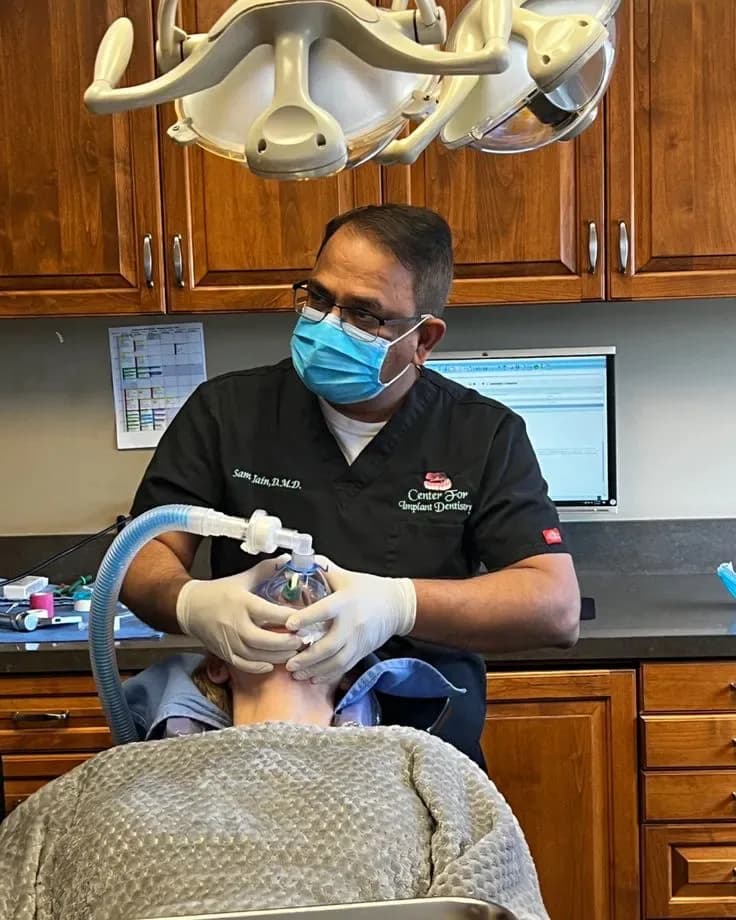
Nitrous oxide is breathed through a small nose mask mixed with oxygen. It takes effect within a few minutes, produces a warm, slightly detached calm, and keeps you awake and able to talk. Its defining advantage is how quickly it leaves: once the gas is switched off and you breathe oxygen for a few minutes, most of the effect is gone. It is minimal sedation, and it is well suited to mild nerves, shorter procedures, and patients who want to drive themselves home.
It has real limits for implant work. It takes the edge off rather than removing you from the appointment, so it rarely carries a patient with severe fear through a long surgery. It depends on breathing comfortably through the nose, which a congested patient cannot always do. And it is avoided or used with caution in pregnancy, in some vitamin B12 deficiencies, and in certain lung, ear and sinus conditions — which matters in implant dentistry, because some of the patients who need upper-jaw work also have sinus histories. We review that at the consultation rather than on the day.
Oral sedation: a tablet taken before you arrive
Oral sedation means a prescribed anti-anxiety medication taken at a set time before the appointment, usually from the benzodiazepine family. By the time you sit down, moderate nerves have quieted, and many patients remember the visit only in fragments. It needs no needle for the sedation itself, which appeals to people whose fear is specifically about the IV.
Its weakness is control. Once a tablet is swallowed, the dose cannot be taken back or adjusted, onset depends on absorption, and the effect varies between people and even between days in the same person. For a moderate-length implant procedure in a moderately anxious patient that trade-off is often perfectly reasonable. For a long surgery, or a patient whose response is hard to predict, the inability to titrate is exactly the problem IV sedation solves. You will need a responsible adult to drive you and stay with you, and you should plan on the rest of the day without driving or important decisions.
IV sedation: why it is the standard for longer implant surgery
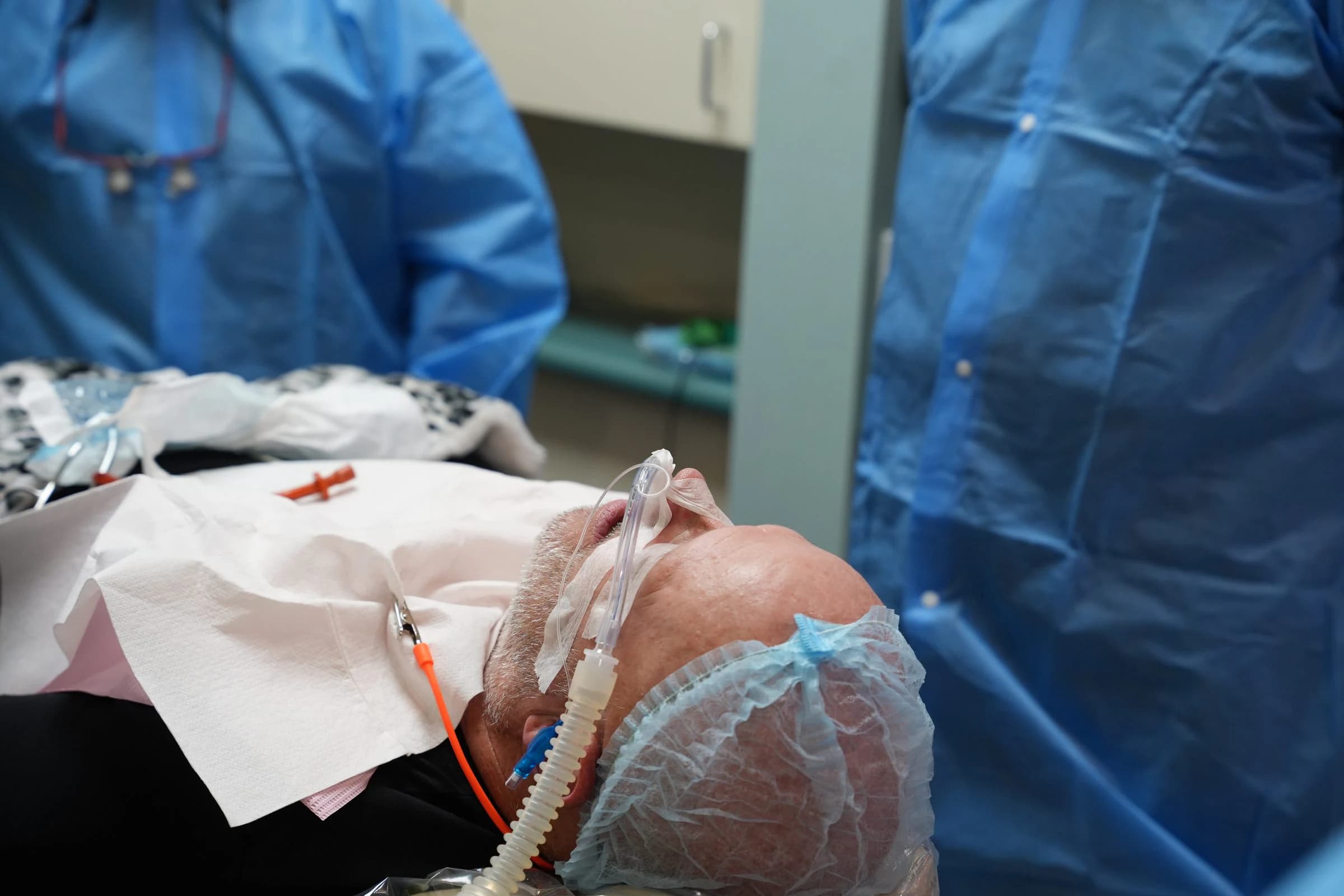
IV sedation delivers medication through a small catheter in a vein, usually in the hand or arm. Because it enters the bloodstream directly, it works within a minute or two, and the doctor can give small increments and watch the response before giving more. That titration is the whole point. It lets us hold a patient at a steady moderate depth through a two-hour full-arch surgery, deepen slightly for the most stimulating step, and lighten toward the end so recovery begins before you leave the chair. Most patients describe the experience the same way: they remember settling in, and their next clear memory is being told it is done.
Midazolam, a short-acting benzodiazepine, is the classic medication for dental IV sedation, and other agents are used in some settings. The research compares them in implant surgery specifically: in a 2021 randomized trial of 43 implant patients, both midazolam and dexmedetomidine produced satisfactory conscious sedation; dexmedetomidine patients reported less pain and higher satisfaction and had fewer drops in oxygen saturation, while midazolam acted faster, and the two did not differ in how much patients remembered. The specific medication and dose are chosen for your health history, weight, current medications and the planned length of surgery, and they are written into your consent.
On safety, the best large dataset comes from office-based surgery rather than general dentistry. A 2021 Mayo Clinic review of 17,634 outpatient sedations given by oral and maxillofacial surgery teams found 16 adverse events — 0.1% — and no deaths. That figure reflects trained teams, careful patient selection and proper monitoring, and it is exactly those three things you should ask about in any office. In ours, sedation is given by the treating doctors themselves, with continuous monitoring from the first dose through recovery, emergency equipment in the room, and no outside anesthesia service arriving for the day. Outside the All-on-4 fee, which already includes IV sedation, it appears as its own line on your written quote, so you can see what it costs rather than finding it folded into another number.

Matching sedation to the implant procedure
In practice the choice follows the surgery and the person. A single implant in healed bone, in a calm patient, usually needs local anesthesia alone. An extraction with an immediate implant, a small bone graft, or two to four implants in one visit is where mildly to moderately anxious patients often choose nitrous or oral sedation. A sinus lift is commonly done under local anesthesia, with IV sedation for patients who would rather not be present — nitrous is decided case by case because of the sinus considerations above.
Full-arch surgery is different. Removing remaining teeth, contouring bone, placing four to eight implants and fitting fixed teeth the same day is a long, stimulating appointment, and most of our patients having All-on-4 or the All-on-8 Robust protocol choose IV sedation. The same is true for zygomatic implants, which anchor in the cheekbone, and for revising implants that failed elsewhere. That said, a relaxed patient who wants to stay awake for a larger case can do so; the local anesthetic is still doing the numbing.
Medical history can override preference in either direction. Significant sleep apnea, poorly controlled heart or lung disease, certain medication combinations, pregnancy and some airway anatomy change what is safe in an office setting. That review happens at the consultation, alongside the 3D CBCT scan, and when we need information from your physician we ask for it in writing — the way we describe in our guide to medical clearance.
The day of surgery, and the first twenty-four hours
For oral or IV sedation you will receive written instructions well before the appointment: when to stop eating and drinking, which of your regular medications to take and which to hold, what to wear, and who must come with you. Follow the fasting times exactly as written for you. They are there because an empty stomach protects your airway if you become more sedated than planned, and they vary with the medication and your health.
Afterward, you rest in the office until you are awake enough to walk steadily with help, and then your escort takes you home. Plan on the remainder of the day without driving, operating anything with a blade or an engine, signing anything important, or making decisions you would want to remember making. Most patients feel close to normal the next morning. The discomfort you notice as the local anesthetic wears off comes from the surgery, not the sedation, and the post-operative instructions cover how to manage it.
If you are unsure which level fits you, that uncertainty is exactly what the consultation is for. We will tell you honestly when local anesthesia alone is enough, and just as honestly when a long surgery would be kinder with IV sedation. The decision stays yours, and you can schedule that conversation here.
Written and medically reviewed by Dr. Sam Jain, DMD, MS, and Dr. Arpana Gupta, DDS, MDS, who own this practice. Reviewed
This article is patient education, reviewed by Dr. Sam Jain, DMD, MS, and Dr. Arpana Gupta, DDS, MDS, and is not a substitute for an exam. Treatment recommendations are made only after an in-person consultation and 3D imaging.